


In short ⚡
EDI Transmission (Electronic Data Interchange) is the automated exchange of standardized business documents between computer systems without human intervention. This technology enables seamless communication between trading partners, replacing paper-based processes with electronic formats like invoices, purchase orders, and shipping notices for faster, error-free transactions.
Introduction
Manual document processing causes delays, errors, and compliance headaches in international trade. A single misplaced decimal in a customs declaration can trigger shipment rejections. EDI Transmission solves this by automating data exchange with machine-readable accuracy.
In global logistics, this technology serves as the digital backbone connecting suppliers, carriers, customs authorities, and buyers. Companies processing thousands of transactions daily cannot afford paper-based bottlenecks or manual data entry mistakes.
- Speed: Documents transmit in seconds versus days through postal services
- Accuracy: Eliminates 30-40% of human data entry errors
- Compliance: Standardized formats meet customs and regulatory requirements
- Cost Reduction: Saves 60-80% on document processing expenses
- Integration: Connects directly with ERP, TMS, and WMS systems
EDI Architecture & Technical Framework
EDI operates through standardized message formats like EDIFACT (UN/EDIFACT), ANSI X12, or XML-based protocols. Each format defines precise data structures for specific business documents. A purchase order becomes an 850 transaction set in ANSI X12 or an ORDERS message in EDIFACT.
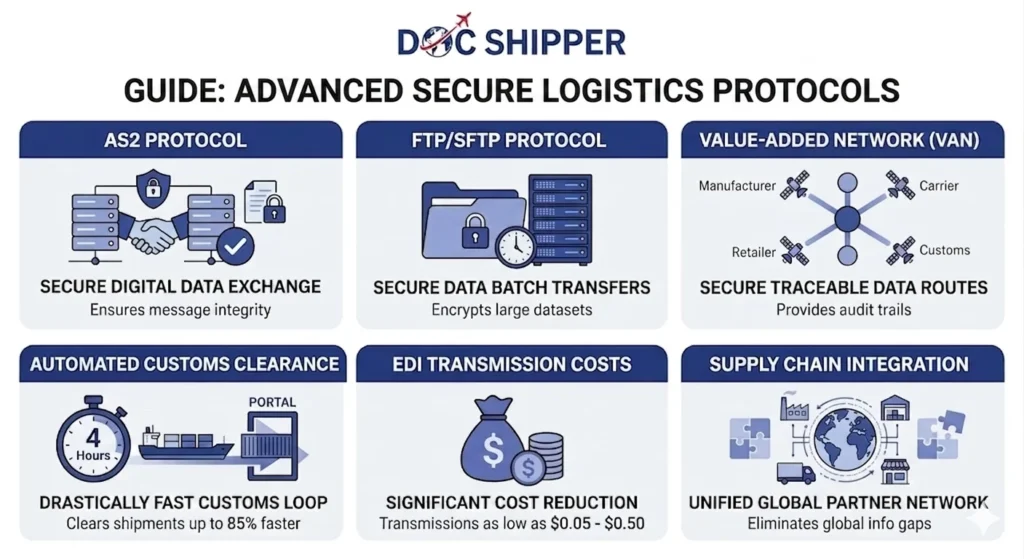
The transmission process involves three critical layers. First, translation software converts internal business data into standardized EDI format. Second, a communication protocol (AS2, SFTP, or VAN) securely transmits the message. Third, the recipient’s system automatically translates and imports the data into their backend systems.
Value-Added Networks (VANs) act as intermediaries, routing messages between trading partners with different technical capabilities. They provide mailbox services, protocol conversion, and audit trails. Direct connections using AS2 protocol over the internet offer cheaper alternatives for high-volume partners.
Security protocols ensure data integrity through encryption, digital signatures, and acknowledgment receipts (997 functional acknowledgments in ANSI X12). The sender receives confirmation that the recipient’s system successfully processed the transmission without errors.
According to U.S. Customs and Border Protection, EDI-based customs declarations process 85% faster than paper submissions. The Automated Manifest System (AMS) requires ocean carriers to submit manifests electronically 24 hours before loading.
At DocShipper, we configure EDI connections with customs authorities worldwide, ensuring your shipment data transmits in compliant formats. Our systems automatically validate document codes before submission to prevent rejection delays.
Real-World Applications & Data
EDI transforms multiple touchpoints in the supply chain. Here’s how different industries leverage this technology:
Transaction Volume Comparison
| Document Type | Manual Processing Time | EDI Processing Time | Error Rate Reduction |
|---|---|---|---|
| Purchase Order | 45-60 minutes | 2-3 seconds | 92% |
| Invoice | 30-40 minutes | 1-2 seconds | 88% |
| Customs Declaration | 2-4 hours | 5-10 seconds | 95% |
| Advance Ship Notice | 20-30 minutes | 3-5 seconds | 90% |
Use Case: Automotive Parts Importer
A European automotive manufacturer imports 12,000 components monthly from Asian suppliers. Before EDI implementation, their logistics team manually processed:
- 480 purchase orders per month (40 per day)
- 720 invoices requiring three-way matching
- 360 customs entries across multiple EU ports
Results after EDI integration: Processing time dropped from 18 staff-days to 3 staff-days monthly. Invoice discrepancies decreased by 87%. Customs clearance accelerated from 48 hours average to 6 hours, reducing demurrage costs by €42,000 annually.
Key Implementation Metrics
- ROI Timeline: Most companies achieve positive ROI within 6-9 months of deployment
- Document Accuracy: EDI systems maintain 99.7% data accuracy versus 96.2% for manual entry
- Trading Partner Onboarding: Initial setup requires 2-4 weeks, subsequent partners connect in 3-5 days
- Cost Per Transaction: Ranges from $0.05-$0.50 versus $1.20-$3.50 for paper processing
- Compliance Rate: Electronic customs filings achieve 98% acceptance rate on first submission
The retail sector processes 93% of all transactions through EDI networks. Walmart pioneered mandatory EDI compliance for suppliers in 1991, setting industry standards. Today, Amazon requires EDI capability for high-volume sellers, processing over 5 billion transactions annually through automated systems.
Conclusion
EDI Transmission eliminates logistics friction by replacing error-prone manual processes with automated precision. Companies handling international shipments gain speed, compliance, and cost advantages that directly impact competitiveness.
Need expert assistance implementing EDI for your supply chain? Contact DocShipper for tailored integration solutions that connect your systems with global trading partners and customs authorities.
📚 Quiz
Test Your Knowledge: EDI Transmission
What is the core definition of EDI Transmission?
Which statement correctly describes EDI's accuracy advantage over manual processing?
A small business processes 40 international shipments monthly. When should they consider implementing EDI?
🎯 Your Result
📞 Free Personalized QuoteFAQ | EDI Transmission: Definition, Process & Practical Examples
EDI uses structured, machine-readable formats with automatic processing, while email requires manual reading and data entry. EDI systems validate data before transmission, ensuring accuracy. Emails lack standardization, leading to interpretation errors. EDI provides legal audit trails and compliance documentation, which informal email exchanges cannot guarantee for customs or regulatory purposes.
Small businesses benefit when working with large retailers or manufacturers requiring EDI compliance. If you process fewer than 50 transactions monthly, web-based EDI portals offer affordable entry points without infrastructure investment. For customs clearance, many freight forwarders handle EDI submissions on your behalf. Evaluate based on trading partner requirements and transaction volume thresholds.
EDIFACT dominates international trade, particularly in Europe, Asia, and UN-based customs systems. ANSI X12 prevails in North American supply chains. Your choice depends on trading partner requirements and geographic focus. Many systems support both standards through translation mapping. Cloud-based EDI platforms handle multiple standards simultaneously, eliminating the need for upfront commitment to a single format.
Initial setup requires 6-12 weeks for system selection, translation map configuration, and trading partner testing. Simple implementations with cloud-based solutions complete in 4-6 weeks. Complex ERP integrations involving multiple document types may extend to 3-4 months. Each new trading partner connection adds 1-2 weeks after the initial infrastructure is operational.
Modern EDI platforms integrate with major ERP systems like SAP, Oracle, Microsoft Dynamics, and NetSuite through pre-built connectors or APIs. Integration transfers data bidirectionally—incoming EDI documents populate your ERP automatically, while your system exports data for outbound transmissions. Custom integrations handle proprietary or legacy systems, though development timelines and costs increase accordingly.
VANs act as communication hubs, routing EDI messages between partners with different technical capabilities. They provide protocol conversion, message storage, and delivery confirmation. Companies with limited IT resources benefit from VAN services. Direct AS2 connections offer cheaper alternatives for partners with compatible systems. Hybrid approaches use VANs for small partners and direct connections for high-volume relationships.
EDI protocols employ encryption, digital signatures, and secure transmission channels (AS2, SFTP). Each transaction generates audit logs tracking sender, recipient, timestamp, and acknowledgment status. These security features exceed email security standards and meet GDPR, HIPAA, and customs compliance requirements. VANs provide additional security layers through monitored networks and access controls.
Modern EDI systems generate functional acknowledgments confirming successful receipt and processing. Transmission failures trigger automatic alerts to IT teams. Most platforms retry failed transmissions automatically. Error logs identify issues—incorrect formatting, missing data elements, or network interruptions. Trading partners maintain backup procedures, often reverting to manual processing for time-sensitive documents while resolving technical issues.
Most developed economies mandate or strongly encourage electronic customs declarations. The EU's Customs Declaration Service (CDS), U.S. Automated Commercial Environment (ACE), and China's Single Window system all operate through EDI protocols. Developing markets increasingly adopt electronic systems. Your customs broker or freight forwarder confirms country-specific requirements and handles compliant EDI submissions where mandated.
Cloud-based EDI platforms charge $200-$1,000 monthly for small to mid-sized operations, scaling with transaction volume. VAN services cost $0.05-$0.30 per kilocharacter transmitted. On-premise solutions require $10,000-$50,000 initial investment plus annual maintenance. Trading partner onboarding incurs one-time fees of $500-$2,000 per connection. Calculate ROI by comparing these costs against manual processing expenses, error-related losses, and staff time savings.
Customs agencies specify accepted EDI formats and message types. U.S. CBP requires ANSI X12 315 messages for ocean manifests. EU customs accept EDIFACT CUSCAR and CUSDEC messages. China's Single Window uses XML-based declarations. Freight forwarders and customs brokers maintain certified EDI connections with local authorities, ensuring your data transmits in compliant formats with proper harmonized codes and declarations.
EDI enables real-time data sharing across the supply chain. Advance Ship Notices (ASN 856) alert warehouses to incoming shipments with detailed content information. Transportation Status messages (214) provide location updates. Invoice transmissions (810) trigger automatic payment processing. This continuous data flow eliminates information gaps, enabling proactive decision-making and reducing inventory holding costs through precise arrival predictions.
Need Help with
Logistics or Sourcing ?
First, we secure the right products from the right suppliers at the right price by managing the sourcing process from start to finish. Then, we simplify your shipping experience - from pickup to final delivery - ensuring any product, anywhere, is delivered at highly competitive prices.


Fill the Form
Prefer email? Send us your inquiry, and we’ll get back to you as soon as possible.
Contact us




