



In short ⚡
The Exporter Identification Number (EIN) is a unique identifier assigned by customs authorities to businesses engaged in export activities. This registration number enables tracking of shipments, compliance verification, and ensures regulatory oversight throughout the export process. The EIN serves as a legal requirement in most jurisdictions for commercial exporters.
Introduction
Many businesses entering international trade face confusion about registration requirements and identification numbers needed for legal export operations. The Exporter Identification Number eliminates this uncertainty by providing a standardized framework for recognizing legitimate exporters.
In global supply chains, the EIN acts as your company’s export passport. Without proper registration, customs authorities may delay or reject shipments, resulting in substantial financial losses and damaged business relationships. Understanding this critical identifier ensures smooth cross-border transactions.
Key characteristics of the EIN include:
- Unique identification: Each exporter receives a distinct number linked to their business entity
- Customs validation: Authorities use EINs to verify exporter legitimacy and track compliance history
- Mandatory documentation: Required on export declarations, commercial invoices, and shipping manifests
- Multi-jurisdiction recognition: Some systems allow reciprocal acceptance across trade blocs
- Audit trail creation: Establishes transparent records for tax and regulatory purposes
Regulatory Framework & Legal Requirements
The EIN system operates under international customs conventions and national trade legislation. In the United States, the Census Bureau assigns EINs through the Automated Export System (AES), while the European Union utilizes EORI (Economic Operators Registration and Identification) numbers that function similarly.
Registration requirements vary by jurisdiction but generally mandate that companies demonstrate:
- Legal business entity status: Valid incorporation or business license in the country of export
- Tax compliance: Current standing with revenue authorities and proper tax identification numbers
- Physical presence: Verifiable business address and operational infrastructure
- Responsible party designation: Named individuals accountable for export compliance
- Security clearances: Background checks may apply for strategic goods or high-risk sectors
The application process typically involves submitting documentation to customs authorities or designated trade agencies. Processing times range from immediate online approval to several weeks for manual verification, depending on the complexity of your business structure and export products.
According to the WTO Trade Facilitation Agreement, member countries commit to streamlining registration procedures and providing electronic application systems. This international framework promotes efficiency while maintaining security standards.
At DocShipper, we guide clients through the EIN registration process across multiple jurisdictions, ensuring your documentation meets all regulatory requirements before your first shipment. Our compliance team verifies that your number appears correctly on all export paperwork, preventing costly customs rejections.
Application Process & Practical Examples
Understanding how EINs function in real-world scenarios clarifies their operational importance. The registration and utilization process follows distinct procedural steps that vary slightly by country but share common principles.
Comparative Registration Requirements by Region
| Region | Identifier Name | Processing Time | Cost | Validity Period |
|---|---|---|---|---|
| United States | EIN (Export Identification Number) | Immediate (online) | Free | Permanent |
| European Union | EORI Number | 3-5 business days | Free | Permanent (annual validation) |
| United Kingdom | GB EORI Number | 5-10 business days | Free | Permanent |
| Canada | Business Number (BN) | Immediate to 2 weeks | Free | Permanent |
| China | Customs Registration Code | 10-15 business days | Varies by region | Annual renewal |
Practical Use Case: Electronics Manufacturer Export
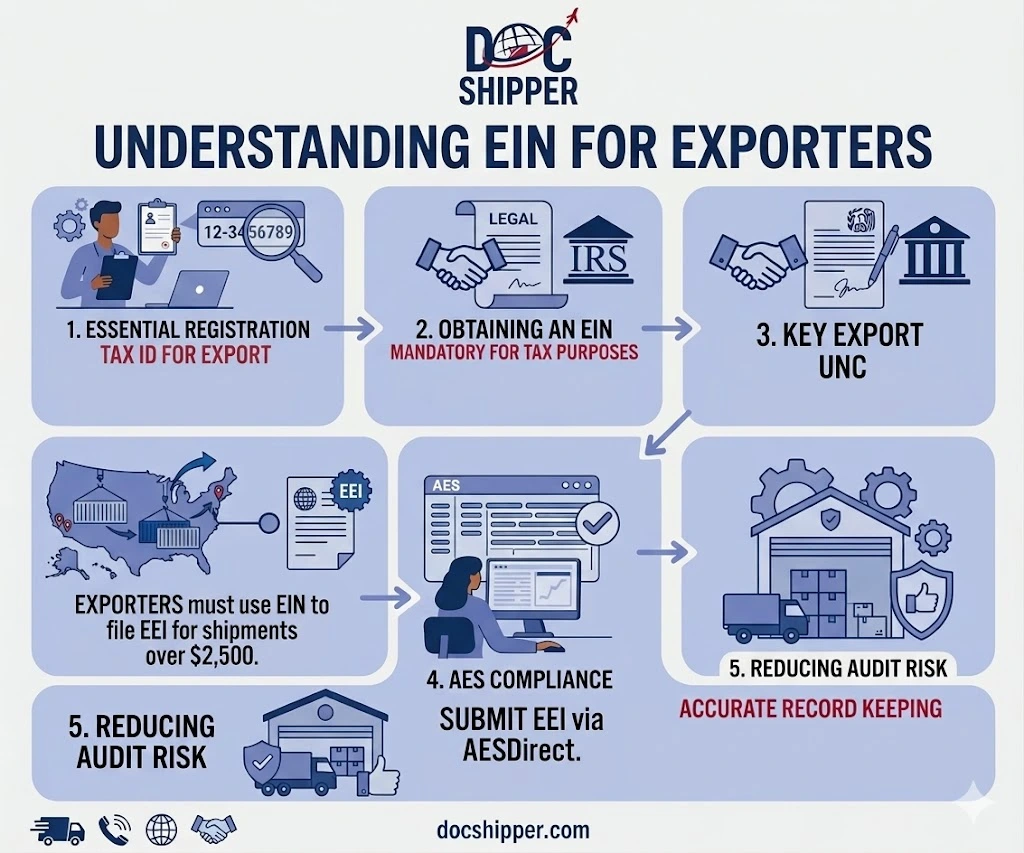
Consider a California-based electronics manufacturer shipping components to Germany. The company must obtain an EIN from U.S. Customs before initiating exports valued above $2,500 or requiring export licenses.
Step-by-step process:
- Registration: Company applies through the Automated Export System (AES) portal using their Federal Tax ID
- Number assignment: System immediately generates a unique EIN linked to their business profile
- Documentation integration: EIN appears on the Electronic Export Information (EEI) filing for each shipment
- Customs clearance: German authorities verify the EIN against international databases during import processing
- Compliance tracking: All transactions remain permanently linked to the company’s EIN for audit purposes
In this scenario, the manufacturer exports $450,000 worth of components monthly. Without a valid EIN, each shipment would face customs holds, potentially delaying production schedules for their German clients and incurring storage fees averaging $200 per day.
Key operational benefits:
- Streamlined processing: Pre-registered exporters experience 60% faster customs clearance times
- Trusted trader status: Established EIN holders qualify for expedited security programs
- Risk mitigation: Proper identification reduces inspection rates and associated delays
- Financial advantages: Some jurisdictions offer duty drawback programs exclusively to registered exporters
- Market access: Certain countries require proof of EIN registration before granting import permits
DocShipper manages EIN registration and integration across all export documentation for our clients. We ensure your identifier appears correctly formatted on bills of lading, commercial invoices, and certificates of origin, maintaining compliance throughout your supply chain.
Conclusion
The Exporter Identification Number represents a foundational element of legitimate international trade, providing the regulatory framework for secure and efficient cross-border commerce. Proper registration and utilization protect your business from costly delays while establishing credibility with customs authorities worldwide.
Need assistance navigating EIN registration or ensuring compliance across multiple jurisdictions? Contact DocShipper today for expert guidance on export documentation and regulatory requirements.
📚 Quiz
Test Your Knowledge: Exporter Identification Number (EIN)
What is the primary function of an Exporter Identification Number (EIN)?
Can a single EIN be used for export operations across multiple countries?
A small U.S. business exports electronics worth $3,200 to Germany as a one-time shipment. Do they need an EIN?
🎯 Your Result
📞 Free Quote in 24hFAQ | Exporter Identification Number (EIN): Definition, Application & Practical Examples
No, the EIN is distinct from your Federal Tax ID or Employer Identification Number. While registration often requires your tax ID as verification, the EIN specifically identifies you as an exporter to customs authorities. Some countries use the same number for both purposes, but in the U.S. and EU, they remain separate identifiers with different regulatory functions.
Requirements depend on shipment value and destination. In the United States, exports exceeding $2,500 per transaction or items requiring export licenses mandate EIN registration regardless of business size. The EU requires EORI numbers for any commercial export activity. Even occasional exporters should register to avoid shipment rejections and establish proper compliance records from the outset.
Processing times vary significantly by country. The U.S. AES system provides immediate online EIN assignment. EU EORI numbers typically process within 3-5 business days. More complex jurisdictions like China may require 10-15 business days for verification and approval. Expedited processing is rarely available, making advance planning essential before your first export shipment.
No, each customs jurisdiction issues its own identification number. A U.S. company exporting to multiple countries needs only one domestic EIN for outbound shipments, but may require separate registrations (like EORI numbers) if establishing operations in foreign markets. Regional systems like the EU EORI provide recognition across member states, simplifying intra-bloc trade.
Customs authorities will refuse to process your shipment documentation, resulting in cargo holds at the port or airport. You'll incur storage fees, demurrage charges, and potential return shipping costs. Repeated violations may trigger penalties ranging from monetary fines to export privilege suspension. The financial impact typically far exceeds the minimal effort required for proper registration.
Most jurisdictions issue permanent EINs that remain valid as long as your business operates. However, you must maintain current business information with customs authorities. The EU requires annual validation of EORI numbers through active trade or formal confirmation. If your business structure changes significantly (merger, acquisition, relocation), you may need to update or obtain a new identifier.
The majority of customs authorities provide EIN registration free of charge as part of trade facilitation initiatives. The United States, EU, Canada, and United Kingdom all offer no-cost registration. Some developing countries may charge nominal administrative fees. Third-party service providers or customs brokers may charge for assistance with the application process, but direct government registration typically incurs zero fees.
This depends on the jurisdiction. In the EU, the EORI number functions for both import and export operations. The U.S. system uses separate identifiers, with the EIN specifically for exports and an Importer Number for bringing goods into the country. Check with your national customs authority to determine whether your export registration covers bidirectional trade or requires separate import registration.
Standard requirements include your business tax identification number, legal business name, physical address, ownership structure details, and primary contact information. Some authorities request bank account verification or business licenses. Exporters of controlled goods may need additional security clearances. Electronic applications typically require digital copies of incorporation documents and authorized signatory identification.
Format varies by issuing authority. U.S. EINs follow a nine-digit format (XX-XXXXXXX) similar to Social Security numbers. EU EORI numbers combine country codes with unique identifiers (e.g., GB123456789000 for UK businesses). The structure enables automated validation systems to verify authenticity and routing information. Understanding your jurisdiction's format ensures correct documentation entries.
While freight forwarders and customs brokers can assist with the application process, the EIN must be issued directly to your business entity. You cannot operate under your forwarder's identification number. However, experienced logistics partners like DocShipper streamline the process by preparing documentation, submitting applications, and ensuring all information meets regulatory requirements, significantly reducing your administrative burden.
Contact the issuing customs authority immediately to retrieve your number. Most agencies provide online lookup tools using your business tax ID or registration details. In the U.S., the Census Bureau maintains EIN records accessible through the AES portal. EU businesses can verify EORI numbers through the European Commission's validation system. Never attempt to apply for a duplicate number, as this creates compliance complications.
Need Help with
Logistics or Sourcing ?
First, we secure the right products from the right suppliers at the right price by managing the sourcing process from start to finish. Then, we simplify your shipping experience - from pickup to final delivery - ensuring any product, anywhere, is delivered at highly competitive prices.


Fill the Form
Prefer email? Send us your inquiry, and we’ll get back to you as soon as possible.
Contact us




:%20Definition,%20Application%20&%20Practical%20Examples)