


In short ⚡
The Equipment Interchange Receipt (EIR) is a critical document in container shipping that records the physical condition and transfer of ownership responsibility for containers between parties. It serves as legal proof of container condition at the time of handover, protecting all parties from damage disputes.
Introduction
Container damage disputes cost the shipping industry over $400 million annually. Most conflicts arise from unclear accountability: who damaged the container, when, and who bears financial responsibility?
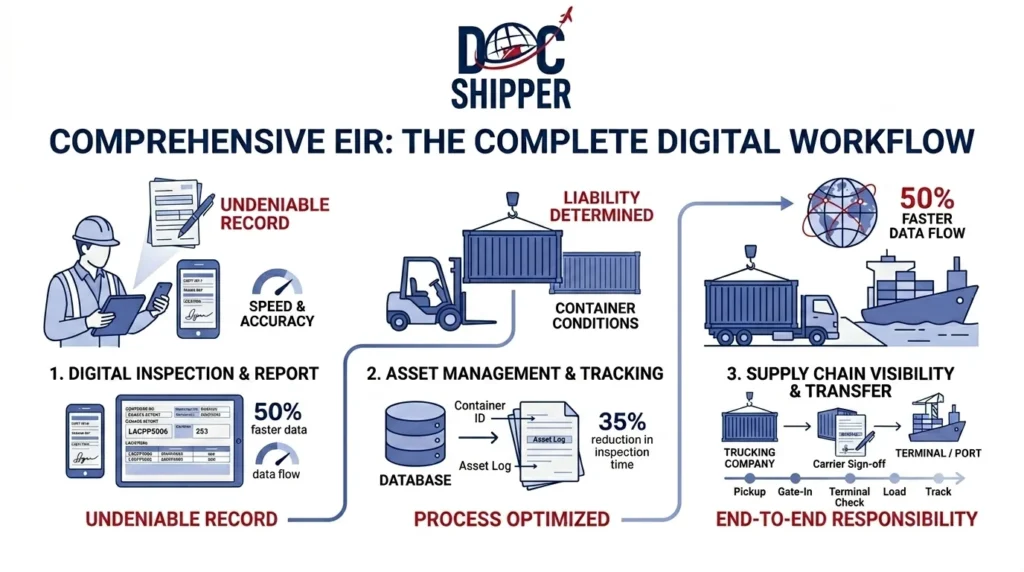
The Equipment Interchange Receipt eliminates this uncertainty. This document creates an indisputable record at every container handover point—from terminal to truck, truck to warehouse, warehouse to vessel.
For import/export operations, the EIR serves five essential functions:
- Legal protection — Documentary evidence in damage disputes
- Condition verification — Detailed inspection record at transfer point
- Liability transfer — Clearly establishes responsibility between parties
- Operational tracking — Monitors container movement through supply chain
- Financial settlement — Basis for demurrage, detention, and damage charges
Understanding the EIR process prevents costly disputes and ensures smooth container operations across international borders.
Technical Framework & Legal Implications
The Equipment Interchange Receipt operates within a standardized framework governed by international maritime regulations. The document follows ACEP (Association of Container Equipment Providers) standards, ensuring global consistency.
Each EIR captures specific container details at the moment of transfer. The receiving party conducts a thorough inspection, documenting any pre-existing damage before accepting responsibility.
Key inspection elements include container number, seal integrity, structural damage, door functionality, and cleanliness status. The Gate-In EIR records container condition when entering a terminal or depot, while the Gate-Out EIR documents condition upon departure.
Legal implications are substantial. The EIR constitutes binding evidence in commercial disputes. If damage appears on a Gate-Out EIR but not the previous Gate-In document, the party who held custody during that interval bears liability.
Digital transformation has revolutionized EIR management. Electronic systems (eEIR) now enable real-time documentation with photographic evidence, GPS timestamps, and automatic cloud storage. This reduces paperwork errors and strengthens legal standing.
The document’s retention period typically extends 7 years, aligning with international commercial law requirements. Carriers, terminals, and transporters must maintain accessible EIR records for audit and dispute resolution.
At DocShipper, we systematically verify EIR documentation at every container handover point, ensuring our clients have complete protection against unfounded damage claims. Our freight forwarding teams review each EIR for accuracy before releasing containers to road transport.
Practical Applications & Real-World Data
Understanding EIR application through concrete scenarios reveals its critical protective function. Industry data shows that 68% of container damage disputes are resolved through properly documented EIR evidence.
Use Case: Export from Germany to China
A German manufacturer books a 40-foot container for electronics shipment to Shanghai. Here’s the EIR journey:
- Gate-Out at Empty Depot (Hamburg) — Trucker receives clean container, EIR shows no damage, seal intact
- Loading at Factory — Container stuffed and sealed, new seal number recorded
- Gate-In at Port Terminal — Terminal operator notes small dent on left door (not affecting cargo integrity)
- Loading onto Vessel — Shipping line accepts container based on terminal EIR
Result: The small dent is attributed to the trucking phase (between depot Gate-Out and terminal Gate-In). The trucker’s insurance covers the €450 repair cost, not the shipper or shipping line.
Comparative Analysis: Paper vs. Digital EIR
| Criteria | Paper EIR | Digital eEIR |
|---|---|---|
| Processing Time | 8-15 minutes per container | 2-4 minutes per container |
| Error Rate | 12-18% (illegible handwriting) | 3-5% (data validation) |
| Photographic Evidence | Separate process, often missing | Integrated, mandatory |
| Retrieval Time | Hours to days (archive search) | Seconds (database query) |
| Legal Validity | Accepted (signature required) | Accepted (digital signature/timestamp) |
Cost Impact Analysis
Major European terminal operators report that proper EIR documentation reduces damage-related disputes by 73%. Average dispute resolution without EIR evidence costs €2,800 in administrative time alone, excluding actual damage payments.
For high-volume shippers managing 500+ containers monthly, implementing digital EIR systems delivers ROI within 6-8 months through reduced dispute costs and faster terminal processing.
Critical Documentation Points:
- Container number verification — Cross-reference against booking confirmation
- Seal number recording — Must match customs and shipping documents
- Damage notation specificity — Location, size, type (dent, hole, rust)
- Timestamp accuracy — Essential for liability determination
- Signatory authorization — Only authorized personnel can validate EIR
Conclusion
The Equipment Interchange Receipt is the foundation of accountability in container logistics. This simple document prevents disputes, clarifies liability, and protects all parties across the international supply chain.
Need expert guidance on container documentation and logistics procedures? Contact DocShipper for comprehensive freight forwarding support.
📚 Quiz
Test Your Knowledge: Equipment Interchange Receipt (EIR)
What is the primary purpose of an Equipment Interchange Receipt?
A container shows damage on the Gate-Out EIR but not on the previous Gate-In EIR. Who bears liability for the damage?
Your trucker arrives at a terminal to pick up a container. The EIR shows existing damage you believe wasn't present. What's the correct action?
🎯 Your Result
📞 Free Quote in 24hFAQ | Equipment Interchange Receipt (EIR): Definition, Purpose & Practical Examples
You have the right to contest the EIR findings. Document your objection in writing on the EIR itself, photograph the container from multiple angles, and request supervisor verification. Never sign an EIR you disagree with without noting your dispute. The refusal should trigger an independent inspection to establish accurate condition before transfer proceeds.
Yes, EIRs are widely accepted as primary evidence in maritime arbitration under UNCITRAL and ICC rules. Digital EIRs with timestamps and photographic evidence carry equal legal weight to paper versions. Courts recognize EIRs as contemporaneous records created during normal business operations, giving them strong evidentiary value in commercial disputes.
Both parties receive copies. The releasing party (terminal, depot, or carrier) retains the original or master copy, while the receiving party (trucker, warehouse, or next carrier) keeps a signed duplicate. Digital systems automatically distribute validated copies to all stakeholders, ensuring complete record accessibility for dispute resolution.
The EIR Gate-Out timestamp starts the detention clock (container use outside the terminal), while the Gate-In timestamp stops it. Shipping lines calculate detention charges based on these EIR timestamps. Accurate EIR documentation prevents overbilling and provides evidence to contest incorrect detention invoices based on actual container movement times.
The terms are interchangeable in practice. "Equipment Interchange Receipt" is the formal industry standard term, covering containers, chassis, and gensets. "Container Interchange Receipt" specifically references container handovers. Both documents serve identical functions: recording condition and transferring responsibility for shipping equipment between parties.
Yes, EIR documentation applies equally to carrier-owned and shipper-owned containers. While the shipper owns the equipment, they still need documented proof of condition at each transfer point for insurance, liability protection, and operational tracking. Terminals and transporters require EIRs for all containers regardless of ownership structure.
Absolutely. Best practice involves requesting comprehensive photographic documentation for high-value shipments, specialized equipment, or when visible pre-existing damage exists. Modern digital EIR systems accommodate unlimited photos. Request close-ups of container doors, corner posts, floor condition, and any noted damage areas for complete protection.
Immediately notify all parties in writing and request timestamp correction. Inaccurate timestamps affect demurrage calculations, liability windows, and shipment tracking. Document the actual handover time with independent evidence (GPS logs, warehouse receipts, driver logs) and insist on amended EIR issuance reflecting correct timing.
Standard inspection averages 5-8 minutes for paper EIR systems, 2-4 minutes with digital platforms. Factors affecting duration include container condition, queue length, inspector experience, and weather. Damaged containers require extended inspection with detailed damage mapping, potentially adding 10-15 minutes to the process.
Yes, comprehensive EIRs include interior condition assessment: cleanliness, odors, residue, and contamination. This is critical for food-grade shipments, pharmaceuticals, and sensitive goods. Rejecting unclean containers at Gate-Out prevents cargo contamination and associated liability. Always request interior inspection notation on the EIR document.
While not standard, documenting severe weather during handover provides context for potential damage discovery later. Note conditions like heavy rain, hail, or extreme temperatures that might obscure full inspection or contribute to container stress. This contextual information supports damage timeline reconstruction during dispute investigation.
The issuing party's master copy serves as authoritative record. Request certified duplicate from the terminal, depot, or carrier who issued the original EIR. Digital EIR systems eliminate this concern through automatic cloud backup and multi-party access. Paper-based operations should implement immediate scanning protocols to prevent total record loss.
Need Help with
Logistics or Sourcing ?
First, we secure the right products from the right suppliers at the right price by managing the sourcing process from start to finish. Then, we simplify your shipping experience - from pickup to final delivery - ensuring any product, anywhere, is delivered at highly competitive prices.


Fill the Form
Prefer email? Send us your inquiry, and we’ll get back to you as soon as possible.
Contact us




:%20Definition,%20Purpose%20&%20Practical%20Examples)