


In short ⚡
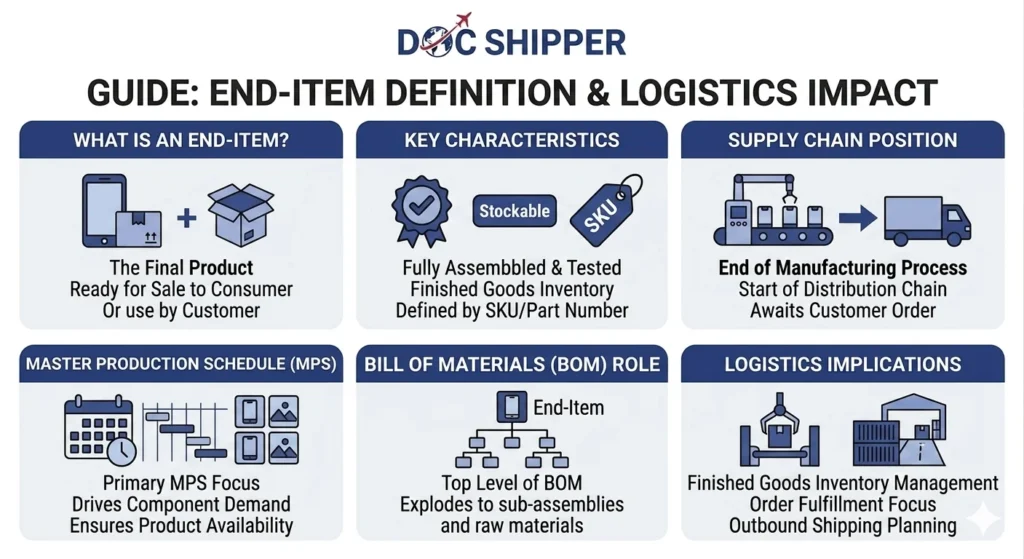
An End Item is a finished product ready for delivery or use by the final customer, requiring no further assembly, manufacturing, or processing. It represents the highest level in a Bill of Materials (BOM) hierarchy and is the ultimate output of a production or supply chain process. Unlike components or subassemblies, end items are complete, functional units that fulfill their intended purpose without additional modification.
Introduction
In international trade and manufacturing, confusion often arises between finished goods, subassemblies, and end items. Many businesses struggle to classify products correctly in their inventory management systems, leading to shipping errors, customs complications, and production planning failures.
The concept of an end item is fundamental to logistics operations. It determines how products are catalogued, shipped, invoiced, and tracked throughout the supply chain. Understanding this classification impacts everything from warehouse management to customs declarations and customer satisfaction.
Key characteristics of end items include:
- Complete functionality: Ready for immediate use without additional assembly
- Final BOM level: Sits at the top of the Bill of Materials hierarchy
- Customer-facing: Delivered directly to end users or retailers
- Inventory designation: Classified separately from raw materials and work-in-progress
- Revenue recognition: Represents the final saleable product for accounting purposes
Understanding End Items in Supply Chain & Manufacturing
The distinction between end items and other product classifications becomes critical in complex manufacturing environments. In a multi-tier production system, components flow through various assembly stages before reaching end item status. This progression affects everything from costing methodologies to quality control procedures.
From a legal and customs perspective, end items must be properly classified using HS codes for international shipment. The European Union’s TARIC database requires precise identification of finished products to calculate duties and verify compliance with import/export regulations.
In Enterprise Resource Planning (ERP) systems, end items receive unique treatment. Unlike subassemblies that may appear in multiple parent assemblies, end items typically represent the final configuration sold to customers. This distinction enables accurate demand forecasting, master production scheduling, and available-to-promise calculations.
The production planning hierarchy treats end items as independent demand items, driven directly by customer orders or sales forecasts rather than dependent demand from higher-level assemblies. This fundamental difference shapes how materials requirements planning (MRP) systems generate procurement and manufacturing orders.
For quality assurance purposes, end items undergo final inspection protocols that differ from in-process quality checks. Regulatory bodies like the FDA or CE marking authorities focus their compliance verification on end items rather than intermediate components, making proper classification essential for market access.
At DocShipper, we ensure that end items are correctly identified and documented before international shipment. Our team verifies that all regulatory requirements, packaging standards, and customs classifications align with the product’s end item status to prevent costly delays at borders.
Practical Examples & Classification Data
Understanding end items becomes clearer through real-world scenarios across different industries. The following examples illustrate how products achieve end item status and how this classification impacts logistics operations.
Industry Classification Examples
| Industry | End Item Example | Component (Not End Item) | Key Distinction |
|---|---|---|---|
| Electronics | Smartphone in retail packaging | Circuit board assembly | Ready for consumer use vs. requires integration |
| Automotive | Complete vehicle delivered to dealer | Engine subassembly | Final product vs. intermediate assembly |
| Pharmaceuticals | Bottled medication with labeling | Bulk active ingredient | Market-ready vs. requires formulation |
| Furniture | Assembled dining table | Table legs (unfinished) | Functional product vs. component part |
| Industrial Equipment | CNC machine ready for operation | Control panel module | Operational unit vs. requires installation |
Use Case: Electronics Manufacturing
A laptop manufacturer produces devices through a multi-stage assembly process. The motherboard, screen assembly, battery pack, and keyboard are all subassemblies—they have value but cannot function independently as customer products.
When these components integrate into a complete laptop, undergo final testing, receive operating system installation, and arrive in retail packaging with documentation, the product becomes an end item. At this stage, it receives a unique SKU, gets listed in the sales catalog, and becomes available for customer orders.
For customs purposes, the laptop receives its own HS code 8471.30 (portable automatic data processing machines), distinct from the codes assigned to individual components. This classification determines applicable import duties, which might be 0-3.9% depending on the destination country.
Critical Data Points for End Item Classification
- Packaging status: End items include all necessary packaging for safe delivery and retail presentation
- Documentation completeness: User manuals, warranty cards, and safety certifications must accompany the product
- Regulatory compliance: All required testing, certifications, and markings must be complete
- Functional independence: The product must operate without requiring additional purchased components
- Revenue recognition trigger: End item status typically determines when revenue can be recognized in financial statements
According to industry data from 2023, misclassification of products as end items when they’re actually subassemblies costs manufacturers an average of 4.7% in inventory carrying costs and leads to shipping delays in 18% of international orders.
Conclusion
Proper identification of end items ensures accurate inventory management, compliance with international trade regulations, and efficient supply chain operations. The distinction between finished products and intermediate assemblies directly impacts logistics planning, customs procedures, and customer delivery timelines.
Need assistance with product classification or international shipping logistics? Contact DocShipper for expert guidance on managing your end items through global supply chains.
📚 Quiz
Test Your Knowledge: End Item
Which statement best defines an end item?
A power supply unit is sold to both repair shops and computer manufacturers. How should it be classified?
A laptop manufacturer has completed device assembly and testing. When does it officially become an end item?
🎯 Your Result
📞 Free Quote in 24hFAQ | End Item: Definition, Classification & Practical Examples
An end item is a complete, functional product ready for customer use without further assembly or processing. A subassembly is an intermediate component that becomes part of a larger assembly. End items can be sold directly to customers, while subassemblies require integration into higher-level products. For inventory purposes, end items represent independent demand based on customer orders, whereas subassemblies have dependent demand derived from production schedules of their parent assemblies.
End items receive specific HS codes based on their complete, finished state, which determines applicable import duties and regulatory requirements. Customs authorities classify products differently when they're end items versus components or subassemblies. This classification impacts duty rates, documentation requirements, and clearance procedures. Shipping end items typically requires more comprehensive documentation including certificates of origin, safety compliance certificates, and user documentation compared to shipping intermediate components.
Yes, this situation occurs frequently in B2B commerce. For example, a power supply unit might be an end item when sold to repair shops or individual consumers, but serves as a component when sold to computer manufacturers. The classification depends on the product's intended use and the customer's application. From a logistics perspective, the packaging, documentation, and shipping procedures may differ based on whether the product functions as an end item or component in the specific transaction.
End items are tracked separately in inventory systems with distinct SKUs, storage locations, and handling procedures. They typically undergo final quality inspections before entering finished goods inventory. ERP systems use end item classification to trigger specific processes including revenue recognition, warranty activation, and customer delivery scheduling. The classification also affects inventory valuation methods, as end items include all accumulated costs from raw materials through final assembly, packaging, and quality assurance.
End items require comprehensive documentation including commercial invoices, packing lists, certificates of origin, safety compliance certificates (CE, UL, FCC, etc.), user manuals, warranty information, and material safety data sheets when applicable. Unlike components, end items often need retail-ready packaging with proper labeling in the destination country's language. Regulatory compliance documentation varies by product category and destination market, with electronics, pharmaceuticals, and food products having the most stringent requirements.
A product achieves end item status when it completes all manufacturing processes, passes final quality inspection, receives appropriate packaging, includes all required documentation, and becomes ready for customer delivery without additional work. This milestone triggers inventory reclassification from work-in-progress to finished goods. The determination point varies by industry but typically occurs after final testing, quality certification, and packaging completion. Some companies define specific "end item gates" in their production processes to ensure consistent classification.
End items are the primary focus of Master Production Scheduling (MPS) because they represent what companies promise to deliver to customers. The MPS creates production plans based on end item demand forecasts and customer orders rather than component requirements. This approach ensures that production resources align with actual market demand. Materials Requirements Planning (MRP) then explodes the end item MPS into component and raw material requirements through the Bill of Materials structure, creating a complete production and procurement plan.
Warranty coverage and service contracts typically apply only to end items, not individual components or subassemblies. When customers register products or file warranty claims, systems track end items by serial number or batch code. This classification determines service entitlements, replacement part availability, and recall procedures. Manufacturers maintain separate inventory of end items for warranty replacement purposes, distinct from production component inventory. The end item designation also triggers legal obligations under consumer protection laws in many jurisdictions.
Yes, digital products including software applications, digital media, and online services can be end items when they're complete, functional offerings delivered to end users. A downloaded software application with license key represents an end item, while a software development kit (SDK) or API library functions as a component for developers. For logistics purposes, digital end items still require proper classification for customs valuation, tax purposes, and intellectual property considerations, even though they don't involve physical shipping.
End items may require different configurations for various distribution channels while maintaining the same core functionality. Direct-to-consumer versions might include retail packaging and extensive documentation, while B2B versions for wholesale distributors use bulk packaging with minimal consumer-facing materials. Companies typically assign different SKUs to these variants despite similar core products, enabling channel-specific inventory management, pricing strategies, and fulfillment processes. This approach allows optimization of logistics costs while meeting diverse customer requirements across distribution channels.
End item classification triggers revenue recognition under accounting standards, as the product becomes available for sale and delivery to customers. This classification affects inventory valuation, with end items carrying the full accumulated cost of materials, labor, and overhead through the manufacturing process. Companies report end item inventory separately in financial statements as finished goods, distinct from raw materials and work-in-progress. The classification also impacts cost of goods sold calculations, gross margin analysis, and inventory turnover metrics that investors and analysts use to evaluate company performance.
End items face more comprehensive regulatory scrutiny than components because they represent complete products entering consumer or commercial markets. Regulatory agencies like the FDA, EPA, or CE marking authorities focus certification and testing requirements on end items rather than individual components. This means end items must demonstrate compliance with all applicable safety, environmental, and performance standards for their intended use. Component manufacturers may only need to certify that their parts meet specifications for incorporation into larger assemblies, while end item producers bear responsibility for the complete product's regulatory compliance.
Need Help with
Logistics or Sourcing ?
First, we secure the right products from the right suppliers at the right price by managing the sourcing process from start to finish. Then, we simplify your shipping experience - from pickup to final delivery - ensuring any product, anywhere, is delivered at highly competitive prices.


Fill the Form
Prefer email? Send us your inquiry, and we’ll get back to you as soon as possible.
Contact us




