


In short ⚡
Engineer to Order (ETO) is a manufacturing strategy where products are designed, engineered, and produced based on unique customer specifications after an order is placed. Unlike mass production, ETO involves customized engineering solutions tailored to individual client requirements, commonly used in complex industries like aerospace, heavy machinery, and specialized industrial equipment.
Introduction
Many businesses struggle to differentiate between standard manufacturing and customized production models. Engineer to Order represents the most sophisticated end of the manufacturing spectrum. It addresses complex buyer needs that cannot be met through off-the-shelf products.
In international trade and supply chain management, understanding ETO is crucial. It impacts lead times, inventory management, and logistics planning significantly. Customs classifications become more complex when dealing with unique engineered goods.
Key characteristics of Engineer to Order include:
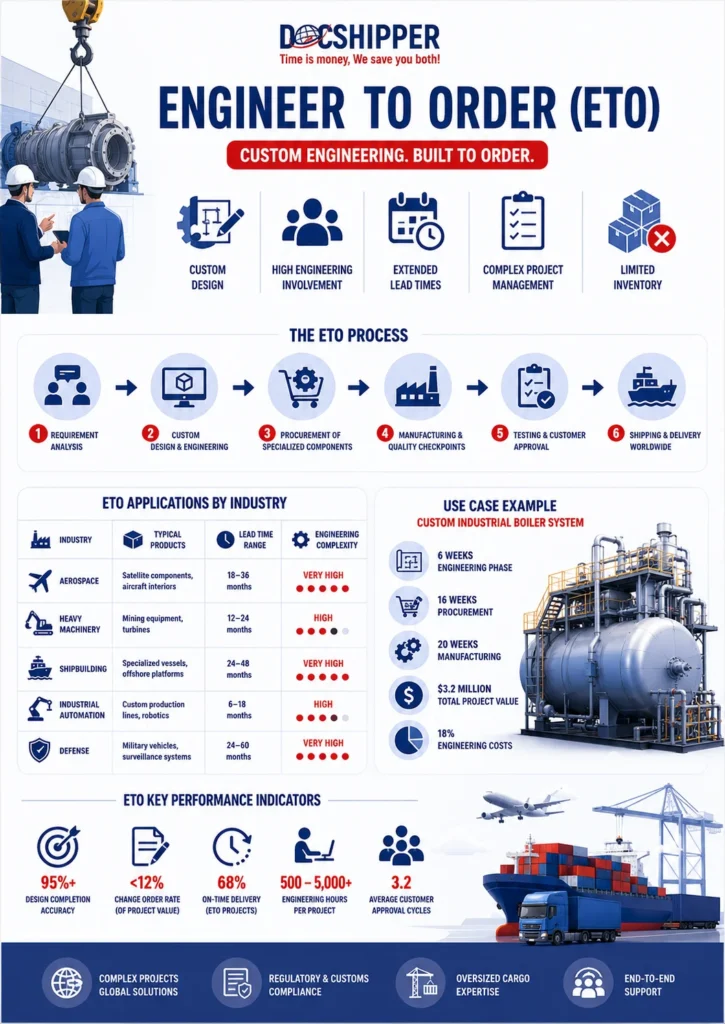
- Custom design phase: Engineering work begins after order confirmation
- Extended lead times: Production cycles ranging from weeks to months
- High engineering involvement: Significant design and prototyping resources required
- Complex project management: Coordination across design, procurement, and manufacturing teams
- Limited inventory: No finished goods stock maintained due to product uniqueness
Understanding ETO: Process & Strategic Implications
The Engineer to Order process fundamentally differs from traditional manufacturing models. It begins with a detailed customer requirement analysis where specifications are gathered through extensive consultations. Engineers then develop custom designs, often requiring multiple approval cycles.
Once designs are finalized, the procurement phase begins. Specialized components must be sourced, which adds complexity to supply chain management. Many ETO manufacturers work with niche suppliers who provide custom-fabricated parts. At DocShipper, we assist ETO manufacturers in coordinating international component sourcing and ensuring compliance with technical specifications across borders.
The production timeline in ETO environments requires careful orchestration. Manufacturing sequences are project-specific, with quality checkpoints at critical engineering milestones. Unlike mass production, process standardization is limited.
From a regulatory standpoint, ETO products present unique challenges. Customs classifications may require detailed technical documentation. Export control regulations become particularly relevant when dealing with specialized industrial equipment or defense-related products. The World Customs Organization provides harmonized system codes, but ETO goods often require expert classification.
Risk management in ETO differs substantially from other manufacturing approaches. Design errors discovered late in the process can be costly. Change orders must be managed carefully to prevent scope creep. Financial exposure is higher since significant resources are committed before product completion.
Real-World Applications & Data-Driven Insights
Engineer to Order dominates several high-value industrial sectors. Understanding practical applications helps clarify when this manufacturing strategy makes strategic sense.
Industry-Specific ETO Applications
| Industry | Typical Products | Lead Time Range | Engineering Complexity |
|---|---|---|---|
| Aerospace | Satellite components, aircraft interiors | 18-36 months | Very High |
| Heavy Machinery | Mining equipment, turbines | 12-24 months | High |
| Shipbuilding | Specialized vessels, offshore platforms | 24-48 months | Very High |
| Industrial Automation | Custom production lines, robotics | 6-18 months | High |
| Defense | Military vehicles, surveillance systems | 24-60 months | Very High |
Use Case: Custom Industrial Boiler System
Consider a power generation facility requiring a specialized boiler system. The project begins with a six-week engineering phase where thermal efficiency requirements, environmental regulations, and site-specific constraints are analyzed.
The design team produces custom specifications for heat exchangers, pressure vessels, and control systems. Procurement spans 16 weeks as specialized alloy components are sourced from multiple countries. Manufacturing takes another 20 weeks, with factory acceptance testing before shipment.
International logistics for such projects require specialized handling. At DocShipper, we coordinate oversized cargo transport, manage temporary import permits for on-site testing, and ensure all technical documentation meets destination country requirements. Total project value: $3.2 million. Engineering costs represent approximately 18% of total project value.
Key Performance Indicators for ETO Operations
- Design completion accuracy: Target above 95% to minimize rework
- Change order rate: Industry benchmark under 12% of project value
- On-time delivery: ETO projects average 68% on-time completion versus 85% for standard manufacturing
- Engineering hours per project: Range from 500 to 5,000+ hours depending on complexity
- Customer approval cycles: Average 3.2 design iterations before final approval
Conclusion
Engineer to Order represents a strategic manufacturing approach for complex, customized products where standard solutions cannot meet client requirements. Success requires robust project management, specialized engineering capabilities, and sophisticated supply chain coordination.
Need expert guidance on managing international logistics for ETO projects? Contact DocShipper for specialized support in customs clearance, oversized cargo handling, and technical documentation management.
📚 Quiz
Test Your Knowledge: Engineer to Order (ETO)
1. What defines Engineer to Order (ETO) manufacturing?
2. In ETO manufacturing, when does the engineering work begin?
3. A company needs a specialized industrial boiler with unique thermal efficiency requirements for their power plant. Which manufacturing strategy should they use?
🎯 Your Result
📞 Free Quote in 24hFAQ | Engineer to Order (ETO): Definition, Process & Real-World Examples
Engineer to Order involves custom design and engineering work after order placement, while Make to Order uses existing designs to produce variations. ETO requires significant engineering resources and longer lead times. MTO leverages pre-engineered components assembled to customer specifications. Engineering costs in ETO can represent 15-25% of project value versus 2-5% in MTO environments.
ETO manufacturers maintain minimal finished goods inventory since products are customer-specific. They focus on strategic raw material inventory and long-lead components. Safety stock strategies target materials with unpredictable supply chains. Work-in-progress inventory is project-based rather than standardized. Procurement planning relies heavily on project pipelines and engineering schedules.
ETO profit margins vary significantly by industry but generally range from 15% to 35% gross margin. Higher complexity and engineering content support premium pricing. Project-based costing requires careful estimation to maintain profitability. Change orders, if managed properly, can enhance margins. Risk premiums are built into pricing due to design uncertainties and long project cycles.
ETO creates dynamic supply chain requirements that change with each project. Supplier relationships emphasize flexibility and custom capabilities over volume pricing. Lead time management becomes critical as component delays directly impact project completion. Multi-tier supplier coordination increases as specialized sub-assemblies require their own engineering cycles. Logistics planning must accommodate non-standard dimensions and handling requirements.
Critical Path Method and Earned Value Management are widely used in ETO environments. Stage-gate processes help control design progression and customer approvals. Agile methodologies are increasingly adapted for ETO, particularly in software-integrated products. Resource leveling across concurrent projects requires sophisticated planning tools. Regular customer communication protocols prevent scope creep and manage expectations.
ETO products often require detailed technical documentation for customs classification. Harmonized System codes may need expert interpretation for unique configurations. Country-of-origin determinations become complex when components source globally. Import duties may apply differently to integrated systems versus separate components. Technical standards compliance documentation is essential for clearance in regulated industries.
Design validation through simulation and prototyping reduces production risks. First article inspection verifies manufacturing processes meet engineering specifications. In-process quality gates at critical assembly stages prevent downstream issues. Factory acceptance testing with customer representatives confirms functionality before shipment. Documentation packages provide traceability for regulatory compliance and warranty support.
Detailed engineering estimates break down labor hours by discipline and experience level. Material costs require supplier quotations for custom components. Overhead allocation methods must account for extended project durations. Contingency reserves typically range from 10-20% depending on design maturity. Historical data from similar projects improves estimation accuracy over time.
Design changes late in the project cycle significantly impact costs and schedules. Supplier capability issues with custom components can delay entire projects. Customer approval delays extend timelines and increase carrying costs. Technical performance risks exist when pushing engineering boundaries. Foreign exchange exposure affects international projects with long duration and milestone-based payments.
3D modeling and digital twins enable better design visualization and customer collaboration. ERP systems with project-centric modules improve resource and cost tracking. Digital manufacturing simulations identify production issues before physical builds. Cloud-based collaboration platforms facilitate real-time communication with global stakeholders. IoT sensors during commissioning provide performance data for future design optimization.
Fixed-price contracts require very detailed specifications and carry higher risk premiums. Cost-plus arrangements share risk but require transparent cost tracking. Time and materials contracts provide flexibility but less cost certainty for customers. Milestone-based payment schedules align cash flow with project progression. Change order procedures must be clearly defined to manage scope variations.
Cross-border engineering collaboration requires clear communication protocols and time zone management. Export controls may restrict technology transfer in certain industries. Currency fluctuations impact project economics over extended timelines. Site installation and commissioning involve travel logistics and work permit considerations. After-sales support infrastructure requires local service capabilities or remote diagnostic systems.
Need Help with
Logistics or Sourcing ?
First, we secure the right products from the right suppliers at the right price by managing the sourcing process from start to finish. Then, we simplify your shipping experience - from pickup to final delivery - ensuring any product, anywhere, is delivered at highly competitive prices.


Fill the Form
Prefer email? Send us your inquiry, and we’ll get back to you as soon as possible.
Contact us




