


In short ⚡
Enroute refers to the status of goods currently in transit between origin and destination. In international logistics, this term indicates that a shipment has departed from the supplier and is actively moving through the supply chain—whether by sea, air, road, or rail—but has not yet reached its final delivery point.
Introduction
One of the most common frustrations in international trade is the uncertainty surrounding shipment location. When a cargo is enroute, buyers often wonder: Where exactly are my goods? Will they arrive on time?
The enroute phase represents the critical period where goods are physically moving but not yet under the receiver’s control. Understanding this status is essential for inventory planning, cash flow management, and customer communication.
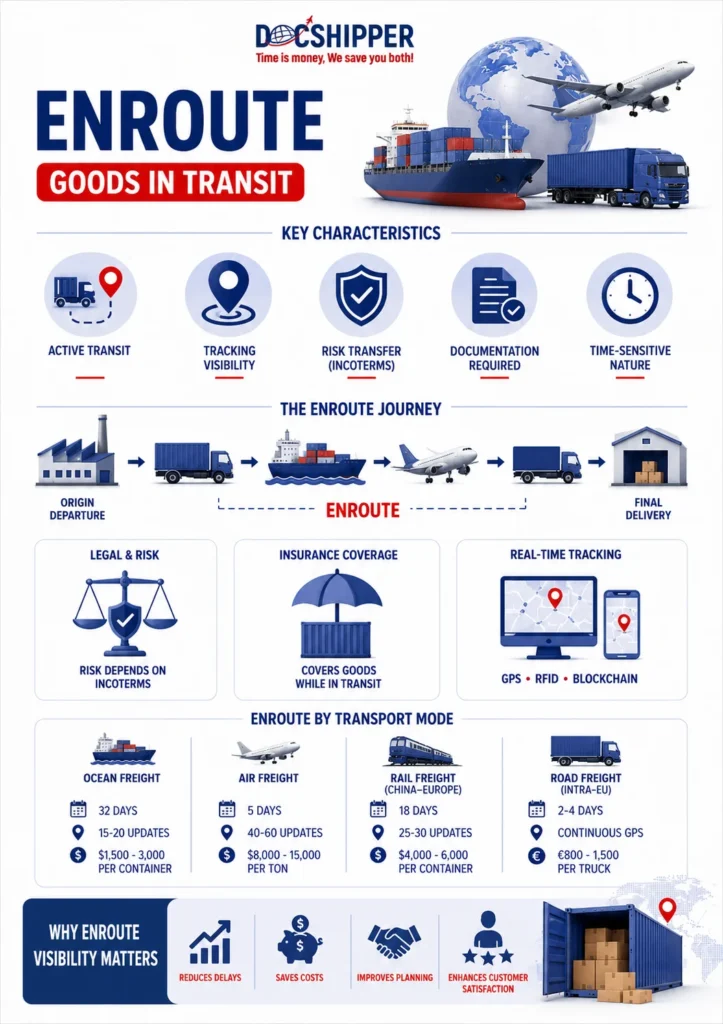
Key characteristics of enroute shipments include:
- Active transit status: Goods have left the origin facility and are moving through transportation networks
- Tracking visibility: Shipments are monitored via GPS, container numbers, or airway bills
- Risk transfer point: Ownership and liability depend on the agreed Incoterms
- Documentation requirements: Bills of lading, customs declarations, and insurance certificates accompany the cargo
- Time-sensitive nature: Delays during this phase directly impact delivery schedules and costs
Enroute Status: Technical & Legal Implications
The enroute designation carries significant operational and legal weight in international logistics. Unlike “in warehouse” or “delivered,” this status indicates active movement with specific responsibilities for all parties involved.
From a customs perspective, enroute goods exist in a unique regulatory limbo. They have exited one jurisdiction but haven’t entered another. During ocean freight, for example, containers may spend 30-45 days enroute from Shanghai to Rotterdam, during which customs authorities cannot physically inspect them.
The risk allocation during this phase depends entirely on the negotiated Incoterms. Under FOB (Free On Board), the buyer assumes all risks once goods cross the ship’s rail. Under CIF (Cost, Insurance, Freight), the seller maintains responsibility until the port of destination. According to ICC Incoterms® 2020, clearly defining the transfer point prevents disputes when cargo is damaged or delayed enroute.
Insurance coverage becomes critical during this window. Marine cargo insurance specifically covers goods “while in transit,” including loading, transport, and unloading. Without proper coverage, a container lost at sea or damaged in transit can result in total financial loss.
Modern tracking technology has transformed enroute visibility. GPS-enabled containers, RFID tags, and blockchain-based platforms provide real-time location data. However, the accuracy varies by mode: air freight offers minute-by-minute updates, while ocean freight may only update at port calls.
At DocShipper, we provide clients with continuous enroute monitoring through our integrated tracking dashboard. Our team proactively identifies potential delays—port congestion, customs holds, weather disruptions—and implements contingency plans before issues escalate. This approach reduces delivery uncertainties by up to 40% compared to passive tracking.
Real-World Scenarios & Data
To illustrate how enroute status affects practical business decisions, consider these documented scenarios from international trade operations:
Case Study: Electronics Import from Vietnam to Germany
A German retailer ordered €200,000 worth of consumer electronics from Vietnam. The shipment was marked “enroute” for 28 days during ocean transit. Midway through the journey, the carrier announced a 7-day delay due to port congestion in Singapore.
| Phase | Duration | Status | Action Taken |
|---|---|---|---|
| Departure from Ho Chi Minh | Day 0 | Enroute initiated | Tracking activated |
| Singapore port call | Day 14 | Enroute (transshipment) | 7-day delay detected |
| Suez Canal transit | Day 26 | Enroute (main leg) | Customer notified |
| Hamburg arrival | Day 35 | Status changed to “arrived” | Customs clearance begun |
Because the importer had real-time enroute visibility, they adjusted their retail launch date and avoided €50,000 in expedited air freight costs that would have been necessary with late notice.
Air Freight Enroute: Speed vs. Visibility
Air cargo typically spends 3-7 days enroute, dramatically shorter than ocean freight’s 25-40 days. However, the cost differential is significant: air freight averages $4-8 per kilogram versus $0.10-0.30 for ocean.
Key enroute metrics by transport mode:
- Ocean freight: Average 32 days enroute, 15-20 tracking updates, $1,500-3,000 per container
- Air freight: Average 5 days enroute, 40-60 tracking updates, $8,000-15,000 per ton
- Rail (China-Europe): Average 18 days enroute, 25-30 tracking updates, $4,000-6,000 per container
- Road freight (intra-EU): Average 2-4 days enroute, continuous GPS tracking, €800-1,500 per truck
A pharmaceutical company shipping temperature-sensitive vaccines chose air freight specifically because the shorter enroute period minimized exposure to temperature fluctuations. Despite paying 12x more than ocean rates, the reduced spoilage risk justified the premium.
Conclusion
The enroute status represents far more than a simple tracking update—it’s a critical phase where proactive management prevents costly delays and protects shipment value. Understanding the legal, financial, and operational implications of goods in transit enables better decision-making throughout the supply chain.
Need expert guidance on managing your international shipments? Contact DocShipper for comprehensive logistics solutions tailored to your business needs.
📚 Quiz
Test Your Knowledge: Enroute
What does "enroute" status specifically indicate in international logistics?
Who assumes responsibility for goods damaged during the enroute phase?
A German retailer's €200,000 electronics shipment from Vietnam is delayed 7 days during the enroute phase due to port congestion. What is the most appropriate immediate action?
🎯 Your Result
📞 Free Quote in 24hFAQ | Enroute: Definition, Calculation & Concrete Examples
Enroute indicates that a shipment has departed from its origin point and is actively moving through the transportation network but has not yet arrived at the final destination. This status applies to all transport modes—sea, air, road, and rail—and signifies goods are physically in transit between two locations.
Duration varies significantly by transport mode. Ocean freight averages 25-40 days enroute for intercontinental routes, air freight typically 3-7 days, rail (China-Europe) approximately 18 days, and road freight within Europe 2-4 days. Actual times depend on distance, route, carrier, and potential delays like customs inspections or port congestion.
Responsibility depends on the agreed Incoterms. Under FOB terms, the buyer assumes risk once goods are loaded onto the vessel. Under CIF or DDP terms, the seller maintains responsibility during transit. Always verify your contract terms and ensure appropriate insurance coverage is in place for the enroute period.
Yes, most carriers provide tracking capabilities. Ocean freight offers periodic updates at port calls and major waypoints. Air freight provides more frequent updates, often in real-time. Modern logistics platforms use GPS, RFID, and IoT sensors to provide continuous visibility. However, tracking granularity varies by carrier and service level.
If damage occurs during transit, liability depends on your Incoterms and insurance coverage. File a claim immediately with the carrier and your insurance provider. Document all damage with photos and reports. Marine cargo insurance typically covers goods "warehouse to warehouse," including the enroute period, but exclusions apply for improper packaging or inherent vice.
For ocean and air freight, customs clearance typically occurs after goods arrive at the destination port, not while enroute. However, some countries allow pre-clearance based on advance documentation. The enroute period is when all customs paperwork should be prepared and submitted electronically to expedite processing upon arrival.
These terms are generally synonymous in logistics, both indicating goods are moving between origin and destination. "In transit" is sometimes used more broadly to include the entire door-to-door journey, while "enroute" specifically refers to the main transportation leg. Industry practice varies, but functionally they mean the same operational status.
Redirection is possible but depends on the transport mode and stage of transit. Ocean freight can sometimes be diverted to alternative ports before arrival, though this incurs significant fees. Air freight offers more flexibility but requires immediate carrier notification. Road and rail shipments can be redirected more easily. All redirections require updated documentation and customs filings.
Tracking gaps occur for several reasons: the vessel is in open ocean with no AIS signal coverage, the shipment is awaiting transshipment at an intermediate port, customs is conducting inspection, or the carrier hasn't updated their system. Contact your freight forwarder if updates haven't occurred for more than 5-7 days on ocean shipments or 24 hours on air shipments.
Not necessarily. Enroute simply confirms active transit; it doesn't guarantee on-time delivery. Delays can occur from weather, port congestion, customs holds, equipment failures, or carrier scheduling changes. Monitor estimated arrival dates and maintain communication with your logistics provider to identify potential delays early and implement contingency plans.
Prepare by ensuring all customs documentation is complete and submitted, arranging payment for duties and taxes, coordinating with your customs broker, scheduling warehouse receiving capacity, and confirming final delivery arrangements. Having these elements ready before goods arrive significantly reduces clearance time and avoids demurrage or storage charges.
Marine cargo insurance (which covers air freight too, despite the name) is essential for enroute protection. Policies typically offer "All Risks" or "Institute Cargo Clauses" coverage. Ensure your policy covers the full invoice value plus freight costs (typically 110% of CIF value) and includes coverage for the specific route and goods type you're shipping. War and strike coverage may require separate endorsements.
Need Help with
Logistics or Sourcing ?
First, we secure the right products from the right suppliers at the right price by managing the sourcing process from start to finish. Then, we simplify your shipping experience - from pickup to final delivery - ensuring any product, anywhere, is delivered at highly competitive prices.


Fill the Form
Prefer email? Send us your inquiry, and we’ll get back to you as soon as possible.
Contact us




