


In short ⚡
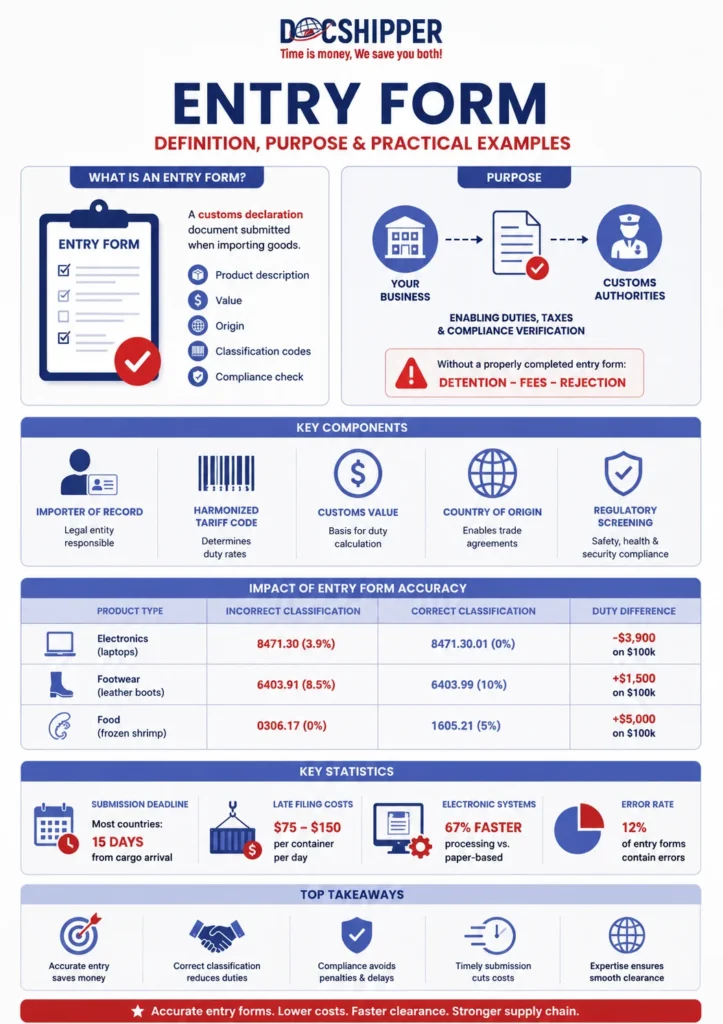
An Entry Form is a customs declaration document submitted to authorities when importing goods into a country. It provides detailed information about the shipment, including product description, value, origin, and classification codes, enabling customs to assess duties, taxes, and compliance requirements before releasing the cargo.
Introduction
Importers often confuse entry forms with commercial invoices or packing lists. While these documents complement each other, the entry form serves a distinct regulatory function. It acts as the formal communication bridge between your business and customs authorities.
Without a properly completed entry form, your shipment faces detention, storage fees, or rejection at the border. This document transforms your commercial transaction into a customs-compliant entry, determining how much you’ll pay and how quickly your goods clear.
Key characteristics of entry forms include:
- Mandatory submission: Required by law in virtually all countries for commercial imports.
- Tariff classification: Contains HS codes that determine applicable duty rates.
- Valuation declaration: States the customs value used for tax calculation.
- Origin certification: Declares country of manufacture to apply trade agreements.
- Regulatory screening: Enables authorities to verify compliance with safety, health, and security regulations.
Entry Form Mechanics & Legal Framework
The entry form operates within a complex regulatory ecosystem. In the United States, it’s governed by the Customs Modernization Act, which shifted responsibility for accurate declarations from customs brokers to importers themselves. The European Union operates under the Union Customs Code, which standardized entry procedures across member states.
The document typically includes several critical components. The importer of record section identifies the legal entity responsible for the shipment and all associated duties. This party must possess an IOR number or equivalent registration. The harmonized tariff code classifies the goods according to international standards, determining duty rates that can range from zero to over 30% depending on product category.
Entry forms require declaration of customs value, which differs from invoice price in many cases. According to World Customs Organization guidelines, customs value includes merchandise cost, international shipping, and insurance up to the port of entry. Additional elements like inland freight or installation fees are typically excluded.
The country of origin declaration enables application of preferential duty rates under free trade agreements. Goods from USMCA countries, for example, may enter duty-free if they meet rules of origin requirements. Misrepresenting origin constitutes a serious violation that can result in penalties exceeding 40% of the shipment value.
Modern entry systems like the U.S. Automated Commercial Environment (ACE) or EU’s Import Control System 2 (ICS2) process these forms electronically. At DocShipper, we verify every entry form element before submission to prevent costly processing delays or compliance violations that could jeopardize your supply chain.
Practical Examples & Compliance Data
Understanding entry forms through real-world scenarios clarifies their practical impact. Consider a textile importer bringing 5,000 cotton t-shirts from Vietnam to the United States. The entry form would classify these under HS code 6109.10, attracting a standard duty rate of 16.5%.
However, if the importer can demonstrate the t-shirts qualify under the U.S.-Vietnam Bilateral Trade Agreement, the duty drops to zero. This single classification decision on the entry form represents a potential savings of $8,250 on a $50,000 shipment.
The following table illustrates how entry form accuracy impacts costs across different product categories:
| Product Type | Incorrect Classification | Correct Classification | Duty Difference |
|---|---|---|---|
| Electronics (laptops) | 8471.30 (3.9%) | 8471.30.01 (0%) | -$3,900 on $100k |
| Footwear (leather boots) | 6403.91 (8.5%) | 6403.99 (10%) | +$1,500 on $100k |
| Food (frozen shrimp) | 0306.17 (0%) | 1605.21 (5%) | +$5,000 on $100k |
Use Case: A machinery importer filed an entry form declaring equipment value at $200,000 FOB Shanghai. Customs questioned the valuation, discovering the actual transaction value included $50,000 in engineering services performed in China. The revised entry form increased customs value to $250,000, resulting in $1,875 in additional duties (7.5% rate) plus penalties for undervaluation.
Entry form submission timing also impacts costs. In most jurisdictions, forms must be filed within 15 days of cargo arrival. Late filing triggers daily storage fees averaging $75-150 per container at port facilities. For a standard 40-foot container, a five-day delay costs $375-750 in avoidable charges.
Electronic entry systems have reduced processing times by 67% compared to paper-based methods. However, error rates remain significant. U.S. Customs reports that approximately 12% of entry forms contain classification errors requiring amendment and potential post-entry audits extending three to five years.
Conclusion
The entry form represents more than bureaucratic paperwork. It’s a strategic document that directly influences your import costs, compliance risk, and supply chain velocity. Accurate completion requires detailed product knowledge, tariff expertise, and understanding of bilateral trade agreements.
Need assistance navigating entry form requirements for your imports? Contact DocShipper for expert customs clearance support that ensures compliant, cost-effective entries every time.
📚 Quiz
Test Your Knowledge: Entry Form
What is the primary regulatory function of an Entry Form?
According to the article, what percentage of U.S. entry forms contain classification errors requiring amendment?
A textile importer brings cotton t-shirts from Vietnam to the U.S. The entry form shows HS code 6109.10 with a 16.5% duty rate. What happens if the importer correctly claims the U.S.-Vietnam Bilateral Trade Agreement on the entry form?
🎯 Your Result
📞 Free Quote in 24hFAQ | Entry Form: Definition, Purpose & Practical Examples
Customs may issue a redelivery notice requiring correction. You'll face duty adjustments based on the correct classification, potential penalty fees ranging from 10-40% of owed duties, and possible delays in future shipments if errors appear systematic. Serious misclassifications can trigger focused assessments where customs examines your entries for three consecutive years.
In most countries, importers have the legal right to self-file entry forms. However, this requires obtaining necessary licenses, bonds, and system access credentials. The complexity of tariff classification and valuation rules makes errors likely for inexperienced filers. Most businesses use licensed customs brokers who possess specialized knowledge and direct electronic filing capabilities that expedite clearance.
Retention periods vary by jurisdiction. The United States requires importers maintain entry documentation for five years from entry date. The European Union mandates three years after the customs declaration year ends. Countries like Canada require six years. These records must be readily accessible for audit purposes, with digital formats increasingly accepted alongside traditional paper files.
An entry form (or entry/immediate delivery) allows cargo release, while the entry summary provides final accounting of duties and fees. The entry form must be filed within five days of arrival to obtain release. The entry summary follows within 10 days, containing detailed commodity information, final valuation, and duty calculation. This two-step process balances security screening needs with commercial urgency.
Yes, undervaluation constitutes fraud and attracts severe consequences. Penalties typically equal the duty loss multiplied by a factor between two and eight times, depending on intent determination. Criminal prosecution is possible for egregious cases. Beyond financial penalties, customs may subject all your future entries to 100% examination, dramatically increasing clearance times and costs.
When claiming preferential duty rates under FTAs, entry forms require additional certifications proving origin eligibility. You must indicate the applicable FTA, possess valid origin documentation, and ensure products meet rules of origin criteria. Failing to maintain proper certification when claiming preferential treatment results in duty recovery plus interest, making documentation accuracy essential for realizing FTA benefits.
Entry forms mandate complete exporter identification including legal business name, address, and tax identification number if applicable. This information enables customs to verify transaction authenticity and apply any exporter-specific requirements. For certain high-risk countries or products, additional exporter details like manufacturing facility addresses may be required to satisfy enhanced screening protocols.
Post-release amendments are possible but complex. You must file a Post Entry Amendment within specific timeframes, typically before liquidation (the final duty determination). Amendments affecting duty calculations require payment of additional amounts owed or demonstrate overpayment for refunds. Repeated amendments trigger scrutiny and may result in focused assessments of your import compliance program.
Most countries establish de minimis thresholds below which simplified or no entry forms apply. The U.S. sets this at $800 for most goods, the EU at €150, and Canada at CAD $20 for duties. However, even low-value shipments may require standard entry forms if they contain restricted goods, alcohol, tobacco, or items subject to quotas or trade remedies like anti-dumping duties.
Entry forms trigger regulatory agency reviews beyond customs duties. Product codes alert agencies like FDA, EPA, or CPSC to enforce safety standards. The form must declare compliance with applicable regulations, and false declarations expose importers to product seizures, recalls, and significant civil penalties. Proper entry form completion ensures concurrent regulatory clearance alongside customs release.
A continuous customs bond guarantees payment of duties and compliance with regulations for all entry forms filed within a year. Rather than purchasing single-entry bonds for each shipment, frequent importers obtain continuous bonds covering unlimited entries. The bond amount typically equals 10% of annual duty payments with minimum thresholds. Without valid bond coverage, customs will not process entry forms.
Missing filing deadlines results in cargo being sent to general order storage, a secured warehouse where goods incur daily storage fees. After a statutory period (typically 15 days in the U.S., 90 days in the EU), unclaimed cargo may be sold at public auction or destroyed. Beyond storage costs, late filing often triggers priority examinations and compliance questionnaires that complicate future imports.
Need Help with
Logistics or Sourcing ?
First, we secure the right products from the right suppliers at the right price by managing the sourcing process from start to finish. Then, we simplify your shipping experience - from pickup to final delivery - ensuring any product, anywhere, is delivered at highly competitive prices.


Fill the Form
Prefer email? Send us your inquiry, and we’ll get back to you as soon as possible.
Contact us




