


In short ⚡
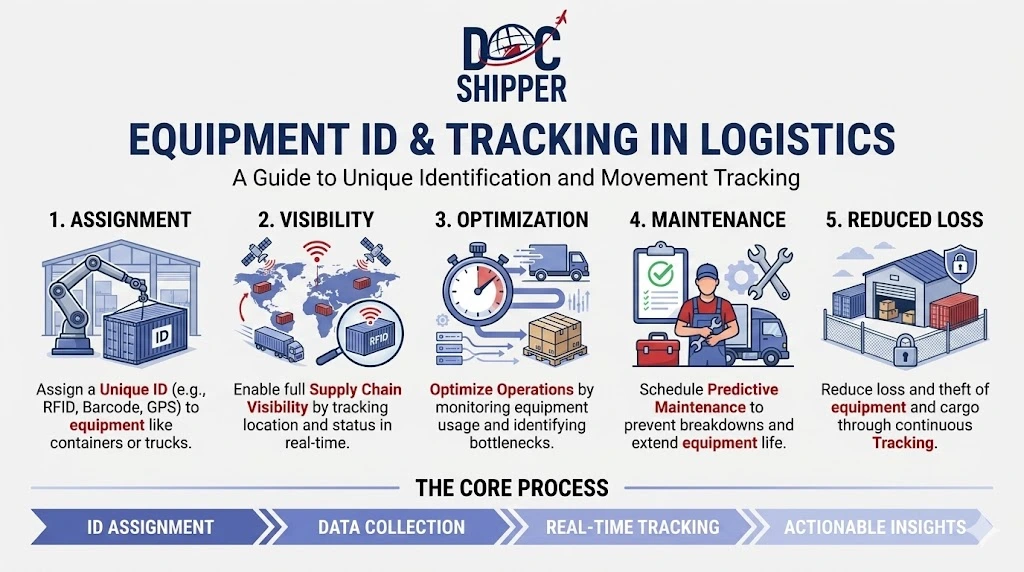
Equipment I.D. (Identification) is a unique alphanumeric code assigned to shipping containers and transport equipment, enabling tracking, verification, and documentation throughout the international supply chain. This standardized identifier ensures traceability, regulatory compliance, and operational efficiency across global logistics networks.
Introduction
In international freight, confusion often arises when containers arrive at ports without proper identification, causing delays and additional costs. Equipment I.D. serves as the universal language between carriers, customs authorities, and logistics providers worldwide.
This identification system is fundamental to modern supply chain management. Every shipping container, chassis, trailer, or intermodal unit requires a unique identifier to move legally across borders and through different transport modes.
Key characteristics of Equipment I.D. systems include:
- ISO 6346 compliance for container identification codes
- BIC (Bureau International des Containers) registration ensuring global uniqueness
- Check digit validation preventing transcription errors
- Physical marking requirements on all four sides of equipment
- Integration with EDI systems for automated customs clearance
Understanding Equipment I.D. prevents costly mistakes in shipping documentation, customs declarations, and cargo tracking throughout the import/export process.
Technical Standards & Regulatory Framework
The ISO 6346 standard establishes the structure for container identification codes. This code consists of four components: owner code (3 letters), equipment category identifier (1 letter), serial number (6 digits), and check digit (1 digit).
The owner code represents the container operator registered with the BIC. This three-letter prefix uniquely identifies the company responsible for the equipment. For example, MAEU represents Maersk, while CSQU identifies COSCO.
The equipment category identifier specifies the type of container or chassis. “U” indicates freight containers, “J” represents detachable equipment, and “Z” designates trailers and chassis. This single letter provides instant classification for handling procedures.
The check digit calculation follows a specific algorithm based on the preceding ten characters. This mathematical validation catches 100% of single-digit errors and approximately 88% of transcription mistakes, significantly reducing documentation errors at customs checkpoints.
According to BIC Code regulations, all container owners must register their codes before equipment can legally operate in international commerce. Physical marking specifications require characters at least 100mm high on container sides and doors, ensuring visibility during handling operations.
At DocShipper, we systematically verify Equipment I.D. codes against BIC registries before booking shipments, preventing delays caused by invalid or unregistered container numbers during customs processing.
Practical Applications & Data Insights
Understanding Equipment I.D. structure enables faster problem resolution and accurate documentation. The following comparison illustrates how different equipment types are identified:
| Equipment Type | Category Code | Example I.D. | Typical Use |
|---|---|---|---|
| Standard Container | U | MSCU1234567 | Ocean freight, intermodal |
| Refrigerated Container | U | TEMU7654321 | Temperature-controlled cargo |
| Chassis | Z | FLXZ9876543 | Container ground transport |
| Tank Container | U | STBU4567890 | Liquid bulk transport |
Case Study: Import Documentation Error Prevention
A European importer received customs holds on 23% of shipments due to Equipment I.D. discrepancies between bills of lading and container manifests. By implementing automated validation against BIC databases, error rates dropped to under 2% within three months.
The financial impact was significant. Each customs hold averaged 3.5 days of demurrage charges, costing approximately $350 per container. For this importer processing 200 containers monthly, proper Equipment I.D. verification saved over $240,000 annually.
Five Critical Verification Points:
- Owner code validation: Confirm registration with BIC before accepting equipment
- Check digit calculation: Apply ISO 6346 algorithm to verify code integrity
- Physical inspection: Match container markings with documentation exactly
- Category identifier consistency: Ensure equipment type matches shipping requirements
- Database cross-reference: Verify code against carrier and port authority systems
Industry data shows that 78% of container-related documentation errors stem from incorrect Equipment I.D. transcription. Automated optical character recognition (OCR) systems combined with manual verification reduce these errors by 94% compared to manual-only processes.
Conclusion
Equipment I.D. forms the backbone of container tracking and regulatory compliance in international logistics. Proper understanding and verification of these identifiers prevents costly delays and ensures smooth customs clearance.
Need assistance with Equipment I.D. verification or container tracking for your shipments? Contact DocShipper for expert guidance on international freight documentation.
📚 Quiz
Test Your Knowledge: Equipment I.D. (Identification)
What is the primary function of Equipment I.D. in international shipping?
According to ISO 6346, what happens when an Equipment I.D. has an incorrect check digit?
A logistics manager receives container documentation with the code "MSCU-1234-567". What should they do?
🎯 Your Results
📞 Free Quote in 24hFAQ | Equipment I.D. (Identification): Definition, Standards & Practical Examples
Incorrect check digits trigger automatic rejections in port and customs systems. The container cannot be processed through electronic data interchange (EDI) systems until corrected. Shippers must contact the carrier to verify the correct Equipment I.D. and submit amended documentation, typically causing 24-48 hour delays.
No. Each Equipment I.D. is globally unique and registered through the BIC. Duplicate numbers indicate either fraudulent equipment or documentation errors. If duplicates appear in shipping records, immediately verify with the carrier and BIC database to identify the legitimate equipment.
Initial BIC registration for container operators typically takes 5-10 business days after submitting required company documentation and fees. Rush processing is available for urgent needs. Once approved, owner codes remain valid indefinitely as long as annual registration fees are maintained.
Containers used exclusively within one country are not legally required to have ISO 6346-compliant Equipment I.D. codes. However, most major logistics operators assign them anyway for consistency across their fleets and to facilitate potential international use without re-marking equipment.
Equipment I.D. identifies the container or transport unit itself, while seal numbers identify the security devices placed on container doors. Equipment I.D. remains constant throughout the container's lifespan, whereas seal numbers change with each shipment. Both must be accurately documented for customs clearance.
No. Once assigned, Equipment I.D. codes are permanently retired when containers are removed from service. This prevents confusion in historical shipping records and ensures data integrity in global tracking systems. New containers always receive unique, never-before-used identification codes.
Check the code against the BIC database at bic-code.org, which lists all registered owner codes. Calculate the check digit using the ISO 6346 algorithm to verify mathematical accuracy. Cross-reference with the carrier's equipment registry. Physical inspection should confirm markings match documentation exactly.
Report damaged markings to the carrier immediately before accepting the container. Do not proceed with loading until the Equipment I.D. is clearly visible and verified. Carriers must repair or re-mark equipment to meet ISO standards. Loading cargo into improperly marked containers risks customs rejection.
Air cargo containers (Unit Load Devices or ULDs) follow IATA standards rather than ISO 6346. ULD identification uses a three-letter prefix, five-digit serial number, and two-letter owner code. While the structure differs, the principle of unique identification and registration remains consistent with ocean containers.
Blockchain implementations record Equipment I.D. movements across the supply chain in immutable ledgers. Each transfer, inspection, or status change creates a permanent record linked to the container's unique identifier. This provides unprecedented visibility and reduces documentation fraud by up to 95% in pilot programs.
Using unregistered codes violates international transport conventions and can result in cargo seizure, heavy fines from port authorities, and carrier liability claims. Customs agencies may refuse entry to countries, requiring transloading into compliant equipment at shipper expense, typically costing $2,000-$5,000 per container.
No. ISO 6346 permits only capital letters (A-Z) and numbers (0-9). No spaces, hyphens, or special characters are allowed. The format is strictly enforced: three letters, one letter, six digits, one digit. Any deviation renders the code invalid for international transport documentation systems.
Need Help with
Logistics or Sourcing ?
First, we secure the right products from the right suppliers at the right price by managing the sourcing process from start to finish. Then, we simplify your shipping experience - from pickup to final delivery - ensuring any product, anywhere, is delivered at highly competitive prices.


Fill the Form
Prefer email? Send us your inquiry, and we’ll get back to you as soon as possible.
Contact us




:%20Definition,%20Standards%20&%20Practical%20Examples)