


In short ⚡
An EXIM Bank (Export-Import Bank) is a government-backed financial institution that provides trade finance solutions to domestic companies engaged in international commerce. It offers loans, guarantees, and insurance to mitigate risks associated with exporting goods and services, particularly to emerging markets where commercial financing may be unavailable or prohibitively expensive.
Introduction
Many exporters face a critical challenge: how to secure payment when shipping goods to unfamiliar markets. Commercial banks often refuse to finance exports to high-risk countries, leaving businesses unable to capitalize on international opportunities.
This is where Export-Import Banks become essential. Operating in over 85 countries worldwide, these institutions bridge the financing gap by assuming risks that private lenders avoid.
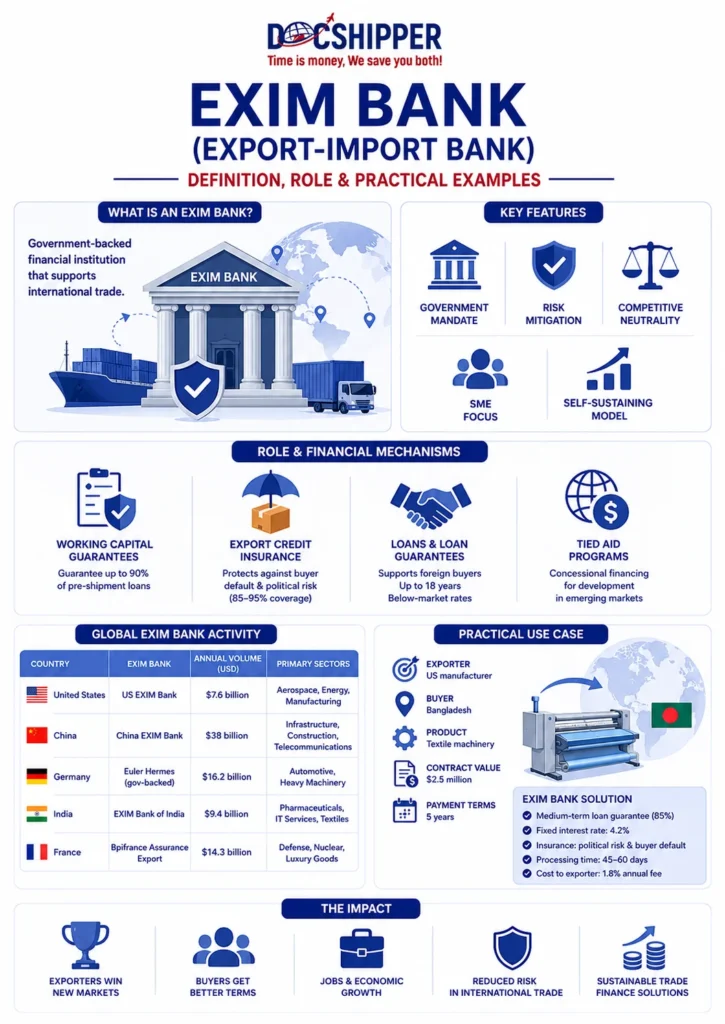
Key characteristics of EXIM Banks include:
- Government mandate: Operate under federal charters with explicit trade promotion objectives
- Risk mitigation: Provide insurance against non-payment, political instability, and currency fluctuations
- Competitive neutrality: Level the playing field against foreign competitors with subsidized export financing
- SME focus: Typically allocate 20-30% of support to small and medium-sized enterprises
- Self-sustaining model: Generate revenue through fees and interest to cover operational costs
Role & Financial Mechanisms
EXIM Banks fulfill a critical gap-filling function in international trade finance. They intervene only when private-sector lenders decline to provide adequate support, ensuring exporters can compete globally without excessive risk exposure.
The primary financial instruments offered include:
Working capital guarantees enable exporters to secure pre-shipment financing from commercial banks. The EXIM Bank guarantees 90% of the loan value, reducing lender risk and allowing businesses to purchase inventory, hire labor, and fulfill large orders.
Export credit insurance protects against buyer default and political risks. Coverage typically ranges from 85-95% of invoice value, with premiums calculated based on country risk ratings published by agencies like OECD.
Direct loans and loan guarantees support foreign buyers purchasing capital goods from domestic exporters. Terms can extend to 18 years for infrastructure projects, with fixed interest rates below market levels to match competitor financing.
Tied aid programs combine concessional financing with development assistance, particularly for transactions in least-developed countries where commercial terms would be unaffordable.
At DocShipper, we regularly collaborate with EXIM Bank representatives to structure financing for clients shipping heavy machinery, industrial equipment, and high-value goods to emerging markets. Our expertise ensures proper documentation and compliance with eligibility requirements.
Concrete Examples & Data
Understanding EXIM Bank operations becomes clearer through real-world applications and comparative data.
Global EXIM Bank Activity Comparison
| Country | EXIM Bank | Annual Volume (USD) | Primary Sectors |
|---|---|---|---|
| United States | US EXIM Bank | $7.6 billion | Aerospace, Energy, Manufacturing |
| China | China EXIM Bank | $38 billion | Infrastructure, Construction, Telecommunications |
| Germany | Euler Hermes (gov-backed) | $16.2 billion | Automotive, Heavy Machinery |
| India | EXIM Bank of India | $9.4 billion | Pharmaceuticals, IT Services, Textiles |
| France | Bpifrance Assurance Export | $14.3 billion | Defense, Nuclear, Luxury Goods |
Practical Use Case: Manufacturing Equipment Export
Scenario: A US-based manufacturer needs to export $2.5 million in textile machinery to a buyer in Bangladesh.
Challenge: The buyer requests 5-year payment terms. Commercial banks decline financing due to perceived country risk.
EXIM Bank Solution:
- Provides a medium-term loan guarantee covering 85% of contract value
- Fixed interest rate of 4.2% (vs. 8-10% commercial rate)
- Insurance against political risk and buyer default
- Processing time: 45-60 days with complete documentation
- Total cost to exporter: 1.8% annual guarantee fee
Outcome: The manufacturer secures the contract, outbidding European competitors who lacked equivalent government support. The buyer receives favorable terms, and the EXIM Bank earns fee income while supporting domestic employment.
Conclusion
EXIM Banks serve as indispensable tools for exporters navigating the complexities of international trade finance. By providing government-backed guarantees and insurance, they enable businesses to pursue opportunities that would otherwise be financially inaccessible.
Understanding eligibility requirements and application procedures is crucial for maximizing these benefits. Need expert guidance on leveraging EXIM Bank programs for your shipments? Contact DocShipper for personalized trade finance solutions.
📚 Quiz
Test Your Knowledge: EXIM Bank
What is the primary function of an EXIM Bank?
Which statement correctly describes EXIM Bank's intervention policy?
A US manufacturer needs to export $2.5M in machinery to Bangladesh with 5-year payment terms, but commercial banks decline due to country risk. What is the most appropriate EXIM Bank solution?
🎯 Your Result
📞 Free Personalized QuoteFAQ | EXIM Bank (Export-Import Bank): Definition, Role & Practical Examples
EXIM Banks assume risks that commercial banks avoid, focusing on trade promotion rather than profit maximization. They operate under government mandates to support exporters in high-risk markets where private financing is unavailable. Commercial banks prioritize loan safety and shareholder returns, typically declining transactions in unstable regions or with unproven buyers.
Yes, most EXIM Banks allocate 20-30% of their portfolio specifically to small and medium-sized enterprises. Many offer expedited processing for transactions under $500,000 and provide dedicated SME advisory services. Application requirements are often streamlined, with reduced documentation compared to large corporate transactions.
Processing times vary by transaction complexity. Working capital guarantees may receive preliminary approval within 10-15 business days. Medium-term and long-term facilities require 45-90 days for complete underwriting, including buyer credit assessments and country risk evaluation. Express programs exist for repeat customers with established track records.
Standard requirements include: export contracts or letters of credit, financial statements for both exporter and buyer (past 3 years), detailed product specifications, shipping documentation, and compliance certificates. Additional documents may be requested based on transaction size, destination country, and end-use verification needs.
Coverage varies by institution. Most EXIM Banks maintain restricted country lists excluding nations under international sanctions or with unacceptable political risk. Certain products like military goods, nuclear materials, or items with dual-use concerns may require special licenses. Agricultural commodities often have separate financing programs with specific eligibility criteria.
Rates follow OECD Arrangement guidelines, calculated using Commercial Interest Reference Rates (CIRRs) plus risk premiums. Country risk classification (0-7 scale) significantly impacts pricing. Higher-risk destinations incur additional fees, while creditworthy buyers in stable markets receive preferential rates competitive with private financing.
Yes, EXIM Bank products often complement letters of credit, factoring, and supply chain finance solutions. Many exporters structure multi-layered financing using EXIM working capital guarantees for production, export credit insurance for buyer risk, and commercial LC for payment assurance. This approach maximizes coverage while optimizing costs.
The EXIM Bank pays the guaranteed percentage (typically 85-95%) of the outstanding amount to the exporter or financing bank within 60-90 days of claim submission. The institution then pursues recovery directly from the defaulting buyer or through international arbitration. Exporters must demonstrate reasonable collection efforts before filing claims.
Yes, fee structures include: facility fees (0.125-0.25% of commitment amount), exposure fees (risk-based, 0.5-3% annually), and insurance premiums (calculated by country risk and tenor). Working capital guarantee fees average 1.5-2% per year. These costs are generally lower than equivalent private-sector alternatives for comparable risk levels.
Tied aid programs blend concessional loans with development assistance for projects in least-developed countries. These facilities combine EXIM financing (covering export goods/services) with grant components from development agencies. Terms may include 20-30 year repayment periods with grace periods, enabling infrastructure projects that support both development goals and exporter competitiveness.
Buyer credit involves the EXIM Bank lending directly to the foreign purchaser, who pays the exporter in cash. The bank assumes buyer risk and manages repayment. Supplier credit provides financing to the exporter, who extends terms to the buyer. The exporter retains buyer relationship management but transfers non-payment risk to the EXIM Bank through guarantees or insurance.
Studies indicate that every $1 billion in EXIM-supported exports sustains approximately 5,000-7,000 domestic jobs across manufacturing, logistics, professional services, and supply chains. By enabling contracts that would otherwise go to foreign competitors, these institutions preserve high-wage employment in export-intensive industries while generating tax revenues that exceed program costs.
Need Help with
Logistics or Sourcing ?
First, we secure the right products from the right suppliers at the right price by managing the sourcing process from start to finish. Then, we simplify your shipping experience - from pickup to final delivery - ensuring any product, anywhere, is delivered at highly competitive prices.


Fill the Form
Prefer email? Send us your inquiry, and we’ll get back to you as soon as possible.
Contact us




