


In short ⚡
Explanatory Notes are official interpretive texts that accompany the Harmonized System (HS) classification, providing detailed guidance on tariff headings, product descriptions, and classification criteria. Published by the World Customs Organization (WCO), these notes help customs authorities and importers determine the correct HS code for goods crossing international borders.
Introduction
Misclassifying goods can trigger penalties, shipment delays, and incorrect duty calculations. Many importers struggle with ambiguous product descriptions that fit multiple HS codes.
Explanatory Notes serve as the authoritative reference for resolving classification uncertainties. They bridge the gap between generic tariff headings and the technical realities of traded products.
Understanding these notes is essential for anyone involved in international trade:
- Customs brokers rely on them to justify classification decisions during audits
- Importers use them to calculate accurate landed costs and avoid surprises
- Exporters reference them to ensure compliance with destination country requirements
- Customs authorities apply them as the foundation for tariff enforcement
- Legal teams cite them during classification disputes or litigation
Legal Framework & Classification Mechanisms
The Harmonized System organizes over 5,000 commodity groups into 21 sections and 99 chapters. However, the six-digit HS codes alone cannot cover every product variation or manufacturing process.
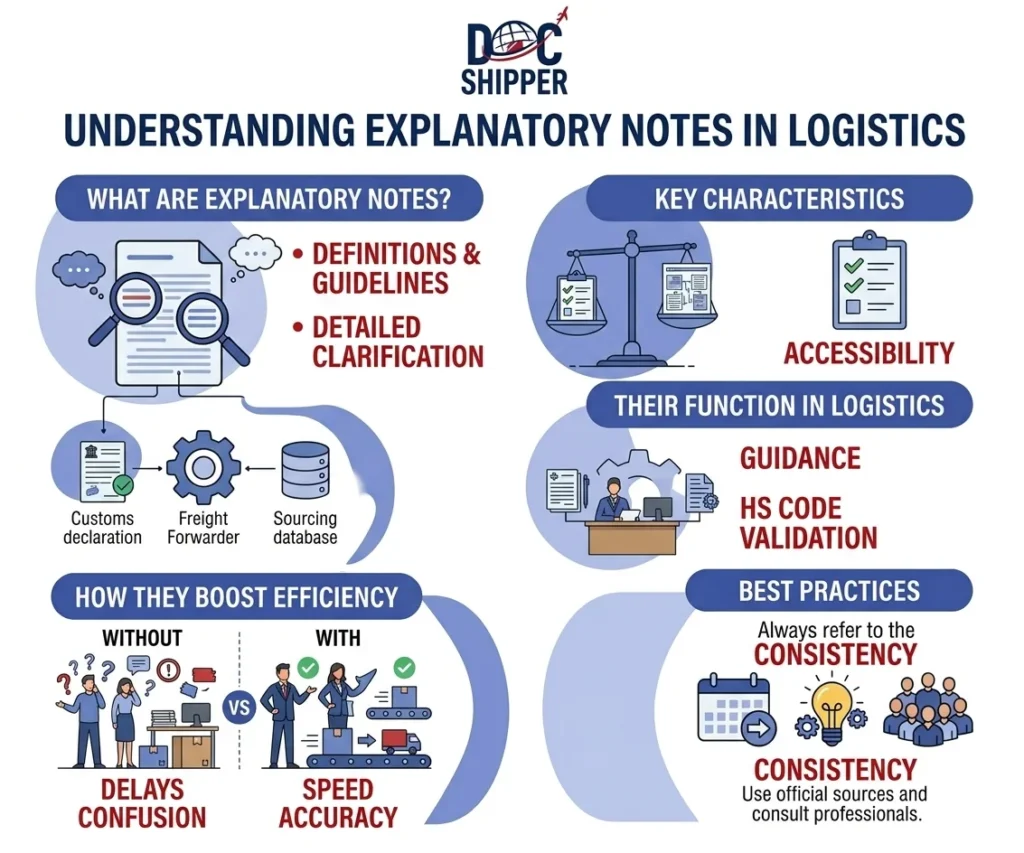
Explanatory Notes provide three critical functions:
Chapter and Section Notes establish exclusions and mandatory classifications. For example, Chapter 84 notes specify that certain machines must be classified by function rather than construction material. These binding instructions override general interpretation rules.
Heading-Level Guidance describes the scope and technical specifications for each four-digit heading. When a product contains multiple materials or functions, the notes clarify which characteristic determines classification priority.
Subheading Clarifications distinguish between closely related products at the six-digit level. This granularity becomes crucial when duty rates vary significantly between similar goods.
At DocShipper, our classification specialists cross-reference Explanatory Notes with product technical sheets to prevent costly reclassification by customs authorities during clearance.
The World Customs Organization updates these notes every five years alongside HS code revisions. The 2022 edition incorporated changes reflecting new technologies like 3D printers and drones.
Legal weight varies by jurisdiction. While not legally binding treaties, customs courts worldwide reference Explanatory Notes as persuasive authority. The European Court of Justice and US Court of International Trade regularly cite them in classification rulings.
General Interpretative Rules (GIRs) work in tandem with Explanatory Notes. GIR 1 mandates classification by heading descriptions first. When headings conflict, GIR 3 provides tiebreaker mechanisms that the notes illustrate through hundreds of examples.
Practical Examples & Data
Classification errors cost businesses an estimated $5 billion annually in penalties and overpaid duties. Explanatory Notes reduce this risk through precise product differentiation.
Case Study: Industrial Mixers
A manufacturer exports food processing equipment. The base HS heading 8438 covers machinery for food preparation. However, the specific mixer could also fall under heading 8479 (machines with individual functions).
The Explanatory Notes for 8438 explicitly include “mixing machines for preparing foodstuffs” and exclude general-purpose industrial mixers. By documenting the machine’s food-grade materials and sanitation features, the correct classification becomes defensible.
| Product Type | Potential HS Codes | Explanatory Note Clarification | Duty Rate Impact (EU) |
|---|---|---|---|
| LED Light Bulbs | 8539.50 / 8543.70 | Notes specify classification by primary light source technology | 3.7% vs 2.7% |
| Smartphone Cases (Leather) | 4202.32 / 3926.90 | Material composition determines heading (natural vs. plastic leather) | 4.5% vs 6.5% |
| Frozen Pizza | 1902.20 / 2106.90 | Notes define “stuffed pasta” exclusions for composite food preparations | 6.1% vs 9% |
| Digital Cameras (Drone-Mounted) | 8525.80 / 8806.90 | Classification depends on whether camera or aircraft function predominates | 0% vs 3.7% |
Data Point: Classification Consistency
A 2021 WCO study found that 87% of classification disputes involving Explanatory Notes were resolved in favor of the party citing specific note provisions. This demonstrates their practical authority in trade enforcement.
Key considerations when applying Explanatory Notes:
- Material composition vs. function: Notes prioritize essential character (GIR 3b) through detailed examples
- Multi-component products: Guidance on principal function determination prevents arbitrary classification
- Technological evolution: Recent updates address smart devices and IoT integration challenges
- Processing stage: Notes differentiate between raw materials, semi-finished, and finished goods
- End-use consideration: When permitted by chapter notes, intended application influences classification
At DocShipper, we maintain a comprehensive database cross-referencing product types with relevant Explanatory Note sections to accelerate customs clearance processes.
Conclusion
Explanatory Notes transform the Harmonized System from a general framework into a precise classification tool. Mastering their application protects businesses from compliance risks and optimizes duty expenditures across global supply chains.
Need expert guidance on HS classification for your products? Contact DocShipper for a detailed tariff analysis.
📚 Quiz
Test Your Knowledge: Explanatory Notes
What is the primary function of Explanatory Notes in international trade?
According to the article, what percentage of classification disputes citing Explanatory Notes were resolved in favor of the citing party?
A client asks you to classify a drone-mounted digital camera. Which classification approach aligns with Explanatory Notes guidance?
🎯 Your Result
📞 Free Quote in 24hFAQ | Explanatory Notes: Definition, Function & Practical Examples
They are not binding treaties but hold persuasive authority. Courts and customs administrations worldwide reference them as the WCO's official interpretation. Most trade agreements recognize their authoritative status, making contradictory national interpretations difficult to sustain during appeals.
Major revisions align with the five-year HS code update cycle. The WCO also issues amendments between cycles to address emerging products or clarify ambiguities raised by member countries. Subscribers receive notifications through the WCO online platform.
The WCO sells official editions through its online bookshop. Some customs authorities provide limited free access to their national tariff databases with abbreviated notes. Full access requires purchasing the complete six-volume set or subscribing to the digital platform.
Apply the General Interpretative Rules systematically. Start with GIR 1 (heading descriptions), then GIR 3 for composite goods. The notes provide analogies and principles that extend to products not specifically listed. Customs rulings for similar goods offer additional guidance.
The HS system aims for global uniformity through the first six digits. However, national subdivisions (digits 7-10) and implementation practices vary. The EU and US sometimes adopt different interpretations for identical products, requiring market-specific classification research.
The 2022 edition introduced classifications for drones, 3D printers, and smart wearables. For cutting-edge technologies, the WCO issues preliminary guidance through technical opinions. Products often classify under "machines with individual functions" until specific headings are created.
Yes. Formal protests and appeals should cite specific note sections supporting your position. Include technical documentation demonstrating how your product matches the note's description. Administrative appeals have higher success rates when backed by Explanatory Note references.
Chapter notes apply to all headings within that chapter and often contain mandatory exclusions. Heading notes provide detailed scope and examples for a single four-digit heading. Chapter notes take precedence when conflicts arise between the two levels.
No. They focus exclusively on tariff classification. Origin rules are governed by separate agreements like the WTO Valuation Agreement or regional trade pacts. However, proper classification is a prerequisite for applying preferential origin benefits.
Include all material components, manufacturing processes, and functional characteristics mentioned in the relevant notes. Technical specifications like voltage, capacity, or dimensions should match the note's criteria. Vague descriptions undermine the classification defense.
Professional brokers maintain subscriptions to official tariff databases including full Explanatory Notes. They apply this expertise during classification research but cannot provide the official text without WCO authorization. Always verify broker classifications against original sources.
Binding tariff rulings require detailed justification. Customs authorities expect applications to reference specific Explanatory Note sections demonstrating why the proposed classification is correct. Strong note-based arguments expedite approval and withstand subsequent challenges.
Need Help with
Logistics or Sourcing ?
First, we secure the right products from the right suppliers at the right price by managing the sourcing process from start to finish. Then, we simplify your shipping experience - from pickup to final delivery - ensuring any product, anywhere, is delivered at highly competitive prices.


Fill the Form
Prefer email? Send us your inquiry, and we’ll get back to you as soon as possible.
Contact us




