


In short ⚡
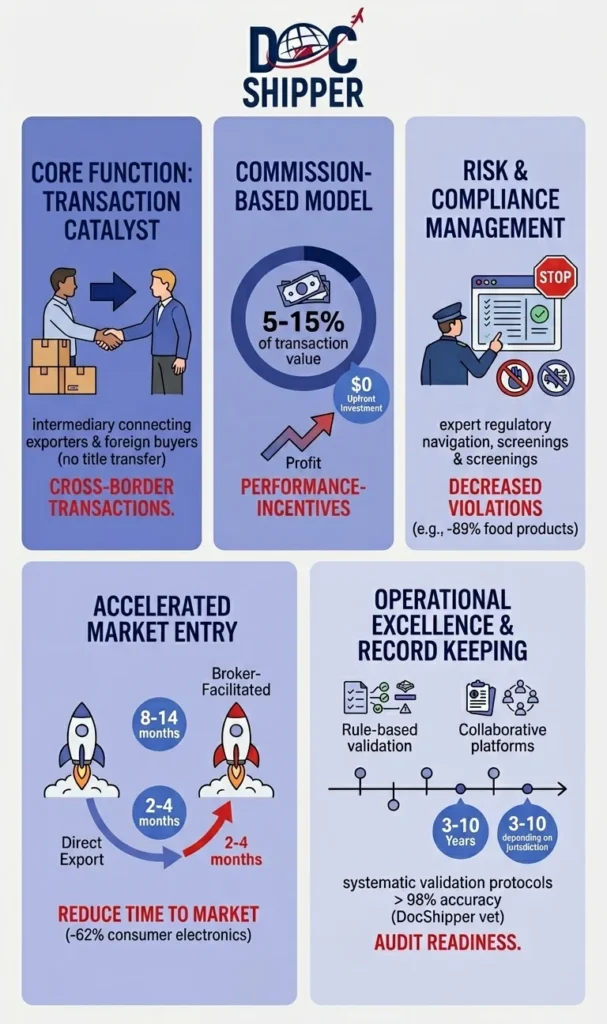
An export broker is an intermediary who facilitates international trade transactions by connecting exporters with foreign buyers without taking ownership of goods. They earn commissions by negotiating deals, identifying markets, and managing documentation, acting as crucial facilitators in cross-border commerce for businesses lacking direct export capabilities or market knowledge.
Introduction
Many manufacturers struggle to navigate international markets. They possess quality products but lack connections, market intelligence, or export documentation expertise. This knowledge gap costs businesses millions in lost opportunities annually.
Export brokers bridge this critical divide. They transform domestic businesses into global competitors without requiring massive infrastructure investments. Their expertise accelerates market entry while minimizing risk exposure.
Key characteristics of export brokers include:
- Commission-based compensation: Typically 5-15% of transaction value, aligning their success with yours
- Market specialization: Deep knowledge of specific geographic regions or product categories
- Network leverage: Established relationships with verified international buyers
- Risk mitigation: Pre-vetting buyers and facilitating secure payment structures
- Documentation expertise: Managing complex export paperwork and compliance requirements
In-Depth Analysis & Expertise
Export brokers operate as transaction catalysts rather than traditional distributors. Unlike export agents who may represent buyers, brokers specifically work on behalf of exporters. They never take title to goods, which fundamentally differentiates them from trading companies or merchant exporters.
The broker’s primary function involves market intelligence gathering. They continuously research emerging opportunities, regulatory changes, and buyer demand patterns. This intelligence allows them to match products with appropriate markets faster than most manufacturers could independently.
Negotiation and deal structuring represent core competencies. Brokers mediate pricing discussions, payment terms, and delivery schedules. Their neutrality often facilitates agreements that direct manufacturer-buyer negotiations would struggle to achieve. They understand cultural business practices across markets, preventing misunderstandings that derail transactions.
According to the U.S. International Trade Administration, brokers must navigate increasingly complex regulatory landscapes. They ensure compliance with export controls, sanctions screening, and destination country import requirements. This compliance oversight protects exporters from costly violations.
Financial arrangement coordination constitutes another critical role. Brokers facilitate letters of credit, documentary collections, and payment guarantee structures. They work with freight forwarders and customs brokers to ensure seamless logistics coordination.
At DocShipper, we collaborate with certified export brokers to extend our clients’ market reach. When our customers need specialized market connections beyond our direct service network, we coordinate with vetted brokers who complement our logistics expertise, ensuring end-to-end transaction success.
Concrete Examples & Data
Real-world scenarios demonstrate how export brokers create tangible value. Consider these documented cases that illustrate their impact across different industries and transaction types.
Case Study: Agricultural Equipment Manufacturer
A mid-sized U.S. agricultural equipment manufacturer with $12 million annual domestic revenue sought to enter West African markets. Lacking international experience, they engaged an export broker specializing in agricultural machinery.
Broker actions: Identified three qualified buyers in Nigeria and Ghana within 45 days. Negotiated initial orders totaling $890,000. Structured payment through confirmed letters of credit, eliminating non-payment risk. Coordinated with freight forwarders for container shipping and customs clearance.
Results: The manufacturer achieved 7.4% revenue growth through export sales in year one. Broker commission of $71,200 was offset by profits exceeding $245,000. The relationship expanded to five additional African markets within 18 months.
Comparative Analysis: Direct Export vs. Broker-Facilitated Export
| Factor | Direct Export | Broker-Facilitated |
|---|---|---|
| Time to First Sale | 8-14 months | 2-4 months |
| Upfront Investment | $50,000-$150,000 | $0 (commission-based) |
| Market Research Cost | $15,000-$40,000 | Included in commission |
| Buyer Verification | Self-managed (high risk) | Pre-vetted network |
| Commission/Cost | N/A | 5-15% of transaction |
Industry-Specific Performance Data
According to international trade statistics, broker effectiveness varies by sector:
- Consumer electronics: Brokers reduce market entry time by 62% compared to independent efforts
- Industrial equipment: Average commission rate of 8.5% generates ROI of 3.2:1 within first year
- Food products: Brokers with regulatory expertise reduce compliance violations by 89%
- Textiles and apparel: Broker-facilitated transactions show 34% higher order repeat rates
- Automotive parts: Quality control coordination through brokers decreases rejection rates by 41%
These metrics demonstrate that while brokers add transaction costs, they typically deliver net positive financial outcomes through accelerated revenue generation and risk reduction.
Conclusion
Export brokers serve as essential intermediaries that democratize international trade access. They transform export complexity into manageable processes, enabling businesses of all sizes to compete globally without prohibitive infrastructure investments.
Need guidance on leveraging export brokers or managing your international logistics? Contact DocShipper for expert consultation on optimizing your export strategy.
📚 Quiz
Test Your Knowledge: Export Broker
What is the fundamental characteristic that defines an export broker?
What is the key difference between an export broker and an export agent?
A small manufacturing company wants to enter international markets but has limited capital for upfront investment. Which approach would be most appropriate?
🎯 Your Result
📞 Free Quote in 24hFAQ | Export Broker: Definition, Role & Concrete Examples
An export broker works on behalf of the exporter to find buyers and facilitate transactions without taking title to goods. They earn commissions from sellers. Export agents, conversely, typically represent foreign buyers seeking suppliers. Agents may work on retainer or commission but represent buyer interests. Brokers maintain seller loyalty and focus on maximizing exporter profitability, while agents prioritize buyer satisfaction and sourcing efficiency.
Export broker commissions range from 5% to 15% of the transaction value, depending on complexity, market difficulty, and relationship longevity. Simple commodity exports to established markets might command 5-7%, while specialized products entering emerging markets with regulatory challenges can justify 12-15%. Some brokers negotiate tiered structures where commission percentages decrease as transaction volumes increase. Initial deals often carry higher rates to compensate for prospecting efforts.
Export licensing requirements depend on your product classification and destination country, not whether you use a broker. Brokers assist with determining if licenses are necessary under Export Administration Regulations (EAR) or International Traffic in Arms Regulations (ITAR). Most commercial goods require no license, but controlled items like certain technologies, chemicals, or defense articles do. Your broker should guide you through screening processes and application procedures if licenses are required.
Yes, experienced export brokers facilitate secure payment structures. They coordinate letters of credit through banks, ensuring payment upon document presentation. They structure documentary collections that release goods only after payment. Many brokers maintain relationships with trade finance institutions and can arrange export credit insurance. Their buyer vetting processes also reduce non-payment risk by working only with financially verified international purchasers.
Check registration with relevant trade authorities in your jurisdiction. In the U.S., verify membership with organizations like the National Association of Export Companies (NEXCO) or Federation of International Trade Associations (FITA). Request references from previous clients in your industry. Confirm their insurance coverage, including errors and omissions policies. Review their market specialization against your needs. Legitimate brokers provide transparent contracts outlining commission structures and responsibilities.
Export brokers excel with specialized industrial equipment, manufactured goods with technical specifications, agricultural products requiring market knowledge, and consumer goods targeting niche international markets. Products requiring regulatory navigation, quality certifications, or complex logistics benefit most. Commodity products with transparent pricing and established markets may not justify broker commissions. High-value, differentiated products where broker expertise adds significant transaction facilitation value are ideal candidates.
Initial qualified lead generation typically occurs within 4-8 weeks for brokers with established networks. First transactions usually close within 2-4 months, depending on product complexity and buyer decision cycles. Industrial equipment sales may require 6-9 months due to capital investment approval processes. Consumer goods can move faster, sometimes achieving sales within 6-8 weeks. Brokers should provide timeline expectations during initial consultations based on your specific product and target markets.
Yes, but structure agreements carefully to avoid conflicts. Assign different geographic territories or product lines to each broker. Clearly define exclusive versus non-exclusive arrangements in contracts. Implement protected customer clauses preventing commission disputes when multiple brokers contact the same buyer. Some exporters use primary brokers for core markets and secondary brokers for exploratory regions. Transparency with all parties prevents relationship damage and legal complications.
Most export brokers coordinate logistics but don't directly execute shipping. They work with freight forwarders, customs brokers, and carriers to arrange transportation. Their role involves selecting logistics partners, obtaining quotes, and ensuring documentation flows correctly. Some full-service brokers offer integrated logistics, but typically they focus on commercial transaction facilitation while partnering with specialized logistics providers. Clarify logistics responsibilities in your broker agreement to avoid service gaps.
Broker liability depends on contract terms and failure cause. If failure results from misrepresentation by the broker, they may face liability for damages. Payment default by buyers typically isn't broker responsibility unless they provided financial guarantees. Quality disputes between parties usually require resolution through existing contracts. Reputable brokers assist with problem resolution even when not contractually obligated. Well-structured agreements should define failure scenarios and corresponding responsibilities for all parties.
Export brokers aren't universally regulated like customs brokers or freight forwarders. However, they must comply with export control laws, sanctions regulations, and anti-corruption statutes like the Foreign Corrupt Practices Act. Some countries require business licenses for brokerage activities. Industry associations provide voluntary certifications and ethical guidelines. Brokers facilitating specific products (agriculture, pharmaceuticals) may need sector-specific authorizations. Always verify your broker complies with applicable laws in both origin and destination countries.
Absolutely. Export brokers provide small businesses access to international markets without requiring large export departments. The commission structure means no upfront costs, making international expansion financially accessible. Brokers' existing buyer networks accelerate market entry that would take small businesses years to develop independently. They level the playing field against larger competitors with established export infrastructure. Many brokers specialize in representing small to medium enterprises, understanding their unique constraints and capabilities.
Need Help with
Logistics or Sourcing ?
First, we secure the right products from the right suppliers at the right price by managing the sourcing process from start to finish. Then, we simplify your shipping experience - from pickup to final delivery - ensuring any product, anywhere, is delivered at highly competitive prices.


Fill the Form
Prefer email? Send us your inquiry, and we’ll get back to you as soon as possible.
Contact us




