


In short ⚡
An Export Sales Contract is a legally binding agreement between a seller and a foreign buyer that defines the terms of an international sale. It specifies product details, pricing, delivery conditions, payment terms, and responsibilities of each party, providing legal protection and reducing trade risks in cross-border transactions.
Introduction
Many exporters underestimate the legal complexity of international sales, relying on verbal agreements or informal emails. This approach exposes businesses to payment disputes, delivery conflicts, and unenforceable claims across jurisdictions. Without a properly structured export sales contract, recovering damages or proving contractual obligations becomes extremely difficult.
In global trade, the export sales contract serves as the foundation for all commercial transactions. It protects both parties by clearly defining expectations, mitigating risks related to currency fluctuations, regulatory compliance, and logistical failures. Whether shipping machinery to Germany or electronics to Brazil, this document ensures all parties understand their obligations.
Key characteristics of an effective export sales contract include:
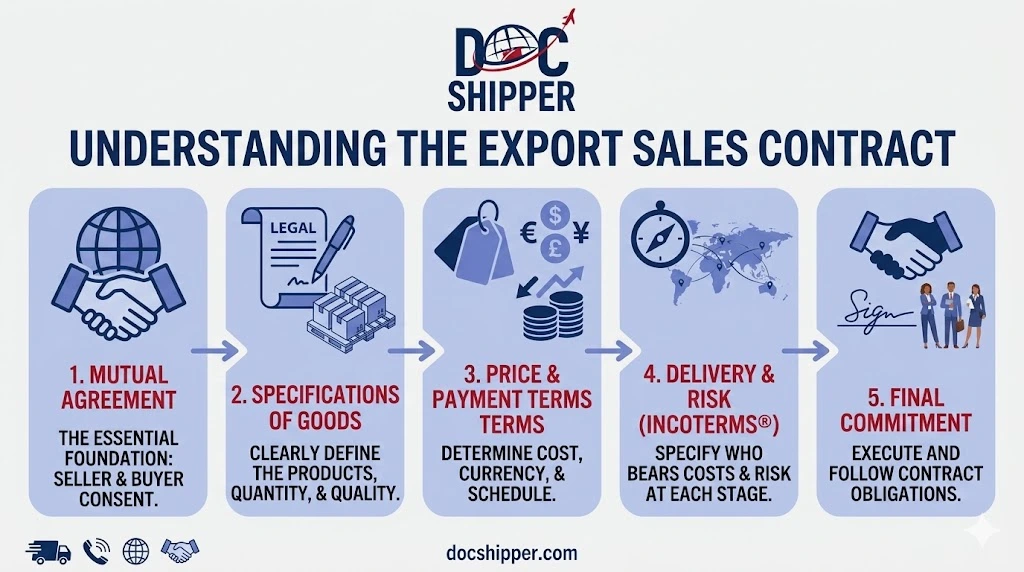
- Clear product specifications – detailed descriptions, quantities, quality standards, and technical requirements
- Precise delivery terms – Incoterms designation (FOB, CIF, DDP, etc.) defining risk transfer points
- Payment conditions – currency, method (L/C, wire transfer, open account), schedule, and guarantees
- Legal jurisdiction – governing law and dispute resolution mechanisms (arbitration, specific courts)
- Force majeure clauses – protections against unforeseeable events disrupting contract execution
Essential Clauses & Legal Framework
A robust export sales contract must address multiple dimensions beyond basic pricing. The product description clause requires technical precision—generic descriptions like “industrial equipment” are insufficient. Include model numbers, specifications, compliance certifications (CE, UL, ISO), and quality benchmarks to prevent disputes.
The Incoterms clause is critical for defining responsibility boundaries. Under FOB (Free On Board), the seller’s obligation ends when goods cross the ship’s rail at the departure port. With DDP (Delivered Duty Paid), the seller assumes all costs and risks until goods reach the buyer’s premises. Misunderstanding these terms causes 30% of international trade disputes according to ICC data.
Payment terms require careful structuring based on trust levels and transaction size. Letters of Credit offer security for both parties but add $500-$2,000 in banking fees. Documentary collections provide moderate protection at lower cost. Open account terms favor the buyer but expose sellers to non-payment risk. At DocShipper, we systematically review payment clauses to ensure they align with the chosen Incoterm and protect our clients’ cash flow.
The inspection and acceptance clause establishes quality control procedures. It should specify who conducts inspections (third-party surveyor, buyer representative), when they occur (pre-shipment, upon arrival), and how discrepancies are resolved. Include timeframes for claims—typically 7-15 days after delivery for visible defects, 30-60 days for hidden defects.
Dispute resolution mechanisms prevent costly litigation. International arbitration through bodies like the International Chamber of Commerce provides neutral ground. Specify the arbitration location, language, and applicable rules. The governing law clause determines which country’s commercial code applies—often a neutral jurisdiction rather than either party’s home country.
Practical Examples & Contract Scenarios
Consider a French manufacturer exporting textile machinery to India. The contract specifies EUR 250,000 CIF Mumbai. This means the seller covers freight and insurance to Mumbai port, but risk transfers when goods are loaded in Le Havre. Payment terms: 30% advance, 60% against shipping documents, 10% after installation. The inspection clause requires buyer approval within 10 days of delivery, with third-party testing for mechanical specifications.
Compare this to a software export scenario. A US company sells enterprise software to a Brazilian client under DDP São Paulo terms. The contract value is USD 180,000, paid via wire transfer in three installments: upon signature, upon delivery of source code, and after 90-day warranty period. Since software involves intellectual property, the contract includes extensive licensing terms, restrictions on reverse engineering, and confidentiality clauses.
| Contract Element | Physical Goods (Machinery) | Digital Goods (Software) |
|---|---|---|
| Incoterm | CIF, FOB, DDP (physical transfer) | Not applicable—delivery via download |
| Inspection | Physical inspection, testing protocols | Functionality testing, performance benchmarks |
| Warranty | 12-24 months for parts/labor | Bug fixes, updates, support period |
| Risk Transfer | At specified shipping point | Upon successful download/installation |
| Key Clauses | Packaging, transport insurance | IP rights, licensing restrictions |
A practical challenge involves currency fluctuation protection. If a contract signed in January specifies EUR 100,000 with payment in June, a 5% currency shift could cost either party EUR 5,000. Solutions include currency hedging clauses, price adjustment formulas tied to exchange rates, or payment in a stable third currency like USD or CHF.
Documentation requirements vary by destination. Exporting pharmaceuticals to Saudi Arabia requires certificate of origin, health certificates, halal certification, and import permits. The contract should specify which party obtains each document and deadlines for submission. At DocShipper, we coordinate all documentation requirements to prevent customs delays that could trigger penalty clauses.
Key contract management practices include:
- Amendment protocols – formal procedures for modifying terms, requiring written consent from both parties
- Performance guarantees – bank guarantees or surety bonds ensuring contract fulfillment
- Penalty clauses – liquidated damages for late delivery, typically 0.5-2% of contract value per week
- Termination rights – conditions allowing contract cancellation (bankruptcy, breach, force majeure)
- Confidentiality obligations – protection of technical data, pricing, and business information
Conclusion
The export sales contract is not merely administrative paperwork—it is the legal backbone of international trade. A well-drafted contract prevents disputes, clarifies responsibilities, and provides enforceable remedies when issues arise. Investing time in proper contract structure saves significantly more in avoided conflicts and legal costs.
Need assistance drafting or reviewing your export sales contracts? Contact DocShipper for expert guidance on international trade documentation and compliance.
📚 Quiz
Test Your Knowledge: Export Sales Contract
What is the primary legal function of an Export Sales Contract in international trade?
According to the article, what percentage of international trade disputes result from misunderstanding Incoterms?
A French exporter and Brazilian buyer verbally agree on delivery terms via phone. Which statement correctly describes this situation?
🎯 Your Result
📞 Free Personalized QuoteFAQ | Export Sales Contract: Definition, Key Clauses & Practical Examples
A proforma invoice is a preliminary sales document providing estimated pricing and terms, while an export sales contract is a legally binding agreement. The proforma serves as a quotation; the contract establishes enforceable obligations. Many transactions begin with a proforma, then finalize with a detailed contract once terms are negotiated.
Incoterm selection depends on your risk tolerance, logistics capabilities, and buyer preferences. FOB minimizes seller responsibility (suitable for experienced exporters), while DDP maximizes seller control but increases cost and complexity. CIF offers balanced risk-sharing for ocean shipments. Consider your insurance coverage, customs expertise, and market practices in the destination country.
Protection mechanisms include Letters of Credit (highest security, moderate cost), documentary collections (medium security, lower cost), export credit insurance, advance payment requirements, or bank guarantees. The appropriate method depends on transaction value, buyer creditworthiness, and relationship history. Combining methods—like 30% advance plus L/C for balance—provides layered protection.
If a buyer unjustifiably refuses delivery, the seller may claim damages including storage costs, return shipping, price differences if resold, and lost profits. The contract should specify dispute resolution procedures and applicable law. Sellers may also have rights to resell goods and claim deficiency. Documentation proving contract breach is essential for legal recourse.
For high-value or complex transactions, legal review is advisable. Lawyers familiar with international trade can identify jurisdiction-specific risks, ensure compliance with export controls, and draft enforceable clauses. For routine, lower-value transactions, standardized templates adapted to your specific terms may suffice. Always ensure contracts comply with both origin and destination country regulations.
Yes, if the email exchange demonstrates offer, acceptance, consideration, and intent to be bound. However, emails often lack comprehensive terms, creating ambiguity. Courts have enforced email agreements, but proving exact terms can be difficult. Formal contracts with signatures provide clearer evidence and more detailed protections, reducing litigation risk significantly.
A force majeure clause excuses contract performance when unforeseeable events beyond parties' control occur—natural disasters, wars, pandemics, or government actions. It prevents breach penalties during these circumstances. The clause should define qualifying events, notification requirements, and whether the contract suspends temporarily or terminates. The COVID-19 pandemic highlighted the critical importance of well-drafted force majeure provisions.
Contract duration depends on transaction type. One-time sales typically remain valid from signing through delivery and warranty period completion. Long-term supply agreements may span 1-5 years with renewal options. Include specific start and end dates, delivery schedules, and provisions for early termination. Time-sensitive elements like pricing or exchange rates may require shorter validity periods or adjustment clauses.
The governing law clause determines which country's legal system interprets the contract. Neutral jurisdictions like UK, Switzerland, or Singapore are common choices. Consider the predictability of the legal system, ease of enforcement, and whether the jurisdiction has ratified international conventions like the Vienna Convention on Contracts. Avoid automatic default to either party's home country to maintain perceived fairness.
Pre-shipment inspection allows defect correction before goods leave, reducing return shipping costs and delays. Post-delivery inspection may be necessary for perishable goods or when full testing requires installation. Many contracts include both—pre-shipment for visible defects, post-delivery for functionality testing. Specify who pays inspection costs (often the buyer) and acceptable timeframes for raising claims.
Liquidated damages are predetermined compensation amounts for specific contract breaches, typically late delivery. Instead of proving actual damages, the aggrieved party receives the agreed sum (e.g., 1% of contract value per week of delay, capped at 10%). This clause provides certainty and avoids lengthy damage calculations. Courts enforce reasonable liquidated damages but may reject amounts deemed punitive rather than compensatory.
All contract modifications should be documented in writing through formal amendments signed by both parties. Verbal changes are difficult to enforce and create disputes. The amendment should reference the original contract, specify exact changes, and confirm all other terms remain unchanged. Maintain a complete file of the original contract plus all amendments to track the evolving agreement accurately.
Need Help with
Logistics or Sourcing ?
First, we secure the right products from the right suppliers at the right price by managing the sourcing process from start to finish. Then, we simplify your shipping experience - from pickup to final delivery - ensuring any product, anywhere, is delivered at highly competitive prices.


Fill the Form
Prefer email? Send us your inquiry, and we’ll get back to you as soon as possible.
Contact us




