


In short ⚡
The Extended Enterprise is a collaborative business model where a company integrates external partners—suppliers, distributors, logistics providers, and even customers—into its core operations and information systems. This approach creates a unified ecosystem that optimizes supply chain efficiency, reduces costs, and enhances responsiveness across the entire value network.
Introduction
Most international traders struggle with fragmented communication between their suppliers, freight forwarders, and customs agents. Information silos create delays, errors, and hidden costs that erode profit margins.
The Extended Enterprise model addresses this challenge by breaking down organizational boundaries. Rather than treating partners as external entities, businesses integrate them into a shared operational framework.
This concept is particularly relevant in international logistics where:
- Real-time visibility across borders prevents shipment disruptions
- Collaborative planning reduces inventory holding costs by 15-25%
- Shared data platforms eliminate redundant documentation processes
- Risk mitigation improves through distributed responsibility networks
- Faster innovation cycles emerge from partner co-development initiatives
In-depth Analysis & Strategic Implementation
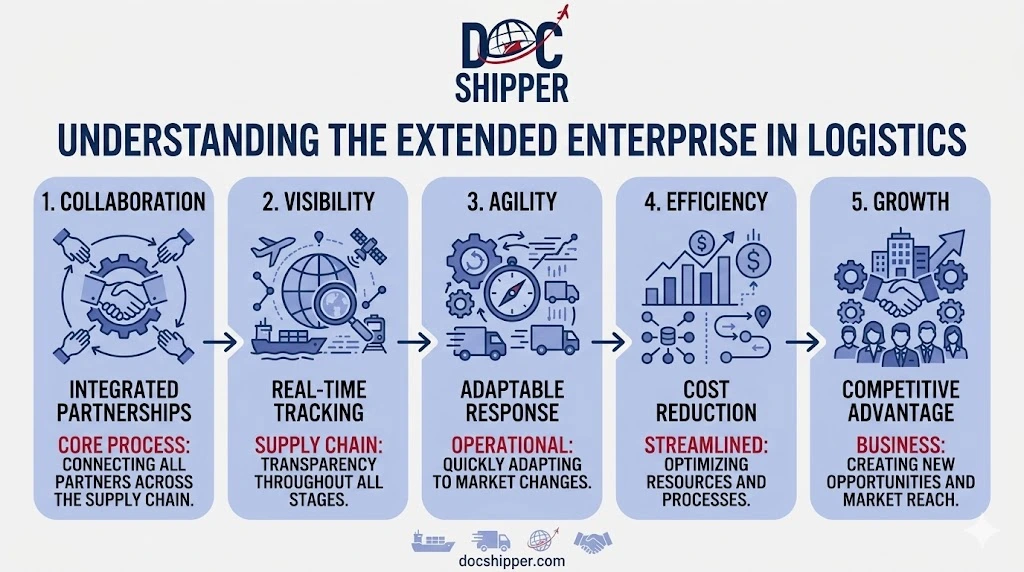
The Extended Enterprise operates on five fundamental pillars that distinguish it from traditional supply chain relationships.
Information system integration forms the technical backbone. Companies deploy Enterprise Resource Planning (ERP) systems with API connections to partner platforms. This enables automatic purchase order transmission, shipment tracking updates, and invoice reconciliation without manual intervention.
Governance frameworks establish clear roles and decision rights. Unlike conventional contracts that focus on transactional terms, Extended Enterprise agreements define collaborative processes, data sharing protocols, and joint performance metrics. The WTO Trade Facilitation Agreement encourages such collaborative customs procedures between public and private sectors.
Risk-sharing mechanisms align incentives across the network. Partners commit to service level agreements with mutual penalties and bonuses. For example, a logistics provider might guarantee 98% on-time delivery, while the shipper ensures accurate documentation—both parties benefit from reduced claim costs.
Cultural alignment proves more challenging than technical integration. Organizations must shift from competitive negotiation mindsets to collaborative problem-solving. This requires executive sponsorship, cross-company training programs, and transparent communication channels.
Continuous improvement processes leverage collective intelligence. Regular business reviews analyze end-to-end performance data to identify bottlenecks. A manufacturer might discover that their packaging specifications cause warehouse inefficiencies at the distributor’s facility—a problem only visible through shared metrics.
At DocShipper, we facilitate Extended Enterprise models by acting as the central coordination hub. Our platform connects manufacturers, freight forwarders, customs brokers, and final delivery agents into a single visibility system. Clients access real-time cargo status regardless of which partner handles each leg.
Concrete Examples & Performance Data
Quantitative evidence demonstrates the Extended Enterprise’s impact on operational efficiency and cost structures.
Automotive sector implementation: A European car manufacturer integrated 47 tier-1 suppliers into its production planning system. The result: inventory levels dropped by 22% while production line stoppages decreased from 8 per month to fewer than 2. The company eliminated €12 million in annual holding costs.
Fashion retail case study: A fast-fashion brand connected Asian suppliers with European distribution centers through shared forecasting tools. Order-to-shelf time decreased from 45 days to 28 days. When demand patterns shifted unexpectedly, the network adjusted production volumes within 72 hours—impossible under traditional buyer-supplier relationships.
Electronics logistics comparison:
| Metric | Traditional Model | Extended Enterprise |
|---|---|---|
| Shipment visibility updates | Every 3-5 days | Real-time |
| Documentation errors | 6.2% | 1.8% |
| Average claim resolution time | 18 days | 6 days |
| Supply chain cost as % of revenue | 11.4% | 8.7% |
| Partner onboarding time | 45-60 days | 12-18 days |
Pharmaceutical cold chain scenario: A biotech company transporting temperature-sensitive vaccines implemented an Extended Enterprise approach with its 3PL provider and airport handling agents. IoT sensors transmitted temperature data to all parties simultaneously. When a refrigeration unit malfunctioned in Frankfurt, the system automatically rerouted the shipment through Amsterdam with replacement cooling equipment prepared in advance. Product loss: zero. Under the previous model, such incidents resulted in average losses of $340,000 per occurrence.
E-commerce fulfillment network: An online marketplace integrated 200+ third-party sellers with regional warehouses operated by five different logistics providers. The platform’s algorithm automatically selects optimal inventory positioning based on demand forecasts shared across the network. This reduced average delivery times from 4.2 days to 2.1 days while cutting transportation costs by 19%.
Conclusion
The Extended Enterprise transforms supply chain relationships from transactional exchanges into strategic partnerships. Companies that successfully implement this model achieve measurable improvements in cost efficiency, speed, and risk management.
Need support building your Extended Enterprise network? Contact DocShipper to discuss integration solutions tailored to your logistics ecosystem.
📚 Quiz
Test Your Knowledge: Extended Enterprise
What distinguishes the Extended Enterprise model from traditional supply chain relationships?
A company implements API connections between its ERP system and partner platforms. Which Extended Enterprise pillar does this represent?
Your pharmaceutical company experiences a refrigeration failure during vaccine transport. In an Extended Enterprise model, what happens?
🎯 Your Result
📞 Free Quote in 24hFAQ | Extended Enterprise: Definition, Implementation & Concrete Examples
Cloud-based ERP systems, API gateways, Electronic Data Interchange (EDI), blockchain for document verification, and IoT sensors form the core technology stack. Modern platforms use microservices architecture to connect disparate partner systems without requiring complete infrastructure overhauls.
Outsourcing transfers specific functions to external providers who operate independently. Extended Enterprise maintains strategic control while integrating partners into collaborative processes. Partners access your planning data and contribute to decision-making rather than simply executing predefined tasks.
Data security concerns, incompatible IT systems, organizational resistance to transparency, and complex governance structures create barriers. Successful implementations address these through phased rollouts, robust cybersecurity protocols, change management programs, and clear contractual frameworks defining data ownership and usage rights.
Pilot programs with 3-5 key partners require 6-9 months. Full network integration across 20+ partners may span 18-24 months. Timeline depends on existing IT infrastructure maturity, partner readiness levels, and scope of process redesign required.
Absolutely. Cloud-based platforms democratize access to enterprise-grade collaboration tools. SMEs often implement Extended Enterprise principles more quickly due to less organizational complexity. Freight forwarding aggregators like DocShipper provide turnkey solutions that connect smaller shippers with global logistics networks.
Key performance indicators include perfect order rate, cash-to-cash cycle time, supply chain cost as percentage of revenue, partner collaboration index, innovation cycle time, and network resilience scores. Leading organizations track end-to-end visibility percentage and collaborative forecast accuracy rates.
Shared documentation platforms reduce declaration errors by ensuring consistent data across all parties. When customs brokers access the same product specifications and origin certificates as manufacturers, classification disputes decrease. Authorized Economic Operator (AEO) programs recognize Extended Enterprise governance as evidence of supply chain security.
Vested agreements, gain-sharing contracts, and consortium models replace traditional service agreements. These frameworks define shared objectives, transparent cost structures, joint investment commitments, and dispute resolution mechanisms. Intellectual property clauses address collaborative innovation ownership.
Role-based access controls limit data visibility to need-to-know basis. Blockchain smart contracts automate information sharing based on predefined triggers without exposing underlying strategic data. Trusted third-party platforms aggregate sensitive information into anonymized benchmarks that benefit all parties.
No. Most companies maintain multi-sourcing strategies while creating deeper integration with preferred partners. The model allows tiered relationships where strategic suppliers receive full system access while transactional vendors use standard interfaces. This balances collaboration benefits with supply chain resilience.
Integrated systems track carbon emissions, ethical sourcing certifications, and circular economy metrics across the entire value chain. Partners contribute environmental data to consolidated ESG reports. This transparency helps companies meet regulatory requirements like the EU Corporate Sustainability Reporting Directive (CSRD).
Freight forwarders act as orchestration hubs connecting multiple network participants. They provide neutral platforms for data exchange, manage cross-border compliance, and coordinate physical flows. Advanced providers like DocShipper offer value-added services including demand forecasting, inventory optimization, and network design consulting.
Need Help with
Logistics or Sourcing ?
First, we secure the right products from the right suppliers at the right price by managing the sourcing process from start to finish. Then, we simplify your shipping experience - from pickup to final delivery - ensuring any product, anywhere, is delivered at highly competitive prices.


Fill the Form
Prefer email? Send us your inquiry, and we’ll get back to you as soon as possible.
Contact us




