


In short ⚡
The Federal Aviation Administration (FAA) is the U.S. government agency responsible for regulating civil aviation safety, airspace management, and air traffic control operations. Established in 1958, the FAA sets stringent standards for aircraft certification, pilot licensing, and cargo operations—directly impacting international air freight logistics and compliance requirements for importers and exporters.
Introduction
Every year, over 30 million tons of air cargo move through U.S. airports. Behind this massive flow lies a complex regulatory system governed by the FAA. Whether you’re shipping electronics from China or machinery to Europe, understanding FAA regulations is essential to avoid delays, fines, or confiscated goods.
The FAA’s reach extends far beyond domestic flights. It influences international air freight through bilateral agreements, safety standards, and certification requirements. For businesses engaged in cross-border trade, navigating FAA compliance is non-negotiable.
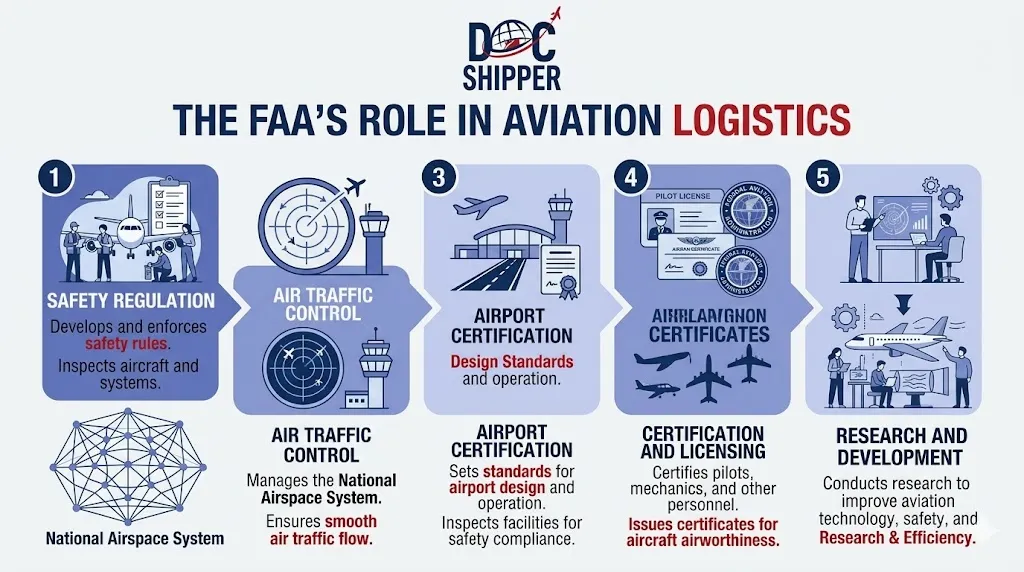
Key aspects of the FAA’s role in logistics include:
- Aircraft safety certification — ensuring cargo planes meet airworthiness standards
- Hazardous materials transport — enforcing strict rules on dangerous goods (batteries, chemicals, etc.)
- Airspace management — coordinating efficient routing for cargo flights
- Security screening protocols — implementing TSA-aligned cargo security measures
- International cooperation — harmonizing standards with ICAO (International Civil Aviation Organization)
FAA Regulatory Framework & Expertise
The FAA operates under Title 14 of the Code of Federal Regulations (14 CFR), which contains thousands of pages detailing aviation safety requirements. For air freight professionals, three areas demand particular attention: aircraft certification, hazmat compliance, and cargo security.
First, every aircraft carrying commercial cargo must hold a valid Type Certificate and Airworthiness Certificate issued by the FAA. This applies to both U.S.-registered aircraft and foreign carriers operating into American airspace. The certification process examines structural integrity, engine performance, and emergency systems. Airlines must also maintain continuous compliance through regular inspections documented in detailed maintenance logs.
Second, the FAA enforces the Hazardous Materials Regulations (HMR) under 49 CFR, in coordination with the Pipeline and Hazardous Materials Safety Administration (PHMSA). Lithium batteries, aerosols, flammable liquids, and other dangerous goods require specific packaging, labeling, and documentation. Violations carry penalties up to $83,000 per incident, with criminal charges possible for severe cases. The FAA publishes its Hazmat Safety Portal as the authoritative resource.
Third, the Air Cargo Security Program mandates screening of all cargo on passenger aircraft and certain all-cargo flights. This includes physical inspection, X-ray scanning, or explosive detection systems. Freight forwarders must be certified as Certified Cargo Screening Facilities (CCSF) or work with approved agents. At DocShipper, we verify CCSF credentials for all our air freight partners to ensure seamless customs clearance and regulatory compliance.
The FAA also plays a crucial role in international harmonization. Through bilateral aviation safety agreements (BASAs), the FAA recognizes certifications from equivalent foreign authorities like EASA (European Union Aviation Safety Agency). This reciprocity reduces redundant inspections but still requires shippers to understand country-specific nuances in documentation and labeling.
For businesses, staying compliant means working with experienced logistics providers. DocShipper’s team continuously monitors FAA regulatory updates, ensuring your shipments meet the latest standards—from initial booking through final delivery. This proactive approach minimizes the risk of costly ground delays or rejected cargo.
Practical Examples & Data for Shippers
Understanding FAA regulations becomes clearer through real-world scenarios. Let’s examine three common situations where FAA rules directly impact air freight operations.
Use Case 1: Lithium Battery Shipments
A consumer electronics manufacturer ships 5,000 power banks from Shenzhen to Los Angeles. Each unit contains a 20Wh lithium-ion battery. Under FAA and IATA rules, batteries between 2.7Wh and 100Wh must be packaged in UN-certified boxes (UN3480 or UN3481 markings). The shipper must provide a Shipper’s Declaration for Dangerous Goods and ensure batteries are at 30% charge or less to reduce fire risk.
Failure to comply results in cargo rejection at origin or confiscation upon arrival. In 2022, the FAA reported over 400 incidents involving improperly shipped batteries, leading to emergency landings and aircraft damage. Proper classification and packaging through a certified handler like DocShipper eliminates this risk entirely.
Use Case 2: Temperature-Controlled Pharmaceuticals
A pharmaceutical company transports COVID-19 vaccines requiring storage between -80°C and -60°C. The FAA mandates that aircraft cargo holds maintain environmental controls and that carriers provide real-time temperature monitoring. Airlines must also have FAA-approved emergency response protocols for refrigeration system failures.
Additionally, the cargo must comply with FDA regulations upon landing, requiring seamless coordination between FAA-certified carriers and customs brokers. DocShipper manages this multi-agency compliance process, ensuring your cold chain remains unbroken from departure to delivery.
Comparative Table: FAA vs. EASA Cargo Requirements
| Aspect | FAA (United States) | EASA (European Union) |
|---|---|---|
| Hazmat Classification | 49 CFR / IATA DGR | ICAO TI / IATA DGR |
| Lithium Battery Limits | Max 100Wh (standalone) | Max 100Wh (standalone) |
| Security Screening | TSA-approved methods | EU ACC3 certification |
| Documentation Language | English mandatory | English + local language |
| Penalty Range | Up to $83,000 per violation | Varies by member state |
This table highlights both alignment and divergence. While FAA and EASA largely follow ICAO standards, procedural differences require shippers to adapt documentation, packaging, and carrier selection based on destination.
Key Statistics on FAA Air Cargo Operations
- 42 billion pounds of cargo passed through U.S. airports in 2023
- The FAA oversees 45,000 flights daily, including cargo and passenger services
- Hazmat violations decreased 18% from 2020 to 2023 due to improved training programs
- Average clearance time for compliant cargo: 2-4 hours; non-compliant: 24-72 hours
- Over 1,200 certified cargo screening facilities operate nationwide
These figures underscore the FAA’s critical role in maintaining safe, efficient air freight networks. Partnering with a compliance-focused provider like DocShipper ensures your shipments meet every standard, reducing delays and maximizing supply chain predictability.
Conclusion
The Federal Aviation Administration shapes every aspect of air cargo logistics, from aircraft safety certifications to hazmat handling protocols. For importers and exporters, FAA compliance isn’t optional—it’s the foundation of reliable, lawful air freight operations.
Need guidance navigating FAA regulations for your next shipment? Contact DocShipper today. Our experts ensure full compliance, from documentation to delivery, so your cargo moves smoothly across borders.
📚 Quiz
Test Your Knowledge: Federal Aviation Administration (FAA)
What is the primary role of the Federal Aviation Administration (FAA)?
Which statement correctly describes the FAA's enforcement authority regarding hazardous materials in air cargo?
A manufacturer needs to ship 5,000 power banks containing 20Wh lithium-ion batteries from China to the United States. What is required for FAA compliance?
🎯 Your Result
📞 Free Quote in 24hFAQ | Federal Aviation Administration (FAA): Definition, Role & Impact on Air Freight
The FAA is the national aviation authority for the United States, while ICAO (International Civil Aviation Organization) is a UN agency setting global standards. The FAA implements ICAO guidelines domestically but adds specific U.S. requirements, such as TSA security mandates. International shippers must comply with both ICAO baseline rules and FAA-specific regulations when cargo touches U.S. airspace.
You don't need direct FAA approval, but your shipment must comply with 49 CFR and IATA Dangerous Goods Regulations. This includes proper classification (UN3480/UN3481), certified packaging, accurate labeling, and a Shipper's Declaration. Airlines verify compliance before accepting cargo. Working with a certified freight forwarder like DocShipper simplifies this process significantly.
The FAA issues regulatory updates continuously through Notices to Airmen (NOTAMs), Advisory Circulars, and formal rulemaking. Major revisions to hazmat rules typically align with ICAO's biennial amendment cycles. Shippers should monitor the FAA's website or subscribe to industry alerts. DocShipper's compliance team tracks these changes in real time, ensuring your shipments always meet current standards.
Violations can result in cargo rejection, shipment delays, fines up to $83,000 per incident, and potential criminal charges for severe cases (e.g., undeclared explosives). The FAA maintains an enforcement database, and repeat offenders face escalating penalties. Proper documentation and pre-shipment audits minimize this risk. DocShipper conducts compliance checks before every air freight booking.
No. Foreign carriers must obtain FAA operational approval through a Foreign Air Carrier Permit or exemption under Part 129 regulations. The FAA evaluates the carrier's home country safety oversight, aircraft maintenance programs, and crew qualifications. Bilateral aviation agreements streamline this process for airlines from countries with equivalent safety standards, like EU member states or Japan.
A CCSF is a TSA-approved facility authorized to screen cargo before it enters the air transportation system. CCSFs must implement strict security protocols, including background checks for personnel and documented screening procedures. Using CCSF-screened cargo accelerates customs clearance and reduces inspection delays. DocShipper partners exclusively with certified facilities to ensure your shipments meet security requirements.
Yes. The FAA oversees commercial unmanned aircraft systems (UAS) under Part 107 regulations. Companies conducting drone cargo deliveries need FAA waivers for operations beyond visual line of sight (BVLOS) or flights over people. As of 2024, the FAA has granted limited exemptions for medical supply drones and rural package delivery. This regulatory framework continues evolving as drone logistics expand.
The FAA and CBP collaborate through joint task forces and information-sharing agreements. While the FAA ensures aviation safety and security, CBP handles customs clearance, tariff assessment, and contraband detection. Cargo must satisfy both agencies' requirements simultaneously. Integrated logistics providers like DocShipper manage this dual compliance process, coordinating documentation for seamless clearance at U.S. ports of entry.
The FAA doesn't directly restrict perishables but enforces safety standards for their transport. Temperature-controlled cargo must use FAA-approved aircraft systems and packaging that prevents spoilage or contamination. Airlines must document cold chain maintenance from origin to destination. Additionally, live animals require specific certifications under Animal Welfare Act regulations enforced by USDA, with FAA overseeing transport safety protocols.
The National Transportation Safety Board (NTSB) leads accident investigations, but the FAA provides technical expertise, regulatory context, and follow-up enforcement actions. The FAA analyzes whether regulatory violations contributed to incidents and issues safety recommendations or mandatory corrective actions. High-profile cargo accidents, like the 2010 UPS Flight 6 crash linked to lithium battery fire, have driven major FAA rule changes.
Yes. The FAA maintains public databases showing carrier safety records, enforcement actions, and operational approvals. You can search the Air Carrier Certificate Database or review enforcement case histories. Additionally, IATA's Operational Safety Audit (IOSA) registry lists carriers meeting international standards. DocShipper vets all partner airlines against these databases, ensuring only compliant carriers handle your cargo.
While the FAA mandates liability insurance for air carriers (minimum coverage varies by aircraft size), shippers should secure separate cargo insurance. FAA-compliant transport doesn't eliminate risks like theft, damage, or force majeure events. Comprehensive cargo insurance covers losses beyond carrier liability limits. DocShipper offers integrated insurance solutions tailored to FAA-regulated air freight, protecting your shipments from origin to final destination.
Need Help with
Logistics or Sourcing ?
First, we secure the right products from the right suppliers at the right price by managing the sourcing process from start to finish. Then, we simplify your shipping experience - from pickup to final delivery - ensuring any product, anywhere, is delivered at highly competitive prices.


Fill the Form
Prefer email? Send us your inquiry, and we’ll get back to you as soon as possible.
Contact us




:%20Definition,%20Role%20&%20Impact%20on%20Air%20Freight)