


In short ⚡
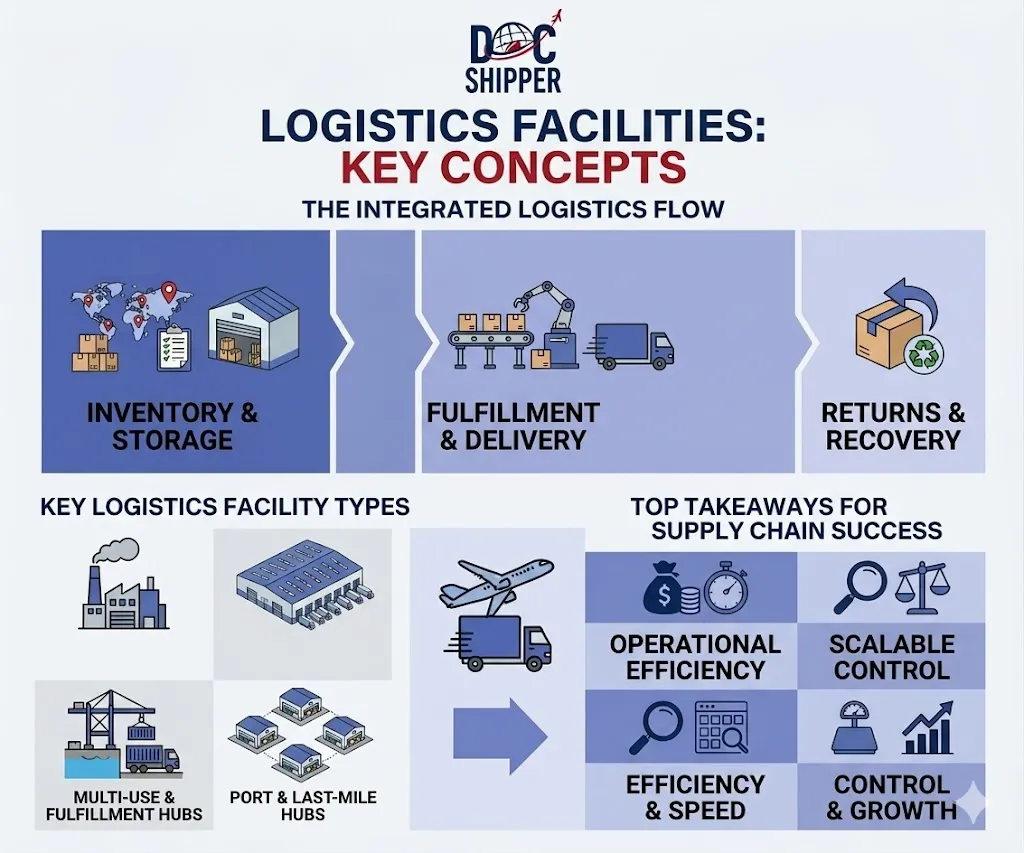
Facilities refer to physical locations and infrastructures where logistics operations occur, including warehouses, distribution centers, manufacturing plants, and freight terminals. These strategic assets enable storage, handling, processing, and movement of goods throughout the international supply chain, serving as critical nodes for inventory management and order fulfillment.Introduction
Many importers and exporters underestimate how facility location and design directly impact delivery times, customs clearance efficiency, and operational costs. Choosing the wrong warehouse or poorly configured distribution center can add 15-30% to total logistics costs while delaying market entry.
In international trade, facilities serve as physical anchors connecting manufacturers, carriers, customs authorities, and end customers. Their strategic importance extends beyond simple storage—they enable value-added services, regulatory compliance, and supply chain resilience.
Key characteristics of effective logistics facilities include:
- Strategic geographic positioning near ports, airports, or border crossings
- Customs bonding capabilities for duty-deferred storage
- Multi-modal connectivity supporting rail, truck, and intermodal operations
- Technology integration with WMS, ERP, and track-and-trace systems
- Scalability and flexibility to accommodate demand fluctuations
Facilities Management & Strategic Positioning
The operational efficiency of facilities depends on sophisticated management practices that balance space utilization, labor productivity, and throughput velocity. Modern facilities require real-time inventory visibility, automated handling systems, and compliance with international standards like ISO 9001 and GDP certifications.
Location optimization represents the most critical strategic decision. Proximity to Free Trade Zones (FTZ) or Special Economic Zones can provide tax advantages and streamlined customs procedures. The European Union’s customs warehousing procedures illustrate how facility designation impacts duty suspension and VAT deferral opportunities.
Bonded warehouse status allows importers to defer duties and taxes until goods enter domestic commerce. This facility type proves essential for businesses managing high-value inventory or testing market demand before full commitment. At DocShipper, we systematically assess bonded warehousing options for clients requiring flexible inventory strategies across multiple jurisdictions.
Cross-docking facilities minimize storage time by transferring goods directly from inbound to outbound transportation, reducing handling costs and inventory carrying expenses. These operations require precise coordination between receiving schedules, quality inspections, and shipping windows—typically within 24-48 hours.
Temperature-controlled facilities add complexity but enable cold chain logistics for pharmaceuticals, perishables, and chemicals. Regulatory compliance with GDP (Good Distribution Practices) or HACCP standards becomes mandatory, requiring continuous monitoring, validation protocols, and backup power systems.
Facility security and insurance requirements vary by cargo type and value. High-value electronics, pharmaceuticals, or bonded goods demand enhanced security measures including 24/7 surveillance, access controls, and comprehensive insurance coverage aligned with Incoterms® obligations.
Concrete Examples & Performance Data
Understanding facility performance through quantifiable metrics helps businesses make informed investment and partnership decisions. The following comparative analysis illustrates operational differences across facility types:
| Facility Type | Primary Function | Avg. Dwell Time | Cost Structure | Ideal Use Case |
|---|---|---|---|---|
| Standard Warehouse | Long-term storage | 30-90 days | $5-8/pallet/month | Seasonal inventory, slow movers |
| Distribution Center | Order fulfillment | 3-7 days | $12-18/pallet + pick fees | E-commerce, fast delivery |
| Cross-Dock Facility | Direct transfer | 12-48 hours | $50-150/container | Time-sensitive goods, consolidation |
| Bonded Warehouse | Duty-deferred storage | Up to 5 years | $8-15/pallet/month | Import testing, re-export operations |
| Cold Storage | Temperature control | 7-21 days | $25-45/pallet/month | Pharmaceuticals, perishables |
Use Case: Electronics Importer Strategy
A European electronics importer receives 12 containers monthly from Asia. By establishing a bonded warehouse near Rotterdam port, they achieved:
- Duty deferral saving €180,000 in working capital annually
- Reduced customs clearance time from 5 days to 18 hours through pre-lodgment programs
- Flexibility to re-export 20% of inventory to Middle East markets duty-free
- Consolidated LTL shipments reducing inland transport costs by 35%
Pharmaceutical Cold Chain Performance
A GDP-certified cold storage facility in Singapore handles vaccine distribution across Southeast Asia. Key performance indicators demonstrate facility impact:
- Temperature deviation incidents: <0.02% of storage events
- Order accuracy rate: 99.7% with dual verification systems
- Emergency power activation: 100% uptime during 8 regional power outages
- Regulatory inspection pass rate: 100% across 14 audits over 3 years
At DocShipper, we conduct comprehensive facility assessments before recommending warehousing partners, evaluating infrastructure quality, compliance certifications, and operational track records to protect client interests throughout the supply chain.
Conclusion
Facilities represent the physical backbone of international logistics, directly influencing cost efficiency, regulatory compliance, and customer satisfaction. Strategic facility selection and management separate high-performing supply chains from those plagued by delays and excess costs.
Need expert guidance on facility strategy for your import/export operations? Contact DocShipper for tailored solutions addressing your specific warehousing and distribution requirements.
📚 Quiz
Test Your Knowledge: Facilities in Global Logistics
1. What is the primary definition of logistics facilities?
2. What distinguishes a bonded warehouse from a Free Trade Zone (FTZ) facility?
3. An electronics importer needs flexible inventory management with the option to re-export 25% of goods to another region. Which facility type best serves this need?
🎯 Your Result
📞 Free Personalized QuoteFAQ | Facilities: Definition, Management & Strategic Role in Global Logistics
A bonded warehouse is a customs-approved facility where imported goods can be stored without paying duties and taxes until they enter domestic commerce. These facilities require government licensing, security bonds, and strict inventory tracking systems. Goods can remain in bonded status for extended periods (typically up to 5 years depending on jurisdiction) or be re-exported duty-free, providing significant financial flexibility for importers managing cash flow and market uncertainty.
Free Trade Zone (FTZ) facilities operate under special customs territory designations where foreign goods are considered outside the customs territory for duty purposes. Unlike regular warehouses, FTZs allow manufacturing, assembly, and value-added processing without triggering duty payments. Finished products can be exported duty-free or imported with duties calculated only on foreign content, creating tax optimization opportunities unavailable in standard warehouse environments.
GDP (Good Distribution Practice) certification stands as the gold standard for pharmaceutical facilities, ensuring temperature control, chain of custody, and handling procedures meet regulatory requirements. Additional critical certifications include ISO 9001 for quality management, ISO 13485 for medical devices, and region-specific authorizations like EU GDP guidelines or FDA registration. Temperature mapping validation, backup power certification, and security clearances complement these core credentials.
Proximity to customs ports of entry significantly accelerates clearance processes. Facilities located within or adjacent to port areas typically achieve customs processing within 4-12 hours versus 2-5 days for inland locations. Direct connectivity to customs automation systems, Authorized Economic Operator (AEO) programs, and pre-clearance capabilities available at port-proximate facilities can reduce dwell time by 60-80%, directly improving inventory turnover and reducing demurrage risks.
Effective cross-docking facilities require high-volume loading dock capacity (minimum 10-20 doors), advanced WMS integration for real-time shipment coordination, and strategic positioning between inbound and outbound transportation networks. Physical layout must minimize handling distances between receiving and shipping areas. Most operations demand 24/7 staffing capabilities and precise scheduling systems to maintain the 24-48 hour transfer window that defines cross-docking efficiency.
Warehouse costs fluctuate dramatically by location. Major Asian port cities range $3-7/sqm/month, European logistics hubs cost $8-15/sqm/month, and prime North American markets demand $10-20/sqm/month. Labor costs create additional variance—Chinese facility operations average $500-800/worker/month versus $2,500-4,000 in Western Europe. Transportation connectivity, land scarcity, and regulatory environments drive these regional differences, making total cost modeling essential for facility selection decisions.
Warehouse Management Systems (WMS) form the operational core, integrating with ERP systems, Transportation Management Systems (TMS), and customs platforms. Barcode or RFID tracking enables real-time inventory visibility, while automated material handling systems (conveyors, sorters, AS/RS) increase throughput. Cloud-based platforms allow multi-party access for customers, carriers, and regulators. IoT sensors for temperature, humidity, and security monitoring provide continuous compliance documentation increasingly required by quality and regulatory standards.
Seasonal peaks (retail holiday periods, agricultural harvests) can require 30-200% capacity increases over baseline operations. Flexible facility strategies include overflow space agreements, temporary warehouse leasing, or shared logistics partnerships. Many businesses maintain base capacity at 70% utilization, reserving 30% for peak absorption. Third-party logistics providers (3PLs) offer scalability advantages through shared multi-client facilities where capacity can flex across different seasonal cycles, reducing fixed infrastructure investments.
Comprehensive facility insurance includes property coverage for the building and equipment, cargo/stock insurance covering stored goods, liability insurance protecting against third-party claims, and business interruption coverage for operational disruptions. For bonded warehouses, customs bonds guarantee duty payments if goods are released improperly. High-value cargo may require all-risk coverage with specified limits. Insurance requirements often tie directly to Incoterms® responsibilities—sellers maintaining ownership until delivery require extended coverage compared to buyers accepting warehouse delivery terms.
Increasingly stringent environmental standards affect facility design and operations. Energy efficiency requirements may mandate LED lighting, solar panels, or LEED certification for new construction. Hazardous materials storage requires specialized containment, ventilation, and emergency response capabilities. Waste management protocols, emissions controls for material handling equipment, and stormwater management systems add operational complexity. EU facilities face particularly strict environmental compliance, with carbon reporting requirements extending to logistics operations under evolving sustainability regulations.
High-security facilities implement layered protection including perimeter fencing with intrusion detection, 24/7 CCTV surveillance with minimum 30-day recording retention, access control systems tracking all personnel entry/exit, and security personnel for manned oversight. Cargo-specific measures include caged high-value storage areas, dual-control access requiring two authorized persons, and GPS tracking for in-facility movements. Cybersecurity protections securing WMS and facility management systems have become equally critical as physical security measures.
Comprehensive facility evaluation examines infrastructure quality (building condition, equipment age), certification portfolio (ISO, customs authorizations, industry-specific credentials), operational performance metrics (order accuracy, on-time shipping rates), technology capabilities (system integrations, reporting tools), and financial stability. Physical site visits reveal operational practices versus marketing claims. Reference checks with existing clients provide unfiltered performance feedback. Financial analysis of pricing structures against service scope prevents hidden cost surprises. At DocShipper, we conduct these multi-dimensional assessments to identify facility partners aligned with client-specific requirements and risk tolerances.
Need Help with
Logistics or Sourcing ?
First, we secure the right products from the right suppliers at the right price by managing the sourcing process from start to finish. Then, we simplify your shipping experience - from pickup to final delivery - ensuring any product, anywhere, is delivered at highly competitive prices.


Fill the Form
Prefer email? Send us your inquiry, and we’ll get back to you as soon as possible.
Contact us




