


In short ⚡
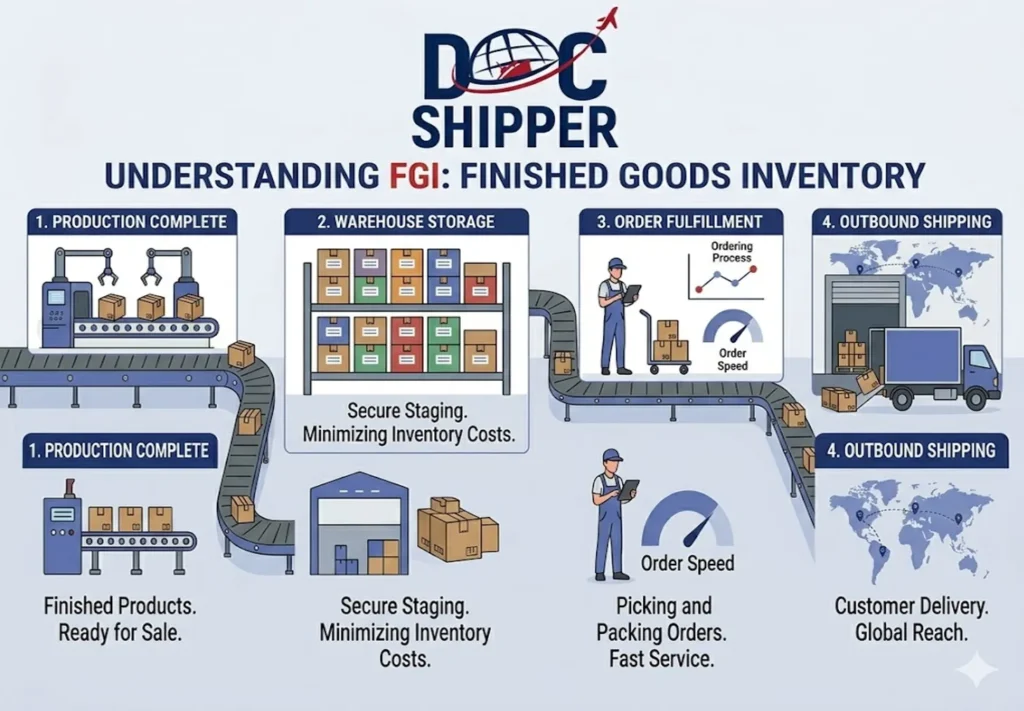
Finished Goods Inventory (FGI) refers to completed products ready for sale that have passed all manufacturing stages and quality checks. This inventory category represents the final stage of the supply chain before customer delivery, requiring careful balance between stock availability and carrying costs to optimize cash flow and customer satisfaction.
Introduction
Many importers struggle with a critical dilemma: how much finished product should they stock to meet demand without tying up excessive capital? This balance defines business profitability in international trade.
Finished Goods Inventory represents the culmination of your supply chain investment. Unlike raw materials or work-in-progress, FGI directly impacts revenue generation and customer experience. Mismanagement leads to either stockouts (lost sales) or overstock (increased storage costs and obsolescence risk).
In the context of import/export operations, FGI management becomes particularly complex due to:
- Extended lead times requiring accurate demand forecasting months in advance
- Container economics encouraging bulk orders that may exceed immediate demand
- Currency fluctuations affecting the value of inventory held
- Customs clearance cycles creating unpredictable availability windows
- Storage cost variations across different markets and warehouse types
Understanding FGI fundamentals enables businesses to optimize working capital, improve cash conversion cycles, and maintain competitive service levels in global markets.
FGI Management Strategies & Best Practices
Effective inventory management strategies depend on understanding the relationship between holding costs, ordering costs, and stockout risks. The optimal FGI level varies significantly across industries and business models.
The Economic Order Quantity (EOQ) model provides a mathematical foundation for determining ideal order sizes. While originally designed for manufacturing, importers adapt this formula by incorporating international shipping variables: container capacity, minimum order quantities, and transit duration.
Inventory turnover ratio serves as the primary performance indicator for FGI efficiency. Calculated as Cost of Goods Sold divided by Average Inventory Value, this metric reveals how quickly you convert stock into revenue. Industry benchmarks vary widely—electronics may turn 8-12 times annually, while furniture might turn only 4-6 times.
Modern demand forecasting techniques combine historical sales data with market intelligence to predict future requirements. Importers must account for seasonality, promotional campaigns, and market trends when projecting FGI needs. Statistical methods like moving averages and exponential smoothing provide baseline forecasts, while machine learning algorithms increasingly enhance accuracy.
The ABC classification system prioritizes inventory management efforts based on value contribution. “A” items (typically 20% of SKUs generating 80% of revenue) receive intensive monitoring and sophisticated forecasting. “C” items may use simpler reorder-point systems. This segmentation allows resource allocation where it matters most.
At DocShipper, we help clients implement inventory management solutions that account for international supply chain complexities. Our warehouse management systems integrate real-time tracking with demand forecasting to maintain optimal FGI levels across multiple markets.
For regulatory compliance, inventory valuation methods significantly impact financial reporting and tax obligations. FIFO (First-In-First-Out), LIFO (Last-In-First-Out), and weighted average methods each present advantages depending on inflation environments and accounting standards. Importers must consult IAS 2 inventory accounting standards to ensure compliance across jurisdictions.
Calculation Methods & Real-World Examples
Understanding FGI metrics requires practical application of key formulas. Let’s examine calculation methods through concrete import scenarios that demonstrate financial impact.
Use Case: Electronics Importer
An electronics distributor imports Bluetooth speakers from China. Their current situation:
- Annual sales: 50,000 units at $25 wholesale price
- Current average FGI: 8,000 units
- Cost of goods (landed cost): $15 per unit
- Annual holding cost rate: 25% (warehousing, insurance, obsolescence risk)
Inventory Turnover Calculation:
Turnover = Annual COGS ÷ Average Inventory Value
= (50,000 × $15) ÷ (8,000 × $15)
= $750,000 ÷ $120,000
= 6.25 turns per year
This means the company cycles through its entire FGI approximately every 58 days. For electronics with rapid product cycles, this turnover rate leaves room for improvement.
Holding Cost Impact:
Annual holding cost = Average Inventory Value × Holding Cost Rate
= $120,000 × 25%
= $30,000 annually
By reducing average inventory to 6,000 units (still maintaining 44 days of stock), holding costs drop to $22,500—saving $7,500 annually without compromising service levels.
| Metric | Current State | Optimized State | Impact |
|---|---|---|---|
| Average FGI (units) | 8,000 | 6,000 | -25% |
| Inventory Turnover | 6.25x | 8.33x | +33% |
| Days of Stock | 58 days | 44 days | -14 days |
| Annual Holding Cost | $30,000 | $22,500 | -$7,500 |
| Capital Tied in Inventory | $120,000 | $90,000 | $30,000 freed |
Safety Stock Determination:
Safety stock protects against demand variability and supply delays. The formula incorporates statistical measures:
Safety Stock = (Maximum Daily Usage × Maximum Lead Time) − (Average Daily Usage × Average Lead Time)
For our electronics importer:
- Average daily sales: 137 units (50,000 ÷ 365)
- Maximum daily sales: 200 units (seasonal peaks)
- Average lead time: 45 days (China to US warehouse)
- Maximum lead time: 60 days (customs delays, port congestion)
Safety Stock = (200 × 60) − (137 × 45) = 12,000 − 6,165 = 5,835 units
This calculation reveals the buffer needed to maintain 95% service level despite supply chain variability—a critical consideration for importers facing unpredictable international logistics.
DocShipper’s supply chain visibility tools enable real-time tracking of shipments, allowing dynamic adjustment of safety stock levels based on actual transit performance rather than conservative estimates.
Conclusion
Finished Goods Inventory management directly determines cash flow efficiency and customer satisfaction in international trade. Balancing availability against carrying costs requires sophisticated forecasting and continuous optimization based on actual performance data.
Need expert guidance on optimizing your FGI strategy? Contact DocShipper’s logistics specialists for customized inventory solutions that reduce costs while improving service levels.
📚 Quiz
Test Your Knowledge: Finished Goods Inventory
What best defines Finished Goods Inventory (FGI) in international trade?
An electronics importer has annual COGS of $2.4 million and average FGI value of $300,000. What does this indicate?
Why do importers typically maintain higher safety stock compared to domestic suppliers?
🎯 Your Result
📞 Free Quote in 24hFAQ | Finished Goods Inventory (FGI): Definition, Management & Optimization Strategies
The ideal FGI level depends on industry, demand variability, and lead times. A general benchmark is maintaining 30-60 days of stock for stable products, though fashion and electronics may require 15-30 days due to rapid obsolescence. Calculate using safety stock formulas that account for your specific demand patterns and supplier reliability. Industries with longer international lead times typically require higher FGI levels to buffer against supply disruptions.
Finished Goods Inventory consists of completed products ready for immediate sale, having passed all quality checks and packaging requirements. Work-in-progress (WIP) includes partially manufactured items still undergoing production processes. For importers, FGI represents goods cleared through customs and available in distribution centers, while WIP would describe items still being manufactured at overseas factories. This distinction affects accounting treatment, insurance coverage, and liquidity calculations.
FGI holding costs typically range from 20-35% of inventory value annually, including warehouse rental (5-10%), insurance (1-3%), obsolescence risk (5-15%), financing costs (3-8%), and handling expenses (2-5%). For importers, additional factors include customs duties paid upfront, currency exposure on unsold goods, and potential demurrage charges if goods remain too long in port warehouses. High-value electronics face steeper obsolescence costs compared to commodity products.
Inventory Turnover Ratio = Cost of Goods Sold (COGS) ÷ Average Inventory Value. Calculate average inventory by adding beginning and ending period values, then dividing by two. For example, if annual COGS equals $2 million and average FGI value is $500,000, turnover is 4 times annually. Higher ratios indicate efficient inventory management, though excessively high turnover may signal inadequate stock levels risking stockouts. Industry benchmarks vary significantly—compare against sector-specific standards.
Safety stock is buffer inventory protecting against demand spikes or supply delays. The standard formula considers demand variability and lead time uncertainty. Importers typically maintain higher safety stock than domestic suppliers due to longer, less predictable international lead times. A common approach maintains enough buffer to cover maximum expected demand during maximum lead time, minus average consumption during average lead time. Statistical methods using standard deviation provide more precise calculations based on historical data patterns.
Container economics significantly influence FGI strategy because importers often must order in full container loads (FCL) to minimize per-unit costs. A 40-foot container holds substantial quantities, potentially exceeding immediate demand. This creates tension between transportation efficiency and inventory holding costs. Smart importers calculate the trade-off between FCL savings versus extended holding costs, sometimes choosing less-than-container-load (LCL) shipments for slow-moving SKUs despite higher freight rates per unit.
FIFO (First-In-First-Out) is most common for importers as it matches physical goods flow and is accepted under both GAAP and IFRS standards. FIFO assumes oldest inventory sells first, providing current cost reflection in COGS. In inflationary environments, FIFO results in lower COGS and higher taxable income compared to LIFO. Weighted average costing simplifies calculations when products from multiple shipments mix in warehouses. Choice impacts financial statements, tax liability, and customs valuation for re-exports—consult accounting standards specific to operating jurisdictions.
Implement demand forecasting tools to align orders with actual consumption patterns rather than guesswork. Negotiate shorter lead times with suppliers or establish regional warehousing closer to end markets. Use drop-shipping for slow-moving items to eliminate FGI entirely. Adopt just-in-time principles where feasible, though international distances limit pure JIT application. Improve inventory visibility through warehouse management systems that trigger reorders based on real consumption. Consider vendor-managed inventory arrangements where suppliers maintain ownership until sale.
Days Sales of Inventory calculates how many days, on average, inventory remains before selling. Formula: (Average Inventory Value ÷ COGS) × 365. Lower DSI indicates faster inventory turnover. For example, if average FGI is $300,000 and annual COGS is $2.4 million, DSI equals 45.6 days. Importers should track DSI trends over time rather than focusing on absolute numbers. Seasonal businesses expect DSI fluctuation—high before peak seasons, low afterward. Compare DSI against payment terms to optimize cash conversion cycles.
For importers, FGI purchased in foreign currency faces revaluation risk. If you bought goods when euros cost $1.10 but the euro strengthens to $1.20, your dollar-denominated inventory value increases even without price changes. This creates accounting complexities under IAS 21 currency translation rules. Some companies hedge FGI currency exposure through forward contracts, locking in conversion rates. Conversely, if selling currency weakens against purchasing currency, profit margins compress on existing inventory—requiring price adjustments or accepting reduced returns.
Modern warehouse management systems (WMS) provide real-time FGI visibility, automated reorder triggers, and integration with sales channels. RFID tracking enables precise location monitoring and faster cycle counts. Demand forecasting software uses machine learning algorithms to predict consumption patterns more accurately than traditional methods. Cloud-based inventory platforms allow multi-location coordination for importers managing stock across several markets. ERP systems integrate FGI data with financial and operational systems for comprehensive business intelligence. Mobile scanning apps enable instant inventory adjustments from warehouse floors.
Establish clear aging thresholds defining slow-moving inventory (typically 90-180 days without sales). Implement markdown strategies progressively—10% reduction after 90 days, 25% after 120 days, 50% after 180 days. Consider bulk liquidation through discount channels or return to manufacturer if agreements permit. For perishables or dated goods, establish strict first-expiry-first-out (FEFO) systems. Write down obsolete inventory value on financial statements per accounting standards. Prevention strategies include smaller initial orders, market testing before full container commitments, and contractual return provisions with suppliers.
Need Help with
Logistics or Sourcing ?
First, we secure the right products from the right suppliers at the right price by managing the sourcing process from start to finish. Then, we simplify your shipping experience - from pickup to final delivery - ensuring any product, anywhere, is delivered at highly competitive prices.


Fill the Form
Prefer email? Send us your inquiry, and we’ll get back to you as soon as possible.
Contact us




:%20Definition,%20Management%20&%20Optimization%20Strategies)