


In short ⚡
Field Services refer to on-site operations performed by specialized personnel at customer locations or external facilities to support logistics, installation, maintenance, repair, or quality control activities. These services ensure smooth execution of supply chain operations beyond warehouse or office environments, directly impacting delivery timelines and customer satisfaction.
Introduction
Many businesses struggle to understand when logistics extends beyond warehouse walls. Field services bridge the gap between freight delivery and operational readiness, particularly in international trade where equipment installation, customs inspections, or site surveys occur at destination points.
In import-export contexts, field services encompass everything from container unpacking at customer premises to technical commissioning of machinery. These operations require coordination between freight forwarders, customs brokers, and specialized technicians.
- On-site execution: Services delivered directly at customer facilities or port locations
- Technical expertise: Specialized personnel handle installation, calibration, or compliance verification
- Time-sensitive operations: Often linked to delivery schedules or production timelines
- Documentation requirements: Site reports, completion certificates, and customs clearance support
- Cost implications: Additional charges beyond standard freight rates, typically billed hourly or per project
Field Services Mechanics & Operational Framework
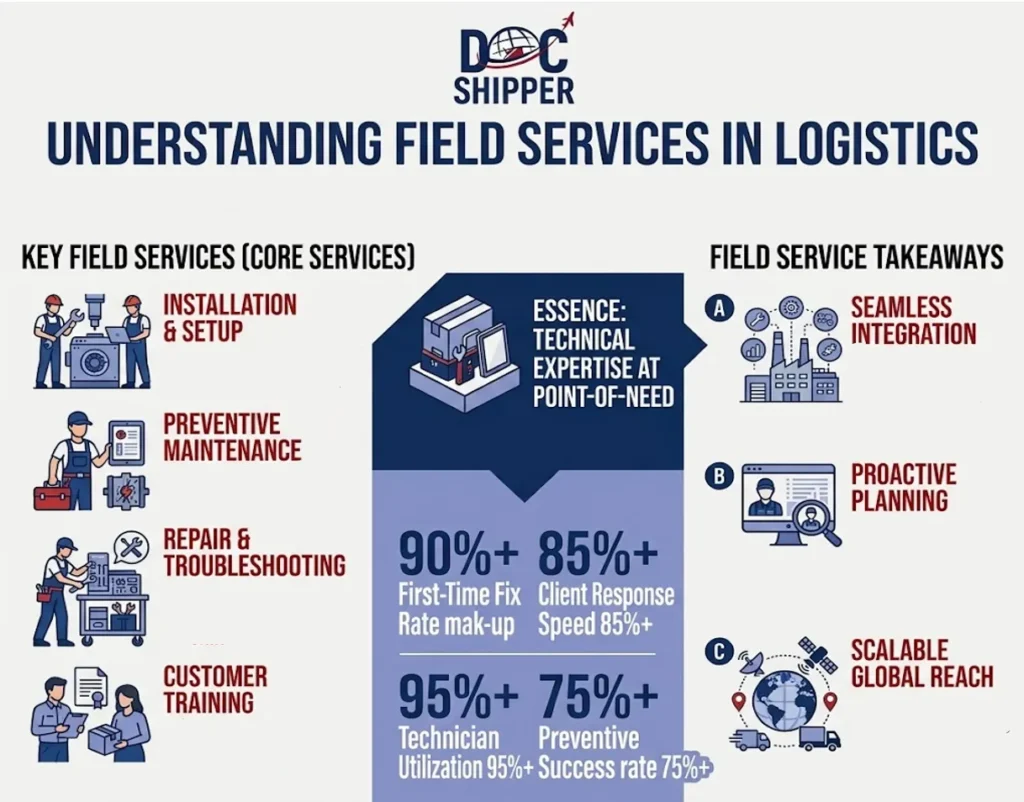
Field services in logistics operate through pre-scheduled deployment models where providers assign qualified technicians or supervisors to specific locations. The process begins with detailed scoping—understanding what tasks require on-site presence versus remote coordination.
For customs clearance support, field agents conduct physical inspections alongside customs officers, verifying documentation against actual cargo. This becomes critical when importing regulated goods like medical devices or machinery requiring certification. At DocShipper, we coordinate field inspections across 50+ countries, ensuring compliance documentation is prepared before officials arrive on-site.
The installation and commissioning category covers machinery setup, testing, and handover. International shipments of manufacturing equipment often include contractual field service clauses specifying technician qualifications, completion timelines, and warranty activation procedures. These services prevent operational delays that could cost thousands in lost production time.
Quality control inspections represent another crucial field service. Before goods leave overseas factories, third-party inspectors visit production facilities to verify specifications, conduct factory audits, or perform pre-shipment checks. The European Commission’s mutual recognition principles require such verifications for CE-marked products entering EU markets.
Technology integration has transformed field services through mobile workforce management systems. Real-time GPS tracking, digital work order completion, and photographic evidence upload create audit trails. These systems enable freight forwarders to provide clients with live updates when technicians arrive at facilities, complete tasks, or encounter issues requiring escalation.
The financial structure typically follows three pricing models: hourly rates (common for unpredictable tasks), fixed project fees (for standard installations), or retainer agreements (for ongoing maintenance contracts). International field services add complexity through travel expenses, accommodation, and per diem allowances, often negotiated separately from base service rates.
Practical Examples & Industry Data
Consider a German automotive manufacturer importing robotic assembly equipment from Japan. The shipment includes not just freight forwarding but field services: a Japanese technician flies to Munich, supervises unpacking, installs the robots, calibrates systems, and trains German staff over five days. The field service cost—€12,000 excluding freight—prevents warranty voidance and ensures production starts on schedule.
Another scenario involves pharmaceutical cold chain logistics. Temperature-sensitive vaccines arriving in Nigeria require field technicians to verify refrigeration equipment at the destination clinic before unloading. This service, costing approximately $800 per site visit, ensures product integrity and regulatory compliance under WHO guidelines.
| Service Type | Typical Duration | Average Cost Range | Common Industries |
|---|---|---|---|
| Customs Site Inspection | 2-4 hours | $200-$600 | Electronics, Food, Chemicals |
| Equipment Installation | 3-7 days | $5,000-$20,000 | Manufacturing, Healthcare |
| Pre-Shipment Inspection | 1 day | $300-$1,200 | Retail, Consumer Goods |
| Container Unpacking Supervision | 4-8 hours | $400-$900 | Furniture, Art, High-Value Goods |
| Factory Audit | 1-2 days | $1,500-$4,000 | Textiles, Toys, Electronics |
Industry data reveals that 68% of machinery importers who skip professional field services face operational delays averaging 11 days, according to a 2023 Supply Chain Management Review study. Conversely, companies using coordinated field services report 94% on-time commissioning rates.
A real-world use case from DocShipper’s portfolio involved Brazilian coffee equipment exported to South Korea. Our field team coordinated:
- Pre-export inspection in São Paulo confirming machinery specifications
- Customs accompaniment at Busan port for sanitary verification
- On-site installation supervision at Seoul roasting facility
- Post-installation documentation for Korean Food Safety Authority
Total field service investment: $8,400. Alternative scenario without coordination: estimated 18-day delay and potential $35,000 in demurrage and lost revenue.
Conclusion
Field services transform logistics from mere transportation into end-to-end operational solutions. Whether ensuring customs compliance, installing complex equipment, or verifying quality standards, these on-site interventions protect investments and maintain supply chain continuity. Need expert coordination for your next international shipment? Contact DocShipper for tailored field service solutions.
📚 Quiz
Test Your Knowledge: Field Services
Question 1: What is the primary definition of Field Services in logistics?
Question 2: A common misconception is that field services are mandatory for all international shipments. When are they actually required?
Question 3: A German manufacturer imports robotic equipment from Japan requiring installation. Which statement correctly describes the field service application?
🎯 Your Result
📞 Free Quote in 24hFAQ | Field Services: Definition, Process & Practical Examples
Standard freight forwarding covers transportation, documentation, and customs clearance coordination. Field services add on-site human intervention—technicians, inspectors, or supervisors physically present at origin or destination points to perform specialized tasks like installation, quality checks, or compliance verification that cannot be executed remotely.
No. Field services become necessary when shipments involve regulated goods requiring physical inspection, complex equipment needing professional installation, high-value items demanding supervision during unpacking, or contractual obligations specifying on-site technical support. Standard palletized goods typically don't require such services.
Most providers require 5-10 business days for domestic field services and 15-20 days for international deployments. This allows time for technician scheduling, visa arrangements if crossing borders, travel bookings, and coordination with customs authorities or facility managers. Urgent requests may incur expedite fees of 30-50%.
Liability depends on contractual terms. If delays stem from provider negligence (late technician arrival, improper installation), the service provider typically compensates per agreed penalties. If delays result from undisclosed site conditions or customer-side issues (unprepared facilities, missing documentation), responsibility shifts to the shipper.
Yes. Comprehensive cargo insurance policies often include field service-related coverage, protecting against damage during supervised unpacking, installation errors, or theft during on-site work. Ensure your policy explicitly mentions "installation and commissioning" coverage, as standard policies may exclude post-delivery activities.
Technicians should hold relevant certifications for the equipment or products involved (manufacturer training certificates, electrical safety qualifications, customs broker licenses if handling clearance support). For regulated industries, additional credentials like FDA registration or ISO auditor certification may be required. Always request credential verification before deployment.
When coordinated properly, field services accelerate clearance by having qualified personnel present during inspections to answer technical questions, provide immediate documentation, or perform required tests on-site. Uncoordinated field work can delay clearance if technicians arrive before customs approval or lack proper accreditation to enter bonded warehouses.
Yes. Companies with recurring international shipments can negotiate annual retainer agreements offering discounted per-service rates, waived travel fees for certain regions, or bundled pricing combining freight forwarding with field services. Volume discounts typically start at 20+ shipments annually, with savings ranging from 15-30%.
Standard deliverables include site visit reports (with timestamps and photographic evidence), installation completion certificates (required for warranty activation), customs inspection transcripts, quality control checklists, and client sign-off forms. These documents serve as proof of service completion and support customs audits or insurance claims if needed.
Reputable providers deploy multilingual technicians or pair specialists with local interpreters. Critical documentation is prepared in both origin and destination languages. For complex installations, pre-deployment video conferences with client teams ensure mutual understanding of technical requirements. Language challenges add 10-20% to service costs in non-English-speaking markets.
Yes. Many providers offer emergency response field services where technicians rapidly deploy to assess damage, photograph evidence for insurance claims, coordinate salvage operations, or perform emergency repairs to prevent total loss. These services typically operate on 24-48 hour response windows with premium pricing of 50-100% above standard rates.
In countries with strict work permit requirements, field service providers partner with locally licensed technicians or obtain temporary work authorizations. For machinery requiring manufacturer-specific expertise, the foreign technician may provide remote supervision while local certified personnel perform physical work. Some nations allow "supervisory roles" without work permits, but verification with local labor authorities is essential.
Need Help with
Logistics or Sourcing ?
First, we secure the right products from the right suppliers at the right price by managing the sourcing process from start to finish. Then, we simplify your shipping experience - from pickup to final delivery - ensuring any product, anywhere, is delivered at highly competitive prices.


Fill the Form
Prefer email? Send us your inquiry, and we’ll get back to you as soon as possible.
Contact us




