


In short ⚡
FIPS (Federal Information Processing Standards) are publicly announced standardization requirements issued by the U.S. National Institute of Standards and Technology (NIST) for federal government computer systems. These standards ensure data security, encryption protocols, and interoperability across government agencies and regulated industries, particularly impacting international trade documentation, customs systems, and secure logistics communications.Introduction
Many logistics professionals encounter FIPS requirements without fully understanding their impact on cross-border operations. When your shipment documentation must interface with U.S. government systems—customs declarations, TSA cargo screening, or Defense Department procurement—FIPS compliance becomes mandatory, not optional.
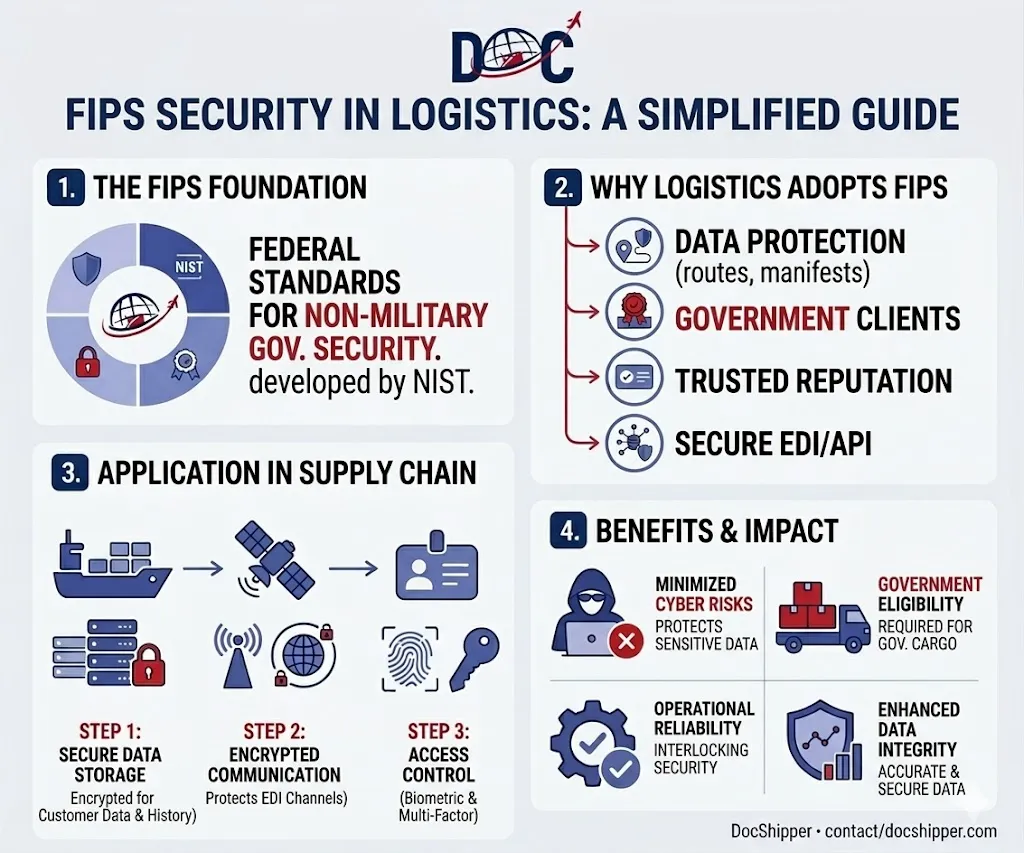
In international freight forwarding, FIPS standards directly affect how sensitive data is encrypted, transmitted, and stored. Non-compliance can result in rejected electronic submissions, delayed customs clearance, or disqualification from government contracts. Understanding these standards protects your supply chain from costly disruptions.
Key characteristics of FIPS in logistics contexts include:
- Cryptographic validation: Encryption modules used in EDI systems must pass NIST certification
- Data integrity requirements: Digital signatures on commercial invoices and certificates of origin
- Access control standards: Authentication protocols for customs broker software platforms
- Secure transmission protocols: TSL/SSL configurations for AES filings and ACE portal access
- Hardware specifications: Physical security requirements for devices processing classified shipment data
Technical Framework & Compliance Requirements
FIPS operates as a tiered system of technical publications. The most critical for logistics operations is FIPS 140-3, which defines four security levels for cryptographic modules. Level 1 requires basic encryption, while Level 4 demands tamper-evident physical enclosures—essential for devices handling classified military shipments or sensitive pharmaceutical transfers.
For freight forwarders working with U.S. government contracts, the Cryptographic Module Validation Program (CMVP) certificate becomes non-negotiable. Your customs clearance software, warehouse management systems, and even handheld scanners must use CMVP-validated encryption libraries. A single non-compliant device in your TMS can invalidate an entire government shipment.
The FIPS 199 standard categorizes information systems based on security impact—low, moderate, or high. An automotive parts shipment to a commercial buyer receives “low” classification. Military equipment bound for a defense contractor requires “high” classification, triggering stringent documentation encryption, multi-factor authentication, and audit trails for every system access point.
Recent updates replaced FIPS 140-2 with FIPS 140-3 in 2022, aligning U.S. standards with international ISO/IEC 19790 requirements. This transition period creates challenges: legacy TMS platforms validated under 140-2 face recertification deadlines. At DocShipper, we proactively audit our technology stack to maintain continuous FIPS compliance across all client shipments requiring federal security standards.
Legal implications extend beyond technology. The Federal Information Security Management Act (FISMA) mandates FIPS compliance for all contractors handling federal data. Non-compliance exposes freight forwarders to breach liability, contract termination, and potential criminal penalties under 15 U.S.C. § 278g-3. Third-party logistics providers must now verify their entire subcontractor chain meets FIPS requirements—from drayage operators to customs brokers.
For detailed technical specifications, consult the official NIST FIPS Publications Library, which provides implementation guidance for each standard.
Practical Applications in International Trade
Understanding FIPS in abstract terms differs vastly from its real-world application. Consider a pharmaceutical cold chain shipment from Switzerland to a U.S. Veterans Affairs hospital. Every temperature sensor transmitting data to the tracking system must use FIPS 140-3 validated encryption. The IoT gateway aggregating sensor readings requires certified cryptographic modules. Even the PDF generator creating the commercial invoice needs compliant digital signature protocols.
Use Case: Defense Contractor Shipment
A European aerospace manufacturer ships precision components to a U.S. Defense Department facility. The logistics flow encounters five FIPS touchpoints:
| Process Stage | FIPS Requirement | Compliance Impact |
|---|---|---|
| Export declaration transmission | FIPS 140-3 Level 2 encryption | Non-validated TLS rejected by ACE system |
| Packing list digital signature | FIPS 186-4 DSA/RSA algorithms | Document authenticity verification required |
| Customs bond filing | FIPS 180-4 SHA-256 hashing | Data integrity check for bond amount |
| Warehouse access control | FIPS 201 PIV card authentication | Physical access logs for auditing |
| Final delivery confirmation | FIPS 140-3 Level 3 handheld device | Tamper-resistant proof of delivery |
Failure at any stage triggers shipment holds. In 2023, CBP reported 14% of defense-related shipments experienced initial electronic filing rejections due to non-compliant encryption protocols.
Commercial Impact Analysis: A mid-sized freight forwarder handling 200 annual government shipments faces approximately $85,000 in technology upgrades to achieve full FIPS compliance. This includes CMVP-validated VPN appliances ($12,000), certified TMS modules ($38,000), and compliant mobile devices for warehouse staff ($35,000). However, non-compliance costs far exceed investment—a single rejected shipment of aerospace components averages $127,000 in delay penalties and storage fees.
At DocShipper, we maintain FIPS-compliant infrastructure across our entire service network, eliminating client exposure to validation failures. Our systems undergo annual NIST audits, ensuring seamless integration with ACE, AES, and defense procurement platforms without requiring clients to manage technical compliance separately.
The pharmaceutical sector presents unique challenges. FDA requires FIPS-compliant systems for Drug Supply Chain Security Act (DSCSA) transaction data. A single pallet of prescription medications generates hundreds of encrypted transaction records across manufacturers, repackagers, and distributors. Each system touchpoint must validate cryptographic integrity. For cold chain logistics, temperature excursion data transmitted from reefer containers must meet FIPS standards to satisfy FDA Part 11 electronic records requirements.
Conclusion
FIPS standards transform from abstract technical requirements into concrete operational necessities when handling U.S. government shipments or regulated cargo. Proactive compliance protects against costly rejections, legal liability, and competitive disadvantage in federal procurement markets.
Need guidance on implementing FIPS-compliant logistics solutions for your import/export operations? Contact DocShipper for expert consultation on secure supply chain management.
📚 Quiz
Test Your Knowledge: FIPS Standards in Logistics
What is the primary purpose of FIPS standards in international freight operations?
Which statement correctly describes FIPS 140-3 requirements for logistics operations?
A European freight forwarder is submitting AES export declarations for U.S.-bound defense components. Which scenario requires FIPS compliance?
🎯 Your Result
📞 Free Compliance Consultation in 24hFAQ | FIPS (Federal Information Processing Standards): Definition, Application & Key Examples
U.S. Customs and Border Protection may reject electronic filings from non-compliant systems, forcing manual paper submissions. This delays clearance by 48-72 hours and disqualifies you from expedited processing programs like C-TPAT. Brokers must provide CMVP validation certificates upon request for government shipments.
Generally no, unless the cargo involves controlled technologies (ITAR/EAR items), pharmaceuticals under DSCSA, or contracts with federal end-users. However, voluntary FIPS adoption strengthens cybersecurity posture and prepares businesses for government contract opportunities without emergency compliance scrambles.
The NIST validation process typically requires 6-12 months from initial submission to certificate issuance. Software vendors must test cryptographic modules at accredited labs, address findings, and undergo multiple review cycles. This timeline makes advance planning critical—wait until needing government shipment capabilities and you've already missed deadlines.
Yes, provided the cloud service provider operates FedRAMP-authorized infrastructure. AWS GovCloud, Microsoft Azure Government, and Google Cloud for Government offer FIPS 140-2/140-3 validated environments. However, your application layer must also use compliant cryptographic libraries—platform compliance alone doesn't guarantee end-to-end validation.
FIPS 140-3 introduces stricter physical security requirements, expanded algorithm testing, and alignment with ISO 19790 international standards. For logistics operations, the practical impact focuses on cryptographic module updates—older handheld scanners or EDI gateways validated under 140-2 must upgrade or face decertification after transition deadlines expire in 2026.
Absolutely. When warehousing government cargo, your 3PL must demonstrate FIPS-compliant access control systems, validated network encryption, and certified inventory management platforms. Non-compliant warehouses cannot legally store defense articles or controlled pharmaceuticals. Always request CMVP certificates and FISMA audit reports during provider vetting.
No exemption exists when handling U.S.-bound shipments requiring federal system interaction. A German freight forwarder filing AES export declarations must use FIPS-validated encryption regardless of company location. The standard applies to the transaction, not the entity's nationality. European privacy laws (GDPR) can coexist with FIPS through properly configured dual-compliance architectures.
Request cryptographic module validation certificates from your software vendors, specifying which FIPS publications apply (typically 140-3, 186-4, 180-4). Check certificate numbers against the official NIST CMVP validated modules list. For network appliances, verify firmware versions include FIPS-mode capabilities—having certified hardware means nothing if FIPS mode remains disabled in configurations.
Federal contractors face contract termination, suspension from future bidding, and potential False Claims Act liability if certifying compliance falsely. Criminal penalties under 15 U.S.C. § 278g-3 include fines up to $100,000 and imprisonment for willful violations. More commonly, non-compliance results in shipment rejections, CBP penalties for incomplete filings, and loss of trusted trader program benefits.
Yes, but consumer smartphones typically don't qualify. FIPS-compliant mobile solutions include Samsung Knox devices running validated Android builds, or specialized rugged handhelds with Level 3 cryptographic modules. The device must encrypt locally stored delivery photos, signatures, and location data using CMVP-certified modules—standard iOS/Android encryption doesn't automatically meet FIPS validation requirements.
CMVP certificates don't expire, but cryptographic module updates require revalidation. When your TMS vendor releases major version upgrades changing encryption libraries, new validation becomes necessary. Industry best practice recommends annual third-party audits verifying operational systems match certified configurations—configuration drift commonly causes compliance failures during surprise CBP inspections or contract audits.
Paradoxically, FIPS compliance often reduces premiums for government cargo and high-value electronics. Insurers recognize validated systems demonstrate lower cyber risk and stronger chain-of-custody documentation. Some policies specifically require FIPS compliance for defense shipments or pharmaceuticals—lacking certification can void coverage entirely if breaches occur due to inadequate data security measures.
Need Help with
Logistics or Sourcing ?
First, we secure the right products from the right suppliers at the right price by managing the sourcing process from start to finish. Then, we simplify your shipping experience - from pickup to final delivery - ensuring any product, anywhere, is delivered at highly competitive prices.


Fill the Form
Prefer email? Send us your inquiry, and we’ll get back to you as soon as possible.
Contact us




:%20Definition,%20Application%20&%20Key%20Examples)