


In short ⚡
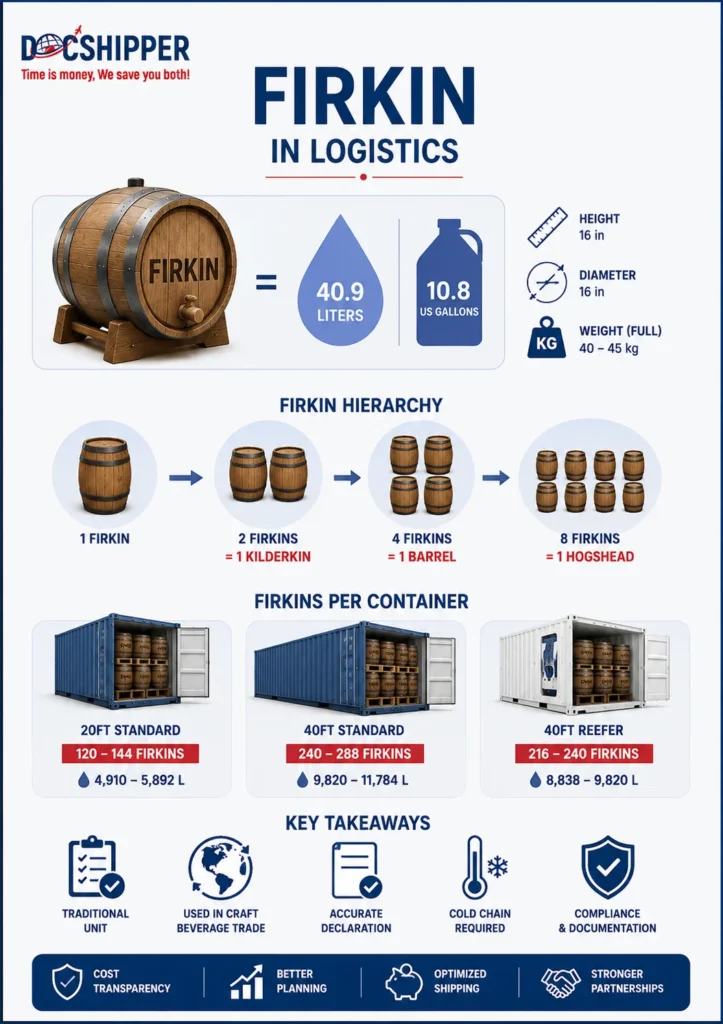
A firkin is a traditional volumetric unit of measurement historically used for liquids and certain dry goods, particularly in British imperial systems. In modern logistics, the firkin primarily refers to a quarter-barrel container (approximately 40.9 liters or 10.8 US gallons), commonly used for transporting and storing beer, cider, and specialty beverages in international trade.
Introduction
In the complexity of international freight forwarding, understanding traditional measurement units remains crucial for certain specialized shipments. The firkin represents one of those legacy measurement systems that continues to impact modern beverage logistics, particularly in craft beer exports and Anglo-Saxon trade routes.
While containerization has standardized most cargo measurements, the firkin persists as both a physical container specification and a volumetric reference in customs documentation. This dual nature creates potential confusion for importers and exporters unfamiliar with British imperial standards.
Key characteristics of the firkin in logistics contexts:
- Historical measurement unit originating from medieval British trade practices
- Standard container size for craft brewing and specialty beverage industries
- Volume equivalent to one-quarter of a standard barrel (half a kilderkin)
- Weight considerations for shipping calculations (full firkin approximately 40-45 kg)
- Customs classification requiring accurate volumetric declarations in certain jurisdictions
The firkin’s continued relevance stems from the global craft beer movement and the export of British-style beverages. Understanding its precise specifications prevents cargo miscalculations and ensures HMRC compliance in UK-origin shipments.
Technical Specifications & Conversion Standards
The firkin functions within a hierarchical system of British imperial measurements that freight forwarders must navigate when handling beverage shipments. Understanding these conversion ratios ensures accurate documentation and prevents costly cargo discrepancies.
In volumetric terms, one firkin equals precisely 40.91481 liters in the imperial system. This translates to 10.8 US gallons or 9.0 imperial gallons. For shipping calculations, logistics professionals typically round to 41 liters for practical purposes, though customs declarations may require exact figures.
The physical container specifications matter significantly for containerization planning. A standard firkin cask measures approximately 16 inches in height and 16 inches in diameter. This dimensional consistency allows for stackability optimization in 20-foot and 40-foot containers, with typical configurations accommodating 48-60 firkins per standard pallet.
Weight calculations present additional complexity. An empty firkin weighs approximately 4-5 kg, while a full firkin of beer reaches 40-45 kg total weight. These figures impact gross weight declarations for both maritime and air freight, affecting freight class determinations and carrier pricing structures.
At DocShipper, we systematically convert all traditional measurement units into standardized metric equivalents for customs documentation, preventing delays at border crossings and ensuring compliance with international shipping regulations.
The firkin exists within a broader hierarchy: four firkins equal one barrel, two firkins equal one kilderkin, and eight firkins equal one hogshead. This proportional system requires careful attention when processing bulk beverage orders, as suppliers may quote quantities in different units while freight forwarders calculate space requirements in standard container measurements.
International regulations increasingly require dual labeling showing both imperial and metric measurements. The European Union’s metrology directives mandate metric primary labeling with imperial as supplementary information, creating documentation requirements that logistics providers must accommodate in their shipping manifests.
Practical Applications & Industry Data
The firkin’s practical relevance centers on the $4.8 billion global craft beer export market, where traditional packaging formats command premium positioning and authentic presentation requirements. Understanding real-world applications prevents costly shipping errors and optimizes container utilization.
Case Study: UK to USA Craft Beer Shipment
A British microbrewery exports 240 firkins (approximately 9,800 liters) quarterly to US distributors. This volume requires precise calculation: 240 firkins occupy 10 standard pallets in a 40-foot refrigerated container. At 41 liters per firkin, total volume equals 9,840 liters, with gross weight reaching 10,800 kg including packaging.
Customs valuation requires declaring the beverage volume in both liters and gallons for FDA compliance. The shipment crosses temperature-controlled logistics zones, maintaining 2-8°C throughout transit. Incorrect volume declarations could trigger alcohol duty miscalculations, potentially costing thousands in penalties or storage fees during customs clearance.
Industry data reveals critical patterns:
| Container Type | Firkins per Container | Total Volume (Liters) | Typical Application |
|---|---|---|---|
| 20ft Standard | 120-144 | 4,910-5,892 | Regional distribution |
| 40ft Standard | 240-288 | 9,820-11,784 | International exports |
| 40ft Refrigerated | 216-240 | 8,838-9,820 | Premium craft beverages |
The craft beer segment grew 23% annually in international trade volume between 2020-2023, driving renewed attention to firkin specifications among freight forwarders. This growth concentrates in UK-to-North America and UK-to-Australia routes, where traditional cask ales command premium market positioning.
Operational Considerations for Freight Forwarders:
- Duty calculations based on alcohol content by volume and total liquid volume
- Hazmat classification for alcohol percentage above certain thresholds (typically >24% ABV)
- Temperature monitoring throughout cold chain logistics
- Return logistics for reusable casks requiring reverse supply chain management
- Documentation precision matching container counts with volumetric customs declarations
At DocShipper, we maintain specialized beverage logistics protocols that automatically convert firkin quantities into container optimization calculations while generating compliant customs documentation for both origin and destination jurisdictions.
Conclusion
The firkin remains a specialized but important measurement unit in international beverage logistics, requiring precise understanding for compliant and efficient shipping operations. Mastery of these traditional units prevents costly errors in the growing craft beverage export sector.
Need assistance with beverage shipments or specialized cargo requiring traditional measurement conversions? Contact DocShipper for expert guidance on your international logistics requirements.
📚 Quiz
Test Your Knowledge: Firkin in International Logistics
What is the primary volumetric definition of a firkin in modern beverage logistics?
For customs documentation purposes, which statement about firkin measurement is correct?
A brewery needs to ship 240 firkins internationally. Which container choice represents optimal logistics planning?
🎯 Your Result
📞 Free Quote in 24hFAQ | Firkin: Definition, Conversion & Practical Examples in International Logistics
A firkin equals precisely 40.91481 liters in the imperial system. For practical shipping purposes, logistics professionals typically use 41 liters as the standard conversion. This measurement applies to liquid volumes in beverage transportation and corresponds to one-quarter of a standard barrel or 9.0 imperial gallons.
A standard 40-foot container accommodates approximately 240-288 firkins depending on palletization method and securing requirements. Refrigerated containers typically hold 216-240 firkins due to insulation reducing internal space. Optimal loading requires professional calculation accounting for weight distribution, temperature control equipment, and destination handling capabilities.
Customs requirements vary by jurisdiction. UK HMRC recognizes firkin measurements for traditional beverages but requires metric conversion in primary declarations. US Customs and Border Protection mandates volume in liters with gallons as supplementary information. Most international shipping documents should include both imperial and metric measurements to ensure compliance across multiple jurisdictions.
A full firkin of beer weighs approximately 40-45 kg total, consisting of 36-37 kg of liquid and 4-5 kg for the container itself. For freight class determination and carrier pricing, use 45 kg as a conservative estimate. This weight affects gross cargo calculations, particularly for air freight where dimensional weight may apply if volume exceeds weight ratios.
Traditional wooden firkin casks are typically reusable, creating return logistics requirements. Stainless steel versions used by modern craft breweries offer greater durability and reusability. Freight forwarders must account for reverse logistics costs and documentation for empty container returns. Deposit systems may apply in certain trade routes, requiring financial tracking alongside physical shipment management.
Alcohol duty calculations depend on both volume and alcohol by volume (ABV) percentage. One firkin at 5% ABV contains approximately 2.05 liters of pure alcohol, determining excise duty liability. Customs authorities calculate duties based on total liters of pure alcohol across the shipment. Accurate firkin-to-liter conversion prevents duty miscalculations that can result in penalties or shipment delays.
Beer and cider in firkins typically require cold chain logistics maintaining 2-8°C throughout transit. Some traditional cask ales may tolerate controlled ambient temperatures (10-15°C) but require documentation specifying storage conditions. Temperature deviation can spoil product and void insurance coverage. Refrigerated containers with monitoring systems are standard for international firkin shipments exceeding 7-day transit times.
Historically, firkins measured butter, soap, and other commodities. Modern logistics rarely applies firkin measurements outside beverage industries. However, specialty food exporters occasionally use firkin units for traditional British products. When encountered, convert firkins to metric measurements for customs documentation while retaining original units as supplementary information for product authenticity and marketing purposes.
A kilderkin equals two firkins or approximately 81.83 liters (18 imperial gallons). In container loading calculations, kilderkins require different spatial planning than firkins due to larger dimensions. The kilderkin appears less frequently in modern craft beer exports but remains relevant for traditional British bitter and mild ale shipments to Commonwealth markets with established British beverage preferences.
Dimensional weight applies when volume exceeds actual weight ratios. For air freight, calculate using length × width × height (in cm) ÷ 5000 for the dimensional weight divisor. A standard firkin (approximately 40cm × 40cm × 40cm) yields 12.8 kg dimensional weight, well below actual weight of 40-45 kg when full. Sea freight rarely applies dimensional weight to firkins, but LCL consolidation may use volume-based pricing per cubic meter.
HS codes classify products, not packaging. Beer in firkins typically falls under HS code 2203 (beer made from malt), with subcategories based on alcohol content and packaging. The firkin container itself doesn't change the HS classification, though packaging type may appear in product descriptions. Accurate HS coding remains critical for duty calculation, regardless of traditional measurement units used in commercial documentation.
Marine cargo insurance for firkin shipments should specify breakage coverage, temperature deviation protection, and spoilage risks. Premium craft beverages may require all-risk coverage rather than standard named-perils policies. Declare the full CIF value including the reusable container value if applicable. Insurance claims require proof of proper packing, temperature maintenance records, and documentation showing firkin quantities matching commercial invoices and bills of lading.
Need Help with
Logistics or Sourcing ?
First, we secure the right products from the right suppliers at the right price by managing the sourcing process from start to finish. Then, we simplify your shipping experience - from pickup to final delivery - ensuring any product, anywhere, is delivered at highly competitive prices.


Fill the Form
Prefer email? Send us your inquiry, and we’ll get back to you as soon as possible.
Contact us




