


In short ⚡
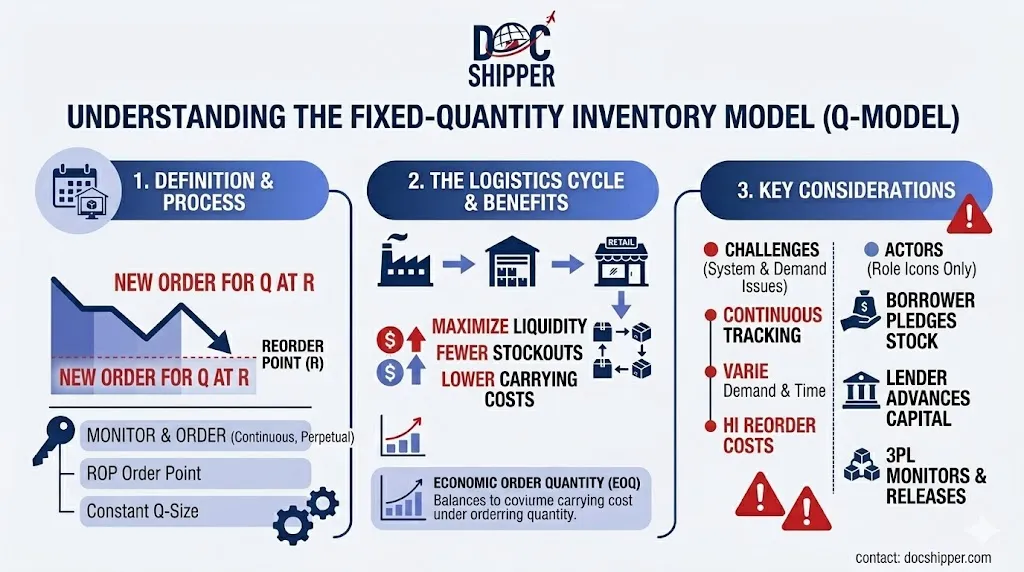
The Fixed Quantity Inventory Model is a replenishment system where a constant order quantity is purchased each time inventory reaches a predetermined reorder point. This model, also known as the Economic Order Quantity (EOQ) system, optimizes ordering costs and holding costs by maintaining consistent order sizes regardless of demand fluctuations, ensuring continuous stock availability while minimizing total inventory expenses.
Introduction
Many businesses struggle with the question: how much inventory should we order and when? Ordering too frequently increases administrative costs and shipping expenses. Ordering too infrequently ties up capital and requires expensive warehouse space. The Fixed Quantity Inventory Model addresses this fundamental challenge in supply chain management.
In international trade and logistics, this model becomes particularly crucial when managing imported goods with long lead times. Companies must balance the cost of frequent small shipments against the risk of stockouts and the expense of holding large inventories. The system provides a mathematical framework for optimization.
Key characteristics of this inventory management approach include:
- Constant order quantity – The same volume is purchased every time
- Variable ordering intervals – Orders are placed when inventory hits the reorder point
- Continuous monitoring – Stock levels must be tracked regularly
- Cost optimization – Balances ordering costs against holding costs
- Safety stock integration – Accounts for demand variability and lead time uncertainty
Understanding the Fixed Quantity Model & Technical Mechanisms
The Fixed Quantity Inventory Model operates on a fundamental principle: economic order quantity (EOQ). This quantity represents the optimal order size that minimizes the sum of ordering costs and inventory holding costs. The classic EOQ formula is: EOQ = √(2DS/H), where D represents annual demand, S is the cost per order, and H is the annual holding cost per unit.
The reorder point (ROP) triggers the purchasing process. It’s calculated as: ROP = (Daily Demand × Lead Time) + Safety Stock. When inventory falls to this level, a new order of the fixed quantity is automatically initiated. This mechanism prevents stockouts while maintaining cost efficiency.
Three critical cost components drive this model. Ordering costs include administrative expenses, transportation charges, and customs clearance fees in international shipments. Holding costs encompass warehousing, insurance, capital opportunity cost, and depreciation. The model seeks the sweet spot where these competing costs are balanced.
Lead time variability represents a significant challenge in international logistics. When importing from Asia to Europe, for example, transit times can fluctuate due to port congestion, customs delays, or weather conditions. The model accommodates this through safety stock calculations based on standard deviation of lead time demand.
The service level parameter determines how much safety stock to maintain. A 95% service level means accepting a 5% chance of stockout between orders. Higher service levels increase safety stock and holding costs but reduce the risk of lost sales. According to the International Organization for Standardization, most manufacturers target 95-98% service levels for critical components.
At DocShipper, we integrate Fixed Quantity Model calculations into our inventory planning services for importers. Our logistics experts analyze your demand patterns, lead times, and cost structures to recommend optimal order quantities and reorder points, ensuring your international supply chain operates at peak efficiency while minimizing capital tied up in inventory.
Practical Examples & Real-World Data
Consider a European electronics retailer importing smartphones from China. Annual demand is 24,000 units, ordering cost per shipment is €500 (including customs clearance), annual holding cost is €12 per unit (20% of €60 unit value), and lead time is 30 days with daily demand of approximately 66 units.
Using the EOQ formula: EOQ = √(2 × 24,000 × 500 / 12) = √2,000,000 = 1,414 units. The reorder point (without safety stock) = 66 units/day × 30 days = 1,980 units. This means ordering 1,414 smartphones whenever inventory drops to 1,980 units, resulting in approximately 17 orders per year.
| Inventory Strategy | Order Quantity | Orders/Year | Ordering Cost | Holding Cost | Total Cost |
|---|---|---|---|---|---|
| Small Orders | 500 units | 48 | €24,000 | €3,000 | €27,000 |
| EOQ Model | 1,414 units | 17 | €8,500 | €8,484 | €16,984 |
| Large Orders | 4,000 units | 6 | €3,000 | €24,000 | €27,000 |
The table demonstrates how the Fixed Quantity Model achieves 37% cost savings compared to non-optimized approaches. Small frequent orders minimize holding costs but explode ordering expenses. Large infrequent orders reduce ordering costs but dramatically increase capital tied up in inventory.
Real-world application: A furniture importer working with DocShipper reduced total inventory costs by 28% after implementing the Fixed Quantity Model for container shipments from Vietnam. By calculating the optimal container loading quantity (approximately 450 chairs per 20-foot container), they balanced ocean freight costs against warehouse expenses, while maintaining a 96% service level through properly calculated safety stock.
Key implementation factors for international trade include:
- Container economics – EOQ should align with full container loads when possible
- Minimum order quantities – Supplier MOQs may override calculated EOQ
- Currency fluctuation buffers – Holding costs must include exchange rate risk
- Customs duty optimization – Order timing can leverage duty rate changes
- Seasonal demand patterns – Model may require periodic recalibration
Conclusion
The Fixed Quantity Inventory Model provides a mathematically rigorous approach to answering one of logistics’ most persistent challenges: optimizing order quantities and timing. By balancing ordering costs against holding expenses, companies can reduce total inventory costs by 25-40% while maintaining high service levels.
Need expert guidance implementing this model for your international supply chain? Contact DocShipper for a customized inventory optimization analysis tailored to your specific import/export operations.
📚 Quiz
Test Your Knowledge: Fixed Quantity Inventory Model
1. What is the fundamental principle behind the Fixed Quantity Inventory Model?
2. In international logistics, which cost component is NOT typically included when calculating the Economic Order Quantity (EOQ)?
3. A European retailer imports electronics from Asia with 30-day lead time and daily demand of 50 units. Without safety stock, when should they place their next order?
🎯 Your Results
📞 Free Quote in 24hFAQ | Fixed Quantity Inventory Model: Definition, Calculation & Practical Examples
The Fixed Quantity Model orders the same amount each time inventory reaches a reorder point (variable timing, constant quantity), while the Fixed Period Model orders at regular intervals with varying quantities based on current stock levels. Fixed Quantity works better for high-value items with stable demand, while Fixed Period suits lower-value items or situations where synchronized ordering reduces costs.
Calculate reorder point as: ROP = (Average Daily Demand × Lead Time in Days) + Safety Stock. For international shipments, lead time includes production, inland transport, customs clearance, and ocean/air freight. Safety stock compensates for demand variability and lead time uncertainty, typically calculated using service level targets and standard deviation of lead time demand.
Yes, but with modifications. For perishable items, holding costs must include spoilage and obsolescence rates, which significantly increase the cost parameter. This typically reduces the optimal order quantity compared to non-perishable goods. Many companies use a modified approach combining EOQ principles with maximum shelf-life constraints to prevent waste while optimizing costs.
Include all transaction-specific costs: purchase order processing, freight forwarding fees, customs brokerage charges, import duties and taxes, inspection fees, bank charges for letters of credit, and inland transportation to your warehouse. For containerized cargo, also factor in container deposits, demurrage risks, and port handling charges. These costs typically range from 2-8% of cargo value.
Review quarterly for stable products, monthly for seasonal items, and immediately when significant changes occur in demand patterns, supplier lead times, freight rates, or holding costs. Major events like new warehouse locations, supplier changes, or market disruptions warrant immediate recalculation. Automated inventory management systems can trigger recalculations based on variance thresholds.
The basic EOQ model doesn't, but the Price Break EOQ variant does. Compare the total cost (ordering + holding + purchase) at each discount threshold. Sometimes ordering above the optimal EOQ makes economic sense if the price reduction exceeds the increased holding cost. Calculate total annual cost for each option to identify the true optimum.
Safety stock depends on your desired service level and demand/lead time variability. Use the formula: Safety Stock = Z-score × √(Lead Time × Demand Variance). For 95% service level, Z = 1.65; for 99%, Z = 2.33. International shipments typically require higher safety stock (15-25% of average demand during lead time) due to greater uncertainty compared to domestic supply chains.
Container economics often override pure EOQ calculations. A 20-foot container holds approximately 28 cubic meters, while a 40-foot holds 58. If your calculated EOQ fills 75% of a container, consider adjusting to a full container load to maximize freight efficiency. The incremental holding cost of 25% more inventory often costs less than inefficient container utilization.
Yes, but it requires careful safety stock management. For products with coefficient of variation (standard deviation ÷ mean demand) above 0.5, consider calculating separate EOQs for peak and off-peak seasons. Alternatively, implement dynamic safety stock that adjusts based on recent demand patterns. Some companies use hybrid approaches combining Fixed Quantity for stable SKUs with other methods for variable ones.
Industry standards range from 15-35% of item value annually. Include: capital cost (8-15%), warehouse space (3-7%), insurance (1-3%), taxes (1-3%), obsolescence (2-5%), and shrinkage (1-3%). For imported goods, add currency hedging costs if applicable. High-tech products typically use 25-35% due to rapid obsolescence, while commodity items may use 15-20%.
Lead time variability directly increases required safety stock. Calculate standard deviation of historical lead times and incorporate into your reorder point formula: ROP = (Average Demand × Average Lead Time) + (Z-score × Standard Deviation of Lead Time Demand). For international shipments with 30-day average lead time and 7-day standard deviation, this significantly impacts optimal inventory levels compared to domestic sources with consistent 3-5 day lead times.
No. The ordering cost component differs dramatically—air freight typically costs 5-10 times more than ocean freight, which increases the optimal EOQ for ocean shipments. Many companies maintain two separate systems: smaller EOQs with higher frequency for air-shipped items (urgent restocks) and larger EOQs for ocean-shipped items (planned replenishment). Calculate separate EOQs for each mode based on their respective ordering and transit costs.
Need Help with
Logistics or Sourcing ?
First, we secure the right products from the right suppliers at the right price by managing the sourcing process from start to finish. Then, we simplify your shipping experience - from pickup to final delivery - ensuring any product, anywhere, is delivered at highly competitive prices.


Fill the Form
Prefer email? Send us your inquiry, and we’ll get back to you as soon as possible.
Contact us




