


In short ⚡
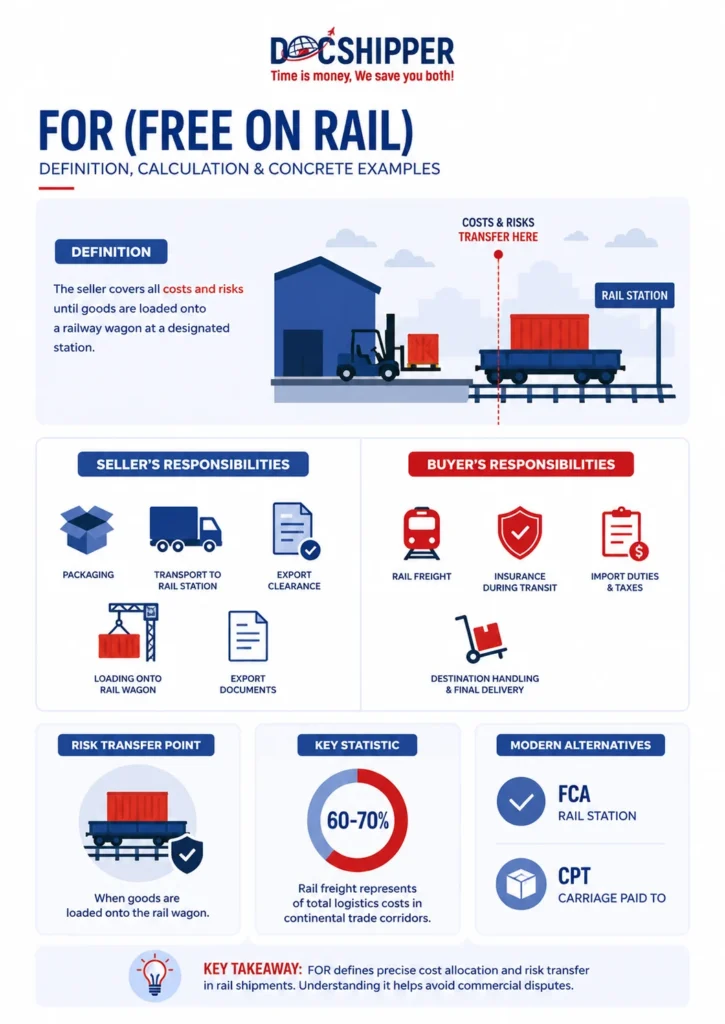
FOR (Free on Rail) is a commercial trade term indicating that the seller covers all costs and risks until goods are loaded onto a railway wagon at a designated station. This historical Incoterm, now largely replaced by modern equivalents, specifies the exact moment when responsibility transfers from seller to buyer in rail-based international shipments.Introduction
Many businesses involved in continental trade struggle to understand legacy shipping terms still appearing in contracts and documentation. FOR (Free on Rail) represents one such historical trade condition that continues to surface in European and Asian rail corridors.
Understanding FOR remains essential for companies managing cross-border rail shipments, particularly in regions where rail infrastructure dominates freight movement. This term defines critical cost allocation and risk transfer points that directly impact pricing negotiations and liability management.
Key characteristics of FOR include:
- Seller’s obligation to deliver goods loaded onto railway wagon at specified departure station
- Cost coverage includes packaging, export clearance, and loading onto rail
- Risk transfer point occurs when goods cross the rail wagon’s threshold
- Buyer’s responsibility for onward rail freight, insurance, and destination handling
- Documentation requirements include railway consignment note and export permits
In-Depth Analysis & Expert Insights
FOR originated in the early 20th century when railway transport dominated international trade across Europe and Asia. Though officially discontinued in the 2010 Incoterms revision, it persists in legacy contracts and regional trade agreements.
The term establishes a precise delivery point at the loading rail station. The seller must handle export formalities, secure goods properly for rail transit, and ensure loading complies with railway regulations. This includes proper wagon selection and load securing methods meeting EU railway safety directives or equivalent standards.
Under FOR conditions, the cost structure divides clearly: sellers cover all expenses until the goods rest on the wagon floor. Buyers assume freight charges, destination unloading, import duties, and final delivery costs. This division requires meticulous contract specification regarding the exact rail station and loading platform.
The risk transfer mechanism operates distinctly from modern Incoterms. Unlike FCA (Free Carrier), which transfers risk upon handover to the carrier, FOR specifically requires physical loading completion. This creates a narrow window where seller liability extends through the loading process itself.
Contemporary logistics often replaces FOR with FCA rail station or CPT (Carriage Paid To) alternatives. However, understanding FOR remains crucial when reviewing historical contracts or operating in markets where traditional terms persist. At DocShipper, we systematically verify which commercial terms apply in each contract to ensure proper cost allocation and liability management throughout the shipping process.
The documentation framework under FOR requires the seller to provide a railway consignment note (CIM waybill for international rail), commercial invoice, packing list, and export clearance certificates. Buyers receive these documents to claim goods at destination and complete import procedures.
Concrete Examples & Data
Consider a German machinery manufacturer selling equipment to a Romanian buyer under FOR Hamburg Hauptbahnhof. The seller’s cost structure includes:
| Cost Element | Seller Responsibility | Buyer Responsibility |
|---|---|---|
| Factory packaging | ✓ | — |
| Transport to Hamburg station | ✓ | — |
| Export customs clearance | ✓ | — |
| Loading onto rail wagon | ✓ | — |
| Rail freight Hamburg-Bucharest | — | ✓ |
| Insurance during transit | — | ✓ |
| Import duties Romania | — | ✓ |
Rail freight costs typically represent 60-70% of total logistics expenses in continental European trade corridors. Under FOR terms, buyers must negotiate these rates separately, creating pricing transparency but also administrative complexity.
A practical scenario demonstrates FOR’s application: A Polish steel producer ships coils to Austria. The agreed price is €45,000 FOR Katowice rail terminal. The seller bears €2,800 in domestic transport, €450 for export documentation, and €650 for crane loading. The buyer contracts rail freight independently at €3,200 and pays €1,100 for unloading and final delivery.
Risk management under FOR requires careful attention. If damage occurs during loading before the goods rest on the wagon, the seller remains liable. Once loaded, the buyer’s insurance coverage must activate immediately. This narrow risk transfer window demands precise documentation and often photographic evidence of loading completion.
Modern alternatives show clear advantages. FCA rail terminal eliminates the loading liability gap, while CPT provides buyers with single-invoice simplicity. However, FOR’s persistence in certain markets reflects entrenched commercial practices and existing contract frameworks that businesses must navigate.
Conclusion
FOR (Free on Rail) represents a specialized trade term requiring precise understanding of cost allocation and risk transfer in railway shipments. Though superseded by modern Incoterms, its legacy presence demands professional handling to avoid commercial disputes.
Need expert guidance on trade terms and international shipping logistics? Contact DocShipper for comprehensive support tailored to your specific requirements.
📚 Quiz
Test Your Knowledge: FOR (Free on Rail)
Under FOR terms, the seller's responsibility ends when:
A common misconception about FOR is that it:
A German machinery company ships equipment FOR Hamburg Hauptbahnhof to a Romanian buyer. Who is responsible for arranging and paying rail freight from Hamburg to Bucharest?
🎯 Your Result
📞 Free Quote in 24hFAQ | FOR (Free on Rail): Definition, Calculation & Concrete Examples
No, FOR was officially discontinued in the 2010 Incoterms revision by the International Chamber of Commerce. However, it may still appear in legacy contracts, regional trade agreements, or customary practices in certain markets. When encountered, parties should clarify whether modern equivalents like FCA or CPT are intended, or if the historical FOR definition applies. Legal counsel should review contracts containing FOR to ensure clarity.
FOR requires the seller to load goods onto the railway wagon, with risk transferring upon loading completion. FCA rail terminal transfers risk when goods are handed over to the carrier at the terminal, before physical loading. FCA provides clearer liability boundaries and aligns with modern logistics practices, whereas FOR's loading requirement creates a specific liability window during the loading process itself. FCA is the recommended modern alternative.
The buyer pays for rail freight from the loading station to the destination under FOR terms. The seller's cost responsibility ends once goods are loaded onto the wagon at the specified departure station. This means buyers must separately contract with railway operators or freight forwarders for the main carriage, giving them direct control over transit costs and service selection.
Under FOR, the buyer should arrange cargo insurance covering goods from the moment they are loaded onto the railway wagon through final delivery. The seller may maintain insurance until loading completion to protect against damage during their liability period. Policies should specify the exact transfer point and include railway-specific risks such as derailment, coupling impacts, and load shifting. Minimum coverage should meet CIM convention requirements for international rail.
The seller must provide a railway consignment note (CIM waybill for international movements), commercial invoice, detailed packing list, export license (if required), certificate of origin when needed, and proof of loading completion. These documents enable the buyer to claim goods at destination, complete import clearance, and verify condition upon receipt. Digital documentation is increasingly accepted where railway operators support electronic systems.
No, FOR specifically applies to railway transportation only. For sea freight, use FOB (Free on Board) or modern alternatives like FCA port terminal. For air freight, FCA airport is the appropriate term. Attempting to apply FOR to other transport modes creates contractual ambiguity and potential disputes over cost allocation and risk transfer points. Always select Incoterms matching the actual transport method.
If damage occurs before loading completion, the seller remains liable and must replace or repair goods at their expense. Once goods rest on the wagon and loading is complete, risk transfers to the buyer. This makes the loading moment critical for liability determination. Parties should document loading completion with timestamped photographs or signed handover certificates to establish the exact transfer point and prevent disputes.
The seller is responsible for export customs clearance under FOR, including obtaining export licenses, paying export duties (if any), and completing customs formalities at the country of origin. This includes preparing and submitting export declarations, securing required certificates, and ensuring goods comply with export control regulations. Buyers handle import clearance at destination, including payment of import duties, taxes, and compliance with destination country regulations.
FOR shipments must comply with applicable railway conventions such as CIM (Convention Internationale concernant le transport de Marchandises par chemin de fer) for international movements in Europe, or SMGS (Agreement on International Goods Transport by Rail) in Eurasia. These establish liability limits, documentation requirements, and operational standards. National railway safety regulations regarding load securing, hazardous materials, and wagon specifications also apply depending on the route and cargo type.
Yes, parties can modify FOR terms through explicit contract language, though this creates potential confusion. Modifications might include extending seller responsibility beyond loading, or shifting specific costs contrary to standard FOR allocation. However, such variations should be clearly documented with detailed specifications to avoid disputes. Using standard modern Incoterms with clear modifications is generally preferable to adapting discontinued terms like FOR.
Start with the FOR price (which includes goods value plus seller's costs to load at rail station). Add rail freight charges from loading station to destination, cargo insurance premiums, destination unloading fees, import duties and taxes, customs clearance charges, and final delivery costs. Unlike CIF or CPT, FOR requires buyers to price multiple logistics elements separately, demanding careful cost calculation and supplier coordination to determine true landed cost.
FCA (Free Carrier) rail terminal is the direct modern replacement, transferring risk upon handover to the carrier without requiring seller loading. CPT (Carriage Paid To) includes main carriage costs in the seller's price, simplifying buyer budgeting. CIP (Carriage and Insurance Paid To) adds insurance coverage. DAP (Delivered at Place) shifts more responsibility to sellers, covering delivery to the final destination. Choice depends on negotiating leverage, risk preference, and administrative capability.
Need Help with
Logistics or Sourcing ?
First, we secure the right products from the right suppliers at the right price by managing the sourcing process from start to finish. Then, we simplify your shipping experience - from pickup to final delivery - ensuring any product, anywhere, is delivered at highly competitive prices.


Fill the Form
Prefer email? Send us your inquiry, and we’ll get back to you as soon as possible.
Contact us




