


In short ⚡
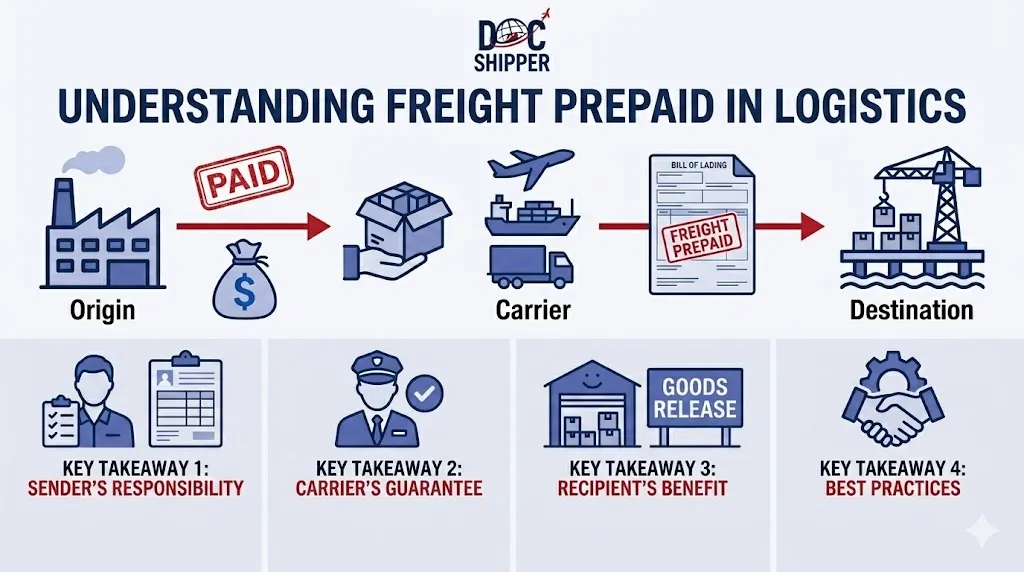
Freight Prepaid is a shipping term indicating that transportation charges have been paid by the shipper before goods are dispatched. This payment arrangement transfers the freight cost responsibility to the seller, who settles all carrier fees upfront, while the consignee receives the shipment without additional freight obligations at destination.
Introduction
One of the most common confusions in international trade involves understanding who bears freight costs and when payment occurs. The Freight Prepaid designation eliminates ambiguity by establishing clear financial responsibility before shipment departure.
This payment term plays a crucial role in cash flow management, customs clearance procedures, and commercial negotiations. Understanding its implications helps importers and exporters structure competitive offers while avoiding unexpected charges at destination ports.
Key characteristics of Freight Prepaid arrangements include:
- Shipper responsibility: The sender pays all transportation costs before cargo movement
- Bill of Lading notation: Transportation documents clearly indicate “Freight Prepaid” status
- Receiver advantage: Consignee receives goods without freight payment obligations
- Cost incorporation: Freight charges typically included in the total invoice price
- Risk allocation: Often aligns with Incoterms® like CFR, CIF, CPT, or CIP
Mechanisms & Legal Implications
The Freight Prepaid mechanism operates as a financial commitment documented on the Master Bill of Lading or Air Waybill. When shippers select this option, carriers require payment settlement or credit approval before releasing cargo for transport. This advance payment secures the carrier’s revenue while transferring cost burden to the shipping party.
From a contractual perspective, Freight Prepaid must align with the agreed Incoterms®. Under CIF (Cost, Insurance and Freight) terms, for example, sellers must arrange and prepay ocean freight to the destination port. The International Chamber of Commerce clarifies that this payment obligation exists independently of ownership transfer points.
The customs valuation impact represents another critical consideration. When freight is prepaid by the seller, importing countries may include these costs in the transaction value for duty calculation purposes. Customs authorities examine whether freight charges appear separately on commercial invoices or are embedded in the goods’ price.
Documentation requirements demand precision. The Bill of Lading clause “Freight Prepaid” legally confirms payment status and prevents double-charging. Carriers stamp or print this designation prominently on transport documents, which customs brokers verify during clearance procedures.
At DocShipper, we systematically verify freight payment terms on all shipping documents to prevent customs delays and ensure alignment between commercial invoices, transport documents, and Incoterms® obligations. This verification process protects both shippers and consignees from unexpected charges or documentation discrepancies.
The liability framework also shifts under prepaid arrangements. Since sellers control carrier selection and payment, they bear responsibility for choosing reliable transporters and ensuring adequate service levels. This control mechanism allows shippers to negotiate better rates through volume commitments or preferred carrier agreements.
Concrete Examples & Data
Consider a German machinery manufacturer exporting equipment to Vietnam under CIF Haiphong terms. The commercial transaction illustrates typical Freight Prepaid mechanics:
| Cost Component | Amount (EUR) | Payment Responsibility |
|---|---|---|
| Machinery FOB Hamburg | 85,000 | Seller (base price) |
| Ocean Freight (Prepaid) | 4,200 | Seller (paid to carrier) |
| Marine Insurance | 950 | Seller (CIF requirement) |
| Total CIF Value | 90,150 | Invoiced to buyer |
| Import Duties (Vietnam) | 9,015 | Buyer (at destination) |
| Destination Handling | 1,200 | Buyer (not prepaid) |
In this scenario, the seller prepays the €4,200 ocean freight charge directly to Maersk Line before container departure. The Bill of Lading clearly states “Freight Prepaid,” and this amount appears in the CIF invoice total. The Vietnamese importer pays only destination charges and customs duties upon arrival.
Industry data reveals significant cost implications. According to 2024 logistics benchmarks, prepaid freight arrangements account for approximately 68% of international containerized shipments. Shippers choosing this method often negotiate annual contracts with carriers, achieving freight rate reductions of 12-18% compared to spot market rates.
A comparative analysis of payment timing demonstrates cash flow impacts:
Freight Prepaid scenario: Seller pays $3,500 freight charge 5 days before shipment departure (day -5). This cost is immediately incorporated into working capital requirements but provides pricing certainty and buyer convenience.
Freight Collect scenario: Buyer pays the same $3,500 upon cargo arrival (day +30 for ocean shipment). The seller’s initial cash outlay is lower, but buyers may negotiate lower product prices to offset their freight payment responsibility.
Real-world data from container tracking systems shows that Freight Prepaid shipments experience 23% fewer delivery delays compared to collect arrangements. This efficiency stems from simplified documentation, pre-verified payment status, and reduced port clearance complications.
Conclusion
Freight Prepaid represents more than a payment method—it’s a strategic tool for managing international trade costs, documentation clarity, and buyer relationships. Understanding its mechanics enables competitive pricing while ensuring smooth customs clearance and delivery processes.
Need assistance structuring your freight payment terms or navigating international shipping documentation? Contact DocShipper for expert guidance on optimizing your logistics strategy.
📚 Quiz
Test Your Knowledge: Freight Prepaid
1. What does "Freight Prepaid" fundamentally indicate in international shipping?
2. A common misconception is that Freight Prepaid and CPT (Carriage Paid To) are identical. Which statement correctly distinguishes them?
3. Your German supplier ships machinery to Vietnam under CIF Haiphong terms with ocean freight of €4,200 prepaid. How should customs authorities in Vietnam typically treat this freight cost?
🎯 Your Results
📞 Free Quote in 24hFAQ | Freight Prepaid: Definition, Calculation & Concrete Examples
Freight Prepaid means the shipper pays transportation charges before cargo departure, while Freight Collect requires the consignee to pay freight costs upon delivery at destination. The choice affects cash flow, pricing strategies, and who controls carrier selection. Prepaid arrangements typically align with seller-controlled Incoterms® like CIF or CPT, whereas collect terms suit buyer-controlled arrangements like FOB or EXW.
Modifications depend on carrier policies and booking stage. Before cargo loading, most carriers allow changes with proper authorization from both shipper and consignee, though administrative fees may apply. After departure, switching payment responsibility becomes extremely difficult and may violate the original Bill of Lading contract. Always confirm payment terms during booking and ensure they match your Incoterms® obligations.
Customs authorities in most countries include prepaid freight costs in the transaction value when calculating import duties. Under CIF terms, for example, the customs value comprises the goods' price, insurance, and freight to the port of importation. Proper documentation showing the freight component separately helps customs officers verify correct duty calculations. This inclusion typically increases the dutiable value compared to FOB pricing.
The carrier or their authorized agent stamps or prints "Freight Prepaid" on the Bill of Lading or Air Waybill after receiving payment confirmation. This notation appears prominently on both the original document and all copies. Freight forwarders coordinating shipments also verify this designation matches the shipper's payment instructions and commercial invoice terms before releasing documents to consignees.
When shippers prepay freight under fixed-rate contracts, they are protected from subsequent rate increases during that shipment. However, if the cargo's actual weight or volume exceeds declared measurements, carriers may invoice additional charges separately. These supplementary fees typically become the shipper's responsibility unless the sales contract specifically transfers such overages to the buyer. Always verify cargo specifications before booking to avoid unexpected charges.
Not exactly. CPT is an Incoterms® rule defining seller obligations to arrange and pay for main carriage to a named destination. Freight Prepaid is a payment status indicating when freight charges were settled. CPT shipments always involve prepaid freight, but Freight Prepaid can apply to various Incoterms® including CFR, CIF, CPT, CIP, DAP, or DDP. The key distinction is that CPT defines comprehensive seller responsibilities, while Freight Prepaid solely addresses payment timing.
Absolutely. Air Waybills frequently display "Freight Prepaid" designations for international air shipments. The mechanism operates identically to ocean freight—the shipper pays airline charges before departure, and the Air Waybill documents this payment status. Air freight prepaid arrangements are particularly common under CPT or CIP terms for time-sensitive cargo, with payment typically processed through IATA-approved cargo agents or directly with airlines.
Generally no. Freight Prepaid typically covers main carriage costs from origin to destination port or airport. Destination terminal handling charges (THC), container demurrage, port storage fees, and delivery to final consignee usually remain separate charges. However, some comprehensive shipping contracts may include these costs under "all-inclusive" prepaid arrangements. Always clarify exactly which charges are covered in prepaid agreements to avoid surprises at destination.
Customs officers verify prepaid freight through the Bill of Lading or Air Waybill notation, commercial invoice breakdown showing freight as a separate line item, and sometimes the freight invoice from the carrier to the shipper. Maintaining copies of payment receipts, cargo insurance certificates showing CIF values, and correspondence confirming Incoterms® terms provides additional documentation. Clear, consistent documentation across all shipping papers prevents clearance delays.
Tax treatment varies by jurisdiction, but generally, prepaid freight costs qualify as deductible business expenses for sellers. When incorporated into the sales price under CIF terms, the entire amount becomes part of taxable revenue, with freight costs offsetting as expenses. VAT or GST implications depend on whether freight services are subject to domestic or international taxation rules. Consult tax professionals to ensure proper accounting treatment for your specific situation.
Indirectly, yes. When sellers control freight arrangements through prepaid terms, they often negotiate better insurance rates through established carrier relationships or bundled logistics services. Additionally, prepaid freight under CIF terms includes mandatory cargo insurance, which sellers can often secure at lower premiums through volume policies. This consolidated approach typically costs less than buyers arranging separate insurance coverage for collect shipments, though actual savings depend on shipment frequency and cargo values.
If carriers attempt to collect freight charges despite prepaid documentation, immediately present the original Bill of Lading showing "Freight Prepaid" notation and payment receipts. Contact the carrier's customer service and escalate to their disputes department if necessary. The prepaid notation creates a legal obligation preventing double-charging. Document all communications, and if resolution fails, consult maritime lawyers or file complaints with relevant shipping authorities. Most disputes resolve quickly when proper documentation is presented.
Need Help with
Logistics or Sourcing ?
First, we secure the right products from the right suppliers at the right price by managing the sourcing process from start to finish. Then, we simplify your shipping experience - from pickup to final delivery - ensuring any product, anywhere, is delivered at highly competitive prices.


Fill the Form
Prefer email? Send us your inquiry, and we’ll get back to you as soon as possible.
Contact us




