


In short ⚡
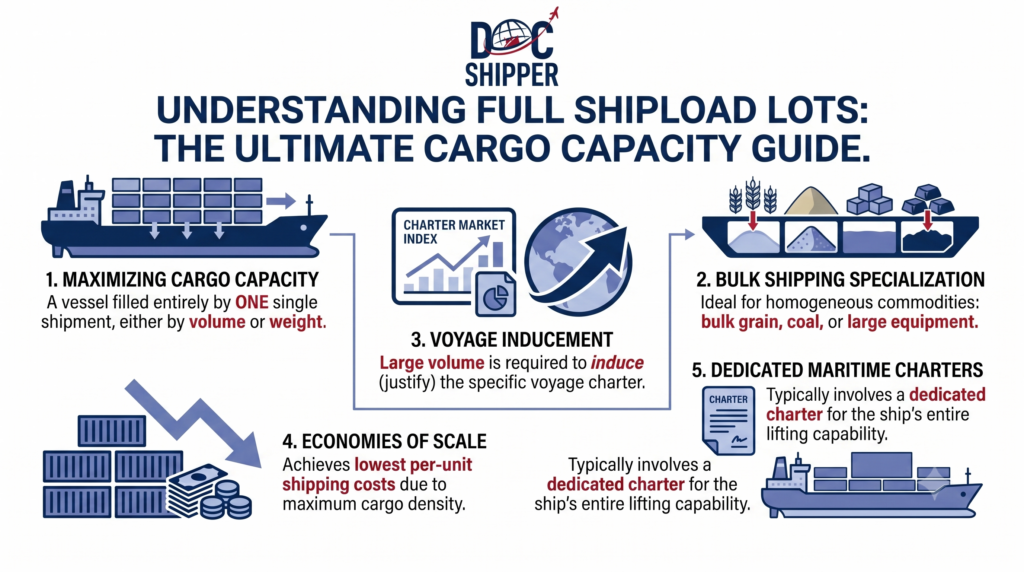
Full Shipload Lot (F) is a bulk transportation term indicating that cargo occupies the entire capacity of a vessel or container, typically for homogeneous goods shipped directly from manufacturer to buyer. This consolidation method eliminates intermediate handling, reduces per-unit costs, and ensures dedicated transport from origin to destination port.
Introduction
Many importers struggle with inefficient cargo consolidation, paying premium rates for partial loads or facing delays due to multi-stop routing. Understanding Full Shipload Lot (F) logistics transforms this challenge into a competitive advantage.
In international trade, controlling transportation costs directly impacts profit margins. The F designation represents the most cost-efficient shipping method for large-volume transactions, particularly in commodity trading and manufacturing supply chains.
Key characteristics of Full Shipload Lots include:
- Exclusive vessel or container allocation – No cargo from other shippers
- Direct routing – Port-to-port shipment without intermediate stops
- Volume-based pricing – Lower per-unit freight costs compared to LCL
- Simplified documentation – Single bill of lading for entire shipment
- Predictable transit times – No delays from cargo consolidation/deconsolidation
Operational Mechanisms & Logistics Expertise
Full Shipload Lots operate under specific contractual frameworks that differ fundamentally from Less-than-Container Load (LCL) arrangements. The shipper assumes full responsibility for loading optimization, meaning cargo must utilize at least 85-95% of available space to justify economic viability.
In maritime shipping, this translates to either booking an entire container (20ft, 40ft, or 40ft High Cube) or chartering dedicated vessel space for bulk commodities. The critical distinction lies in liability transfer: with F shipments, demurrage charges apply immediately if unloading delays occur, unlike shared containers where costs distribute across multiple consignees.
Documentation requirements streamline significantly under Full Shipload Lot protocols. A single Bill of Lading covers the entire shipment, eliminating complex cargo allocation paperwork required in consolidated loads. Customs clearance accelerates because inspectors examine homogeneous cargo rather than mixed goods from multiple sources.
According to World Trade Organization logistics guidelines, Full Shipload Lots reduce handling costs by 30-40% compared to LCL equivalents for shipments exceeding 15 cubic meters. The door-to-door transit time decreases by an average of 5-7 days due to eliminated consolidation warehousing steps.
At DocShipper, we systematically analyze shipment volumes to determine F viability, ensuring clients avoid unnecessary LCL charges when cargo justifies full container booking. Our volume threshold calculators assess whether partial shipments should wait for additional orders to reach Full Shipload Lot economies.
The contractual framework for F shipments includes Freight All Kinds (FAK) rates when commodities vary but originate from a single shipper. This flexibility allows manufacturers to combine multiple product lines while maintaining Full Shipload Lot pricing advantages, provided total volume meets minimum thresholds.
Concrete Examples & Comparative Data
Understanding Full Shipload Lot economics requires concrete cost comparisons across different shipping scenarios. The following table illustrates freight rate differentials for a standard Shanghai-Rotterdam trade lane:
| Shipment Type | Volume | Rate per CBM | Total Cost | Transit Days |
|---|---|---|---|---|
| LCL (Partial) | 8 CBM | $85 | $680 | 32-38 |
| Full Shipload (20ft) | 28 CBM | $52 | $1,456 | 26-30 |
| Full Shipload (40ft) | 58 CBM | $38 | $2,204 | 26-30 |
| Full Shipload (40ft HC) | 68 CBM | $35 | $2,380 | 26-30 |
The data reveals a 38% cost reduction per cubic meter when upgrading from LCL to 40ft High Cube Full Shipload Lot. However, the break-even point occurs around 17-20 CBM, where container rental costs offset per-unit savings.
Use Case: Electronics Manufacturer
A Taiwanese electronics company ships 22 CBM of LED components monthly to German distributors. Initially using LCL at $82/CBM ($1,804 total), they switched to Full Shipload Lot 20ft containers. New costs: $1,500 per shipment, saving $304 monthly ($3,648 annually). Additional benefit: transit time decreased from 35 to 28 days, improving inventory turnover by 12%.
Bulk Commodity Example
A Brazilian coffee exporter ships 1,200 metric tons quarterly to European roasters. Using Full Shipload Lot bulk vessel charter, the per-ton freight cost drops to $42 versus $68 for containerized coffee in standard 20ft units. This $31,200 quarterly saving offsets longer port handling times (14 days vs. 7 days for containers).
Key decision factors for Full Shipload Lot viability:
- Volume threshold – Minimum 15 CBM for standard containers, 500+ MT for bulk charters
- Cargo homogeneity – Single commodity or compatible products under one HS code
- Time sensitivity – Acceptable if 5-7 day consolidation delays are tolerable
- Destination infrastructure – Port must handle container/bulk discharge efficiently
- Regulatory compliance – Some markets restrict bulk imports without pre-arrival certification
Conclusion
Full Shipload Lot (F) shipping transforms high-volume logistics into a strategic cost advantage, reducing per-unit freight expenses by up to 40% while accelerating transit times. Proper volume analysis and route optimization remain critical to maximizing these benefits.
Need assistance determining whether Full Shipload Lot logistics suit your import/export operations? Contact DocShipper for a customized volume assessment and freight rate comparison.
📚 Quiz
Test Your Knowledge: Full Shipload Lot (F)
What is the primary characteristic of a Full Shipload Lot (F)?
A manufacturer has 12 cubic meters (CBM) of electronic components to ship. Which statement is correct?
Your Full Shipload Lot container arrives at the destination port but unloading is delayed by 6 days beyond the free time period. Who bears the demurrage charges?
🎯 Your Result
📞 Free Personalized QuoteFAQ | Full Shipload Lot (F): Definition, Calculation & Concrete Examples
The threshold varies by container type. For maritime shipping, 15-17 cubic meters justifies a 20ft container, while 28-30 CBM requires a 40ft unit. Bulk commodities need 500+ metric tons for dedicated vessel charter. Economic viability depends on specific trade lanes and commodity types, with DocShipper's calculators providing precise break-even analysis.
Full Shipload Lot (F) is a broader term encompassing both containerized FCL and bulk vessel charters, while FCL specifically refers to container shipping. F applies to any exclusive vessel space allocation, including break-bulk and dry bulk commodities. Both eliminate cargo consolidation but F covers non-containerized transport methods.
Yes, under Freight All Kinds (FAK) agreements. A single shipper can combine multiple product lines in one container, maintaining Full Shipload Lot rates. However, customs may require individual packing lists for each SKU, and incompatible goods (hazardous + non-hazardous) face segregation requirements that increase costs.
Container demurrage averages $75-150 per day after the free time period (typically 5-7 days at destination). Bulk vessel demurrage ranges from $8,000-25,000 daily depending on ship size. Full Shipload Lot shippers bear 100% of these costs, unlike LCL where charges distribute among multiple consignees.
Compare LCL rates (per CBM) multiplied by your volume against Full Shipload container rental plus inland haulage. Add 10-15% buffer for unexpected charges. If Full Shipload total is lower and volume exceeds 60% container capacity, F becomes economical. DocShipper provides free break-even calculators for specific trade routes.
Full Shipload Lots use a single Bill of Lading covering the entire shipment, while LCL requires master and house B/Ls. Packing lists for F are simplified since cargo originates from one source. Customs declarations remain similar, but F shipments often receive faster inspection processing due to cargo uniformity.
Insurance premiums average 0.3-0.6% of cargo value for Full Shipload Lots versus 0.5-0.9% for LCL, due to reduced handling risks. However, total insured value is higher, potentially increasing absolute premium costs. Coverage terms remain standard under Institute Cargo Clauses, but claims processing accelerates with single-shipper cargo.
Technically yes, through co-loading agreements, but this negates most F advantages. Shared containers face LCL-style consolidation delays and split liability. Unless both parties ship identical goods to the same destination with synchronized schedules, maintaining separate Full Shipload Lots proves more efficient.
Container utilization significantly affects emissions. A fully loaded 40ft container produces approximately 18 kg CO2 per ton-km, while half-filled containers double this rate to 36 kg. Full Shipload Lots optimize space usage, reducing per-unit emissions by 25-35% compared to inefficient LCL consolidation with multiple transport legs.
You pay for unused space, as Full Shipload Lot rates charge per container regardless of fill level. Below 60% utilization, LCL becomes more economical. Strategic options include consolidating multiple orders, sharing space with your own subsidiary shipments, or using collapsible dunnage to prevent cargo shifting in partially filled containers.
Not officially, but practical advantages exist. Homogeneous cargo from a single shipper faces lower inspection probabilities (8-12% vs. 18-25% for mixed LCL). When inspections occur, single-commodity Full Shipload Lots clear 40% faster on average, as customs officers examine uniform goods more efficiently than diverse LCL cargo.
Peak season (August-October for Asia-Europe routes) sees Full Shipload container rates increase 150-300%, while LCL rates rise only 80-120%. However, advanced booking contracts lock Full Shipload rates for 3-6 months, providing cost predictability. Bulk commodity Full Shipload charters use quarterly pricing indexes, moderating seasonal volatility.
Need Help with
Logistics or Sourcing ?
First, we secure the right products from the right suppliers at the right price by managing the sourcing process from start to finish. Then, we simplify your shipping experience - from pickup to final delivery - ensuring any product, anywhere, is delivered at highly competitive prices.


Fill the Form
Prefer email? Send us your inquiry, and we’ll get back to you as soon as possible.
Contact us




:%20Definition,%20Calculation%20&%20Concrete%20Examples)