


In short ⚡
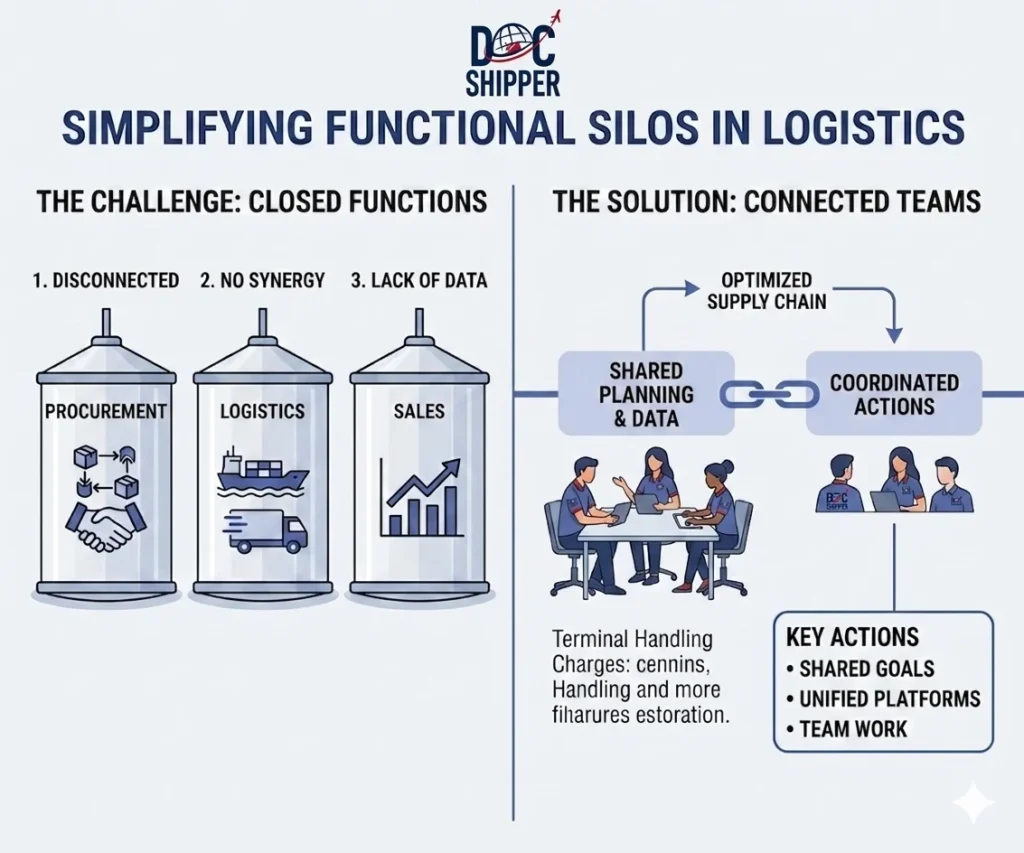
Functional silos are organizational structures where departments operate independently with limited cross-functional communication. In logistics, these isolated units create inefficiencies, delay decision-making, and fragment the supply chain, resulting in duplicated efforts, conflicting priorities, and reduced operational visibility across procurement, warehousing, and distribution functions.
Introduction
Many logistics companies struggle with departments that refuse to share information. Teams work in isolation, pursuing conflicting objectives without understanding how their decisions affect the entire supply chain.
This organizational dysfunction, known as functional silos, creates bottlenecks that damage customer satisfaction and inflate operational costs. In international trade, where coordination between freight forwarders, customs brokers, and warehouse operators is critical, siloed operations can delay shipments by weeks.
Key characteristics of functional silos include:
- Vertical communication: Information flows up and down within departments, rarely across them
- Conflicting KPIs: Each unit optimizes for different metrics without considering enterprise-wide goals
- Duplicated systems: Multiple departments maintain separate databases, inventory records, or customer files
- Knowledge hoarding: Teams protect information as a source of departmental power
- Blame culture: Problems are passed between departments rather than collaboratively solved
Understanding Functional Silos & Their Impact
Functional silos emerge from traditional organizational hierarchies where specialization takes precedence over integration. Each department develops distinct processes, technologies, and cultures that reinforce isolation rather than collaboration.
In logistics operations, common silo boundaries exist between:
- Procurement and warehousing: Purchasing teams order inventory without consulting warehouse capacity constraints
- Transportation and customer service: Carriers prioritize cost reduction while support teams promise delivery speeds they cannot guarantee
- IT and operations: Technology departments implement systems without understanding frontline workflow requirements
- Finance and logistics: Accounting teams enforce payment terms that conflict with supplier relationship strategies
- Domestic and international divisions: Cross-border shipments fall into gaps between regional teams
The legal and operational consequences are substantial. According to ISO supply chain standards, siloed operations directly violate integrated management principles required for certification. Companies face increased compliance risks when customs documentation prepared by one team conflicts with commercial invoices generated by another.
Technology amplifies silo effects when departments deploy incompatible systems. An ERP used by accounting may not communicate with the warehouse management system or the transportation management platform. Data remains trapped in departmental databases, preventing real-time visibility across the supply chain.
At DocShipper, we systematically break down these barriers by implementing unified communication protocols across procurement, freight forwarding, and customs clearance teams. Our integrated approach ensures that purchase orders, shipping documents, and import declarations share consistent data from origin to destination.
The human factor intensifies functional silos. Departmental managers build empires, protecting budgets and headcount. Performance evaluations reward individual unit success rather than cross-functional collaboration. Employees develop loyalty to their immediate supervisor rather than company-wide objectives.
Breaking silos requires structural redesign, not just cultural change. Matrix organizations, cross-functional teams, and process-based structures physically dismantle barriers. Shared KPIs aligned to customer outcomes force departments to coordinate. Integrated technology platforms eliminate duplicate data entry and create transparency.
Real-World Examples & Data
Research quantifies the damage caused by functional silos. A study by the Aberdeen Group found that companies with siloed supply chains experience 23% higher logistics costs and 17% longer order-to-delivery cycles compared to integrated operations.
Case Study: Electronics Importer
A European electronics distributor operated with separate teams for ocean freight, customs clearance, and warehouse receiving. The ocean team negotiated shipping schedules without consulting the warehouse, which had limited dock capacity on Fridays. The customs team prepared clearance documents using product codes that differed from the warehouse inventory system.
Results included:
- Containers arrived when no dock space was available, incurring €2,400 demurrage charges per container
- Product code mismatches delayed receiving by 3-5 days per shipment
- Sales team promised delivery dates based on vessel arrival, unaware of customs processing times
- Customer complaints increased by 34% in six months
After implementing weekly cross-functional planning meetings and a shared shipment tracking system, demurrage costs dropped by 78% and delivery accuracy improved to 94%.
| Metric | Siloed Operations | Integrated Operations | Improvement |
|---|---|---|---|
| Order Processing Time | 6.2 days | 3.8 days | -39% |
| Inventory Accuracy | 87% | 98% | +13% |
| Customs Clearance Errors | 12% of shipments | 2% of shipments | -83% |
| Communication Delays | 47 hours average | 4 hours average | -91% |
| Supply Chain Visibility | 23% real-time tracking | 89% real-time tracking | +287% |
Use Case: Automotive Parts Distribution
A North American automotive supplier maintained separate forecasting, procurement, and logistics departments. Demand planners created production schedules without input from transportation teams. When a major customer increased orders by 40%, the procurement team secured components but logistics lacked carrier capacity.
The result: $1.2 million in expedited freight charges and lost contracts worth $4.7 million due to missed delivery commitments. After restructuring into integrated value stream teams with representatives from all functions, the company reduced emergency shipments by 68% and improved on-time delivery to 96.3%.
Common silo-breaking strategies include:
- Shared performance metrics: All departments measured on total supply chain cost and customer satisfaction
- Cross-functional project teams: Temporary groups formed around specific initiatives like new product launches
- Integrated planning systems: Single platform accessible to procurement, operations, finance, and logistics
- Job rotation programs: Employees spend time in different departments to build understanding
- Physical co-location: Teams from different functions share office space to encourage informal communication
Conclusion
Functional silos transform organizational charts into supply chain obstacles. Breaking down these barriers through structural change, integrated technology, and aligned incentives directly improves delivery performance and reduces operational costs.
Need help integrating your logistics operations across departments and borders? Contact DocShipper for a comprehensive supply chain audit and integration strategy.
📚 Quiz
Test Your Knowledge: Functional Silos
Question 1: What is the core defining characteristic of functional silos in logistics organizations?
Question 2: A company's procurement team orders inventory without consulting warehouse capacity, resulting in containers arriving when no dock space is available. This scenario demonstrates which functional silo problem?
Question 3: According to research cited in the article, companies with siloed supply chains experience what measurable impact compared to integrated operations?
🎯 Your Result
📞 Free Quote in 24hFAQ | Functional Silo: Definition, Impact & Practical Examples
Silos emerge from traditional hierarchical structures that prioritize departmental specialization over cross-functional collaboration. As companies grow, teams develop distinct processes, technologies, and performance metrics that reinforce isolation. Budget competition, separate reporting lines, and lack of shared objectives further entrench boundaries between procurement, warehousing, transportation, and customer service units.
Siloed operations increase costs through duplicated efforts, communication delays, and uncoordinated decisions. When freight forwarders, customs brokers, and warehouse teams work independently, companies pay for expedited shipping to compensate for late documentation, incur demurrage charges from miscommunicated arrival times, and face customs penalties from conflicting paperwork. Studies show logistics costs rise by 15-25% in siloed organizations.
Technology enables integration but cannot eliminate silos alone. Unified platforms create data transparency and workflow automation across departments, but organizational culture and incentive structures must also change. Companies need cross-functional teams, shared KPIs, and leadership commitment to collaboration. The most effective approach combines integrated software with process redesign and performance metrics aligned to enterprise-wide goals rather than departmental objectives.
Departmental specialization means teams develop expertise in specific areas like customs compliance or freight negotiation. Functional silos occur when specialization prevents collaboration—when departments refuse to share information, coordinate activities, or align objectives. Effective organizations maintain specialized knowledge while ensuring communication flows freely across functional boundaries through regular cross-departmental meetings, integrated systems, and shared performance targets.
Meaningful silo reduction typically requires 12-18 months of sustained effort. Quick wins emerge within 3-6 months from improved communication protocols and shared dashboards. Deeper cultural change demands executive sponsorship, restructured reporting relationships, revised compensation systems, and sustained reinforcement. Companies that combine organizational redesign, technology integration, and leadership modeling see measurable improvements in cross-functional collaboration within the first year.
Leadership creates or eliminates silos through organizational design decisions, performance measurement systems, and cultural modeling. Executives who reward departmental success over enterprise objectives encourage silo behavior. Leaders who establish cross-functional teams, implement shared KPIs, participate in collaborative planning sessions, and visibly resolve inter-departmental conflicts signal that collaboration matters more than protecting turf. Leadership commitment determines whether integration efforts succeed or fail.
Customers experience silos as inconsistent communication, missed delivery commitments, and conflicting information from different departments. When sales teams promise delivery dates without consulting logistics, or customer service cannot access real-time shipment data, trust erodes. Research shows companies with siloed operations have 20-30% lower customer satisfaction scores and lose 15-40% more business to competitors offering integrated, transparent service.
Key indicators include high email volume between departments for routine coordination, frequent expedited shipping charges, inventory discrepancies between systems, customs clearance delays from documentation errors, customer complaints about inconsistent information, extended decision-making cycles requiring multiple approvals, and departments maintaining separate databases for shared information. Order-to-delivery time exceeding industry benchmarks by 20% or more often signals siloed operations.
International logistics amplifies silo problems because coordination requirements increase dramatically. Cross-border shipments involve more stakeholders—freight forwarders, customs brokers, overseas partners, multiple carriers, and regulatory agencies. When procurement, logistics, and compliance teams operate in silos, the complexity of international trade creates exponentially more failure points. A domestic delivery delay might cost hours; international silo dysfunction can add weeks and thousands in demurrage, storage, and expedited freight costs.
Yes, silos form even in small organizations when owners create strict role boundaries or when rapid growth outpaces communication systems. A 20-person freight forwarder can develop silos between ocean, air, and customs divisions if teams work from separate locations or use disconnected software. Small company silos often manifest as knowledge concentration in specific individuals rather than departmental barriers, but the effect—fragmented operations and poor information flow—remains identical.
Begin with cross-functional process mapping to visualize how work actually flows across departmental boundaries. Gather representatives from procurement, warehousing, transportation, customs, and customer service to document current workflows, identify handoff points, and reveal communication breakdowns. This creates shared understanding of how silos damage performance and builds consensus for integration. Follow immediately with quick-win projects—shared shipment tracking dashboards or weekly coordination meetings—that demonstrate collaboration benefits without requiring major structural change.
DocShipper operates with integrated service teams where procurement specialists, freight coordinators, customs brokers, and quality inspectors work from unified systems and shared client objectives. Every project has a dedicated account manager who coordinates across all functions, ensuring sourcing decisions consider shipping constraints, customs requirements inform supplier negotiations, and warehouse capacity guides order timing. Our cloud platform provides real-time visibility to all stakeholders, eliminating the information gaps that create traditional functional silos.
Need Help with
Logistics or Sourcing ?
First, we secure the right products from the right suppliers at the right price by managing the sourcing process from start to finish. Then, we simplify your shipping experience - from pickup to final delivery - ensuring any product, anywhere, is delivered at highly competitive prices.


Fill the Form
Prefer email? Send us your inquiry, and we’ll get back to you as soon as possible.
Contact us




