


In short ⚡
Granger Laws were a series of state regulations enacted in the United States during the 1870s-1880s to control railroad freight rates and warehouse charges. Named after the National Grange farming organization, these laws represented the first major governmental attempt to regulate private industry in the public interest, establishing precedents for modern transportation and commerce oversight.
Introduction
Why do modern freight rates require regulatory oversight? The answer traces back to the Granger Laws of the 1870s, when American farmers faced crippling transportation monopolies.
These landmark regulations transformed how governments interact with private logistics providers. They established principles that continue shaping international trade law, customs procedures, and freight forwarding practices today.
Key characteristics of Granger Laws include:
- Rate regulation: Government control over maximum freight charges
- Anti-discrimination provisions: Equal treatment for all shippers regardless of cargo volume
- Warehouse oversight: Regulation of grain storage facilities and fees
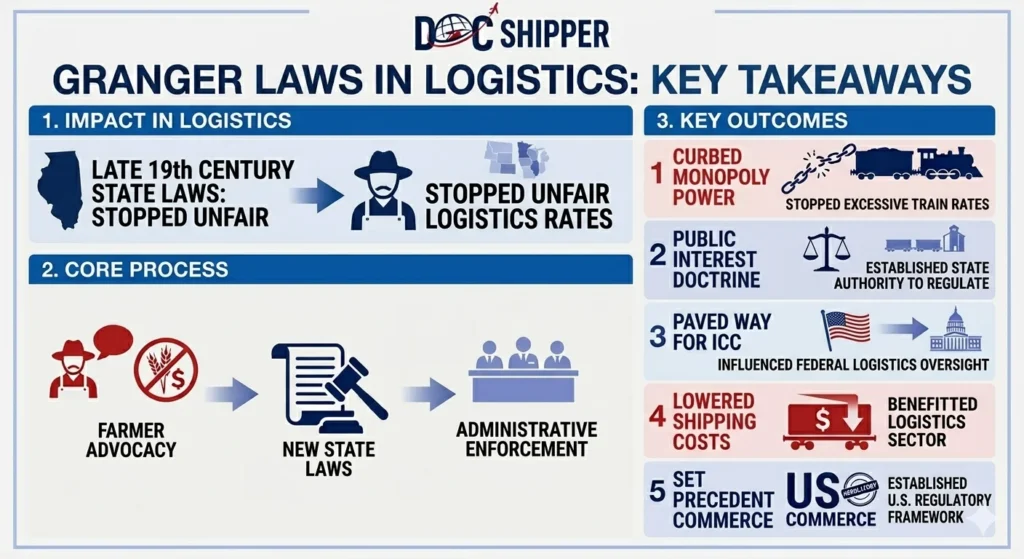
- Public interest doctrine: Recognition that transportation affects community welfare
- State enforcement mechanisms: Creation of railroad commissions with investigative powers
Historical Context & Regulatory Framework
The Granger movement emerged from desperate economic conditions. Midwestern farmers in the post-Civil War era depended entirely on railroads to transport grain to markets. Railroad companies exploited this dependency through discriminatory pricing, charging small farmers exorbitant rates while offering rebates to large corporations.
Between 1871 and 1874, Illinois, Iowa, Wisconsin, and Minnesota enacted the most significant Granger Laws. These regulations established maximum rate schedules and prohibited charging more for short hauls than long hauls on the same rail line—a common exploitative practice.
The legal battle reached the Supreme Court in Munn v. Illinois (1877), where justices upheld states’ rights to regulate businesses “affected with a public interest.” This landmark decision validated the Granger Laws and established the constitutional basis for transportation regulation. You can review the full decision in the Supreme Court archives.
However, railroad companies mounted fierce resistance. They challenged enforcement mechanisms and exploited jurisdictional loopholes. By the mid-1880s, most Granger Laws had been weakened or repealed, though their regulatory philosophy survived in the Interstate Commerce Act of 1887.
At DocShipper, we recognize how these historical precedents established the regulatory frameworks our clients navigate daily. Modern customs clearance procedures and freight rate negotiations rest on principles first articulated in Granger-era legislation.
Modern Trade Implications & Legacy
Though enacted 150 years ago, Granger Laws created regulatory DNA that permeates today’s international logistics. Their legacy appears in freight forwarder licensing requirements, anti-monopoly shipping regulations, and customs broker oversight.
Contemporary manifestations include:
| Granger Principle | Modern Equivalent | Regulatory Body |
|---|---|---|
| Maximum rate setting | Shipping Act container rate filing requirements | Federal Maritime Commission (FMC) |
| Anti-discrimination clauses | Common carrier obligations under 49 USC | Surface Transportation Board (STB) |
| Warehouse regulation | Bonded warehouse licensing by customs authorities | U.S. Customs & Border Protection |
| Public interest standard | Service contract transparency requirements | FMC / Department of Transportation |
| State enforcement commissions | Port authority oversight and fee regulation | State-level port commissions |
Use Case: Ocean Freight Rate Regulation
Consider a 2023 scenario where container rates from Shanghai to Los Angeles spiked 400% during supply chain disruptions. The FMC—a direct descendant of Granger-era thinking—investigated whether carriers violated common carrier obligations. This mirrors 1870s farmers challenging railroad monopolies, demonstrating unchanged core tensions between market freedom and public welfare.
International frameworks also reflect Granger principles. The Rotterdam Rules governing maritime transport incorporate anti-discrimination provisions remarkably similar to 1870s Illinois statutes. The CMR Convention for road freight in Europe establishes carrier liability standards rooted in the same “public interest” doctrine.
At DocShipper, we help clients understand how these historical regulatory foundations affect modern shipping contracts. When negotiating freight terms or challenging unreasonable detention fees, we leverage legal precedents established during the Granger era. For specialized guidance on your logistics contracts, contact our regulatory compliance team.
Conclusion
Granger Laws transformed theoretical free-market economics into practical, regulated commerce. Their legacy ensures that even in globalized supply chains, fairness and transparency remain enforceable standards rather than voluntary ideals.
Need assistance navigating the complex regulatory environment these laws helped create? Our experts at DocShipper provide comprehensive support for customs clearance, freight forwarding, and compliance challenges. Reach out today to discuss your specific logistics needs.
📚 Quiz
Test Your Knowledge: Granger Laws
What was the primary purpose of the Granger Laws enacted in the 1870s?
Which statement accurately reflects a common misconception about Granger Laws?
A modern freight forwarder faces a situation where an ocean carrier attempts to charge significantly higher rates for small shippers compared to large corporations for identical routes. Which Granger Law principle would be most relevant to challenge this practice?
🎯 Your Result
📞 Free Quote in 24hFAQ | Granger Laws: Definition, Historical Impact & Trade Implications
The Granger Laws aimed to protect agricultural producers from exploitative railroad practices by regulating freight rates, preventing discriminatory pricing, and ensuring fair access to transportation infrastructure. These regulations represented farmers' collective action against monopolistic control of essential logistics services.
Railroad companies successfully challenged state-level enforcement through litigation, exploited interstate commerce loopholes, and lobbied for repeal. The 1886 Supreme Court decision in Wabash v. Illinois limited states' authority over interstate rail traffic, necessitating federal legislation like the Interstate Commerce Act of 1887 to maintain regulatory oversight.
Modern freight forwarders operate under licensing requirements and common carrier obligations that trace directly to Granger-era principles. Regulations governing rate transparency, non-discriminatory service, and customer protection in international shipping stem from these 19th-century precedents establishing transportation as a regulated industry.
While primarily focused on railroads, Granger Laws also regulated grain elevators, warehouses, and storage facilities. The broader principle—that businesses serving essential public functions could be regulated—extended beyond rail transport to any logistics infrastructure affecting community welfare and commerce.
The National Grange (formally the Order of Patrons of Husbandry) was a farmers' advocacy group founded in 1867. By 1875, it had over 800,000 members across the Midwest and provided the political organizing structure that pressured state legislatures to enact railroad regulation laws.
This 1877 Supreme Court ruling established that states could regulate private businesses "affected with a public interest." The decision validated Granger Laws and created constitutional foundation for government oversight of transportation, warehousing, and other essential commercial services—principles still applied in modern regulatory frameworks.
Yes, many countries developed similar transportation regulations. European rail nationalization in the early 20th century, British Railway Regulation Acts, and various international conventions governing maritime and road freight all reflect comparable principles of public oversight over essential logistics infrastructure.
Customs brokers operate under licensing and bonding requirements that evolved from Granger-era regulatory philosophy. The principle that intermediaries handling commercial transactions must meet government standards of competency and financial responsibility originates in these 19th-century transportation regulations.
Port authorities' power to regulate terminal fees, storage charges, and access conditions derives from legal precedents established by Granger Laws. Modern port tariff structures and non-discriminatory access requirements directly implement principles first codified in 1870s Midwestern state legislation.
Yes, though through modern regulatory channels. Shippers can file complaints with the Surface Transportation Board (for rail), Federal Maritime Commission (for ocean freight), or relevant authorities alleging unreasonable rates or discriminatory practices—processes that evolved directly from Granger-era enforcement mechanisms.
As digital platforms dominate distribution, Granger Laws provide historical context for regulating essential infrastructure. Debates over Amazon's shipping practices, delivery fee transparency, and third-party marketplace access mirror 1870s concerns about monopolistic control of commerce-critical services.
The Granger movement recognized that transportation monopolies threatened economic security—a concern echoed in modern supply chain vulnerability discussions. Regulatory frameworks ensuring competitive, reliable logistics infrastructure trace their philosophical roots to these agricultural reformers' advocacy for protected, diversified transportation access.
Need Help with
Logistics or Sourcing ?
First, we secure the right products from the right suppliers at the right price by managing the sourcing process from start to finish. Then, we simplify your shipping experience - from pickup to final delivery - ensuring any product, anywhere, is delivered at highly competitive prices.


Fill the Form
Prefer email? Send us your inquiry, and we’ll get back to you as soon as possible.
Contact us




