


In short ⚡
A Handymax vessel is a medium-sized bulk carrier typically ranging from 40,000 to 60,000 deadweight tonnage (DWT), designed to transport dry bulk commodities like grains, coal, and fertilizers. These vessels offer optimal flexibility for ports with draft restrictions while maintaining efficient cargo capacity, making them essential for regional and global maritime trade routes.
Introduction
Many shippers confuse vessel size classifications, leading to suboptimal charter decisions and unnecessary port costs. Understanding the Handymax category is crucial for businesses engaged in bulk commodity trading, as vessel choice directly impacts freight rates, port accessibility, and delivery timelines.
In international maritime logistics, Handymax vessels occupy a strategic middle ground. They bridge the gap between smaller Handysize carriers and larger Panamax ships, offering unique advantages for specific trade routes and cargo types.
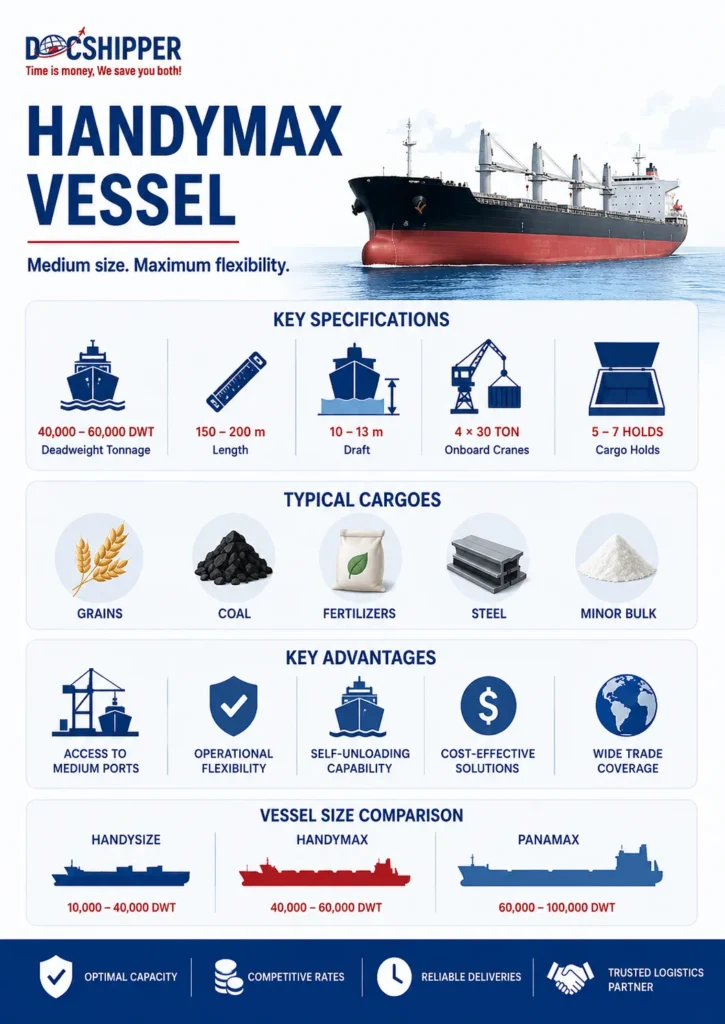
Key characteristics defining Handymax vessels include:
- Deadweight tonnage: 40,000 to 60,000 DWT (some classifications extend to 65,000 DWT)
- Typical length: 150 to 200 meters with beam width of 23 to 32 meters
- Draft restrictions: Usually 10 to 13 meters, enabling access to medium-depth ports
- Cargo holds: 5 to 7 holds with onboard cranes (typically 4 x 30-ton capacity)
- Primary cargoes: Agricultural products, fertilizers, coal, steel, and minor bulk commodities
Technical Specifications & Operational Characteristics
The Handymax classification emerged from practical port infrastructure limitations worldwide. Unlike larger Capesize or Panamax vessels, Handymax ships can navigate shallow-water ports, regional terminals, and rivers with moderate draft requirements.
Vessel dimensions follow International Maritime Organization (IMO) standards, though specific measurements vary by shipyard and design generation. Modern Handymax vessels incorporate fuel-efficient engines and eco-friendly ballast water treatment systems to comply with international environmental regulations.
The self-unloading capability distinguishes many Handymax vessels from larger bulk carriers. Onboard gantry cranes eliminate dependency on shore-based infrastructure, reducing port costs and enabling operations at underdeveloped terminals. This feature proves invaluable when servicing agricultural export terminals in South America or fertilizer import facilities in Southeast Asia.
From a commercial perspective, Handymax vessels offer superior fleet flexibility. Operators can deploy these ships across diverse trade routes—from transatlantic grain shipments to intra-Asian coal movements—without facing the charter market volatility affecting larger vessel categories.
The ballast water management requirements under the BWM Convention particularly affect Handymax operations. Vessels constructed after 2017 must install treatment systems, while older ships required retrofitting by 2024. This regulatory landscape impacts charter rates and vessel valuations.
At DocShipper, we systematically assess vessel suitability based on cargo type, destination port specifications, and cost optimization. Our logistics coordinators verify draft clearances and terminal capabilities before confirming Handymax charters, preventing costly delays or cargo transshipment scenarios.
Practical Examples & Market Data
Understanding Handymax economics requires examining real-world freight scenarios and current market conditions. The Baltic Exchange publishes daily freight rate assessments for various vessel sizes, including the Handymax category.
Case Study: Brazilian Soybean Export
A grain trader needs to ship 52,000 metric tons of soybeans from Santos, Brazil to Rotterdam. Port draft at Santos allows maximum 12.5-meter vessels. A Handymax vessel (55,000 DWT) provides optimal capacity without exceeding draft limits, while a Panamax (70,000+ DWT) would require partial loading or alternative ports.
Freight calculation breakdown:
| Parameter | Handymax Vessel | Panamax Alternative |
|---|---|---|
| Cargo Capacity | 52,000 MT (full utilization) | 52,000 MT (70% utilization) |
| Freight Rate (per ton) | $32/MT | $28/MT (higher daily rate offset) |
| Total Voyage Cost | $1,664,000 | $1,872,000 (inefficiency penalty) |
| Transit Time | 22 days | 21 days |
| Port Availability | Direct berth access | Limited berth options |
According to 2024 Baltic Exchange data, average Handymax time-charter rates fluctuate between $12,000 and $18,000 daily, depending on market conditions and vessel age. Spot market rates for specific routes show significant volatility—grain routes typically command premiums during harvest seasons.
Regional Trade Pattern Analysis:
- Atlantic basin: Handymax vessels dominate East Coast South America grain exports, handling approximately 40% of total soybean shipments
- Pacific routes: Coal movements from Indonesia to India and China constitute 35% of Handymax employment
- Intra-Asian trade: Fertilizer and steel products account for 25% of regional Handymax fixtures
- Specialty cargoes: Salt, sugar, and project cargo utilize remaining capacity
- Backhaul optimization: Return voyages often carry fertilizers or minor bulks to maximize revenue
The global Handymax fleet comprises approximately 2,400 vessels as of 2024, representing 18% of the total dry bulk carrier fleet by number (though only 12% by total capacity). Average vessel age stands at 11.2 years, with significant fleet renewal expected through 2027 due to environmental regulations.
Conclusion
Handymax vessels represent the optimal choice for mid-volume bulk shipments requiring port flexibility and cost efficiency. Their unique combination of cargo capacity, self-sufficiency, and accessibility makes them indispensable for regional commodity trades and specialized cargo movements.
Need expert guidance on vessel selection for your bulk cargo shipments? Contact DocShipper for customized maritime logistics solutions and freight optimization strategies.
📚 Quiz
Test Your Knowledge: Handymax Vessel
What is the primary defining characteristic of a Handymax vessel?
A shipper needs to transport 52,000 MT of soybeans from a port with 12.5-meter draft limitation. Which statement is correct?
What key operational advantage distinguishes Handymax vessels from larger bulk carriers like Capesize?
🎯 Your Result
📞 Free Quote in 24hFAQ | Handymax Vessel: Definition, Specifications & Practical Examples
Handymax vessels typically range from 40,000 to 60,000 DWT, though some industry classifications extend the upper limit to 65,000 DWT. Vessels below 40,000 DWT fall into the Handysize category, while those above 60,000-65,000 DWT transition to Supramax or Panamax classifications. The specific range depends on classification society standards and charter market conventions.
Supramax vessels represent the next size category above Handymax, ranging from 50,000 to 60,000 DWT with enhanced cargo handling equipment. The primary distinction lies in crane capacity (Supramax typically features 4 x 35-ton cranes versus Handymax's 4 x 30-ton) and slightly larger dimensions. Operationally, Supramax vessels access similar ports but offer greater cargo flexibility for heavy bulk commodities.
As of 2024, Handymax time-charter rates average $12,000-$18,000 per day depending on vessel specifications, age, and market conditions. Spot voyage rates vary significantly by route—Atlantic grain trades may command $30-$40 per metric ton, while Pacific coal movements range $18-$28 per ton. Seasonal fluctuations, fuel costs, and port congestion substantially impact actual charter pricing.
Most Handymax vessels can transit the original Panama Canal locks (maximum beam 32.3 meters, draft 12 meters) without restrictions. However, dimensions must be verified against specific vessel specifications. The expanded Neo-Panamax locks accommodate significantly larger vessels, making Handymax transit routine. Canal tolls are calculated based on vessel tonnage and cargo type, typically ranging $80,000-$150,000 per transit.
Primary cargoes include grains (soybeans, wheat, corn), coal, fertilizers, steel products, and minor bulk commodities like salt and sugar. Handymax vessels excel at transporting homogeneous dry bulk cargoes that don't require specialized handling. Their onboard cranes enable efficient loading/unloading of bagged or breakbulk cargoes when necessary, providing operational versatility unavailable on larger Capesize vessels.
Port draft limitations are the primary constraint—Handymax vessels drawing 10-13 meters can access approximately 85% of global bulk terminals, compared to 60% for Panamax vessels. Terminal crane availability matters less for Handymax due to onboard equipment. Berth length requirements (minimum 180-220 meters) and tidal windows also influence port suitability. Shippers must verify specific terminal capabilities before fixture.
Modern eco-design Handymax vessels consume approximately 22-28 metric tons of heavy fuel oil (HFO) daily at 14 knots cruising speed, or 18-22 tons when using compliant low-sulfur fuel oil (LSFO). Ballast voyage consumption reduces by 15-20%. Older vessels (pre-2010) may consume 30-35 tons daily. Total voyage fuel costs depend on bunker prices, distance, and speed optimization requirements.
Yes, Handymax vessels frequently transport project cargo including heavy machinery, construction equipment, and oversized industrial components. Their onboard cranes (typically 30-ton capacity) and flexible hold configurations accommodate non-standard cargoes. However, super-heavy lifts exceeding crane capacity require port-based heavy-lift equipment. Handymax vessels offer cost advantages over specialized heavy-lift ships for moderately sized project components.
IMO 2020 sulfur cap regulations require Handymax vessels to use 0.5% sulfur fuel or install exhaust gas cleaning systems (scrubbers). Energy Efficiency Design Index (EEDI) standards mandate fuel efficiency improvements for new builds. The Carbon Intensity Indicator (CII) rating system, effective since 2023, directly affects charter desirability—vessels rated D or E face market penalties. Ballast Water Management Convention compliance is mandatory for all Handymax vessels operating internationally.
Well-maintained Handymax vessels operate commercially for 25-30 years before recycling. Economic lifespan averages 20-25 years, after which maintenance costs and regulatory compliance expenses reduce profitability. Vessels built to enhanced structural standards (CSR-H requirements post-2006) demonstrate superior longevity. Second-hand vessel values depreciate approximately 4-6% annually during the first 15 years, then decline more rapidly approaching retirement age.
Handymax vessels represent approximately 18% of the global dry bulk fleet by vessel count but only 12% by total deadweight capacity. They demonstrate higher utilization rates (average 320 operating days annually) compared to larger Capesize vessels due to greater trade route flexibility. Regional concentration shows 40% deployment in Asian waters, 35% in Atlantic trades, and 25% globally mobile. Charter market liquidity for Handymax exceeds larger vessel categories.
Essential documentation includes vessel particulars (specifications, drawings, certificates), charter party agreement (typically GENCON or NYPE forms), cargo details (quantity, loading/discharge rates, stowage requirements), and port information (berth specifications, draft restrictions, local regulations). Additional documents encompass P&I Club certificates, classification society records, IMO certifications, and previous cargo declarations. Comprehensive documentation review prevents disputes and ensures regulatory compliance throughout the voyage.
Need Help with
Logistics or Sourcing ?
First, we secure the right products from the right suppliers at the right price by managing the sourcing process from start to finish. Then, we simplify your shipping experience - from pickup to final delivery - ensuring any product, anywhere, is delivered at highly competitive prices.


Fill the Form
Prefer email? Send us your inquiry, and we’ll get back to you as soon as possible.
Contact us




