


In short ⚡
The Hawthorne Effect is a psychological phenomenon where individuals modify their behavior when they know they are being observed. In logistics and supply chain management, this effect significantly influences worker productivity, quality control processes, and operational performance measurements, often leading to temporary improvements during audits or monitoring periods.
Introduction
Why do warehouse productivity metrics spike during management audits, only to decline once oversight ends? This puzzling pattern represents one of logistics’ most persistent challenges: the Hawthorne Effect distorting true operational performance.
Named after studies conducted at Western Electric’s Hawthorne Works factory in the 1920s-1930s, this phenomenon directly impacts how we measure efficiency in warehouses, distribution centers, and freight operations. Understanding this bias is crucial for accurate performance assessment and sustainable improvement strategies.
Key characteristics of the Hawthorne Effect in logistics contexts:
- Temporary performance spikes during observation periods or audits
- Behavioral modifications when workers know metrics are being tracked
- Measurement distortion affecting baseline operational data
- Attention-driven motivation rather than sustainable process improvements
- Return to baseline performance once observation ceases
Understanding the Mechanisms & Implications
The Hawthorne Effect operates through several psychological mechanisms that directly influence logistics operations. When warehouse staff know their pick rates are being monitored, they consciously or unconsciously adjust their work pace, technique, and focus levels.
This creates a fundamental challenge for performance baseline establishment. Standard operational metrics collected during implementation phases or audit periods may not reflect true day-to-day productivity. The European Logistics Association reports that observation-period metrics can overstate efficiency by 15-30% compared to unmonitored operations.
Three primary mechanisms drive this effect:
Attention and Recognition: Workers feel valued when management observes their activities, triggering increased motivation. In distribution centers, this manifests as reduced idle time, faster material handling, and heightened safety compliance during supervisor presence.
Evaluation Anxiety: The knowledge of being assessed creates performance pressure. Forklift operators may drive more carefully, order pickers may double-check accuracy, and loading dock personnel may expedite processes when they know metrics are being captured.
Novelty and Newness: Introduction of new monitoring systems or measurement tools generates temporary enthusiasm. Initial WMS (Warehouse Management System) deployments often show artificially high adoption rates and productivity gains that normalize within 3-6 months.
The legal and operational implications extend beyond simple measurement errors. According to ISO 9001 quality management standards, organizations must account for measurement bias when establishing performance benchmarks and improvement targets.
At DocShipper, we implement extended observation periods spanning multiple weeks to capture true operational baselines, accounting for initial Hawthorne Effect distortions before recommending process improvements or technology investments.
Practical Applications & Real-World Data
Understanding how the Hawthorne Effect manifests in real logistics scenarios enables better measurement design and interpretation. Research from supply chain management journals provides quantifiable insights into this phenomenon’s impact.
Case Study: Warehouse Productivity Monitoring
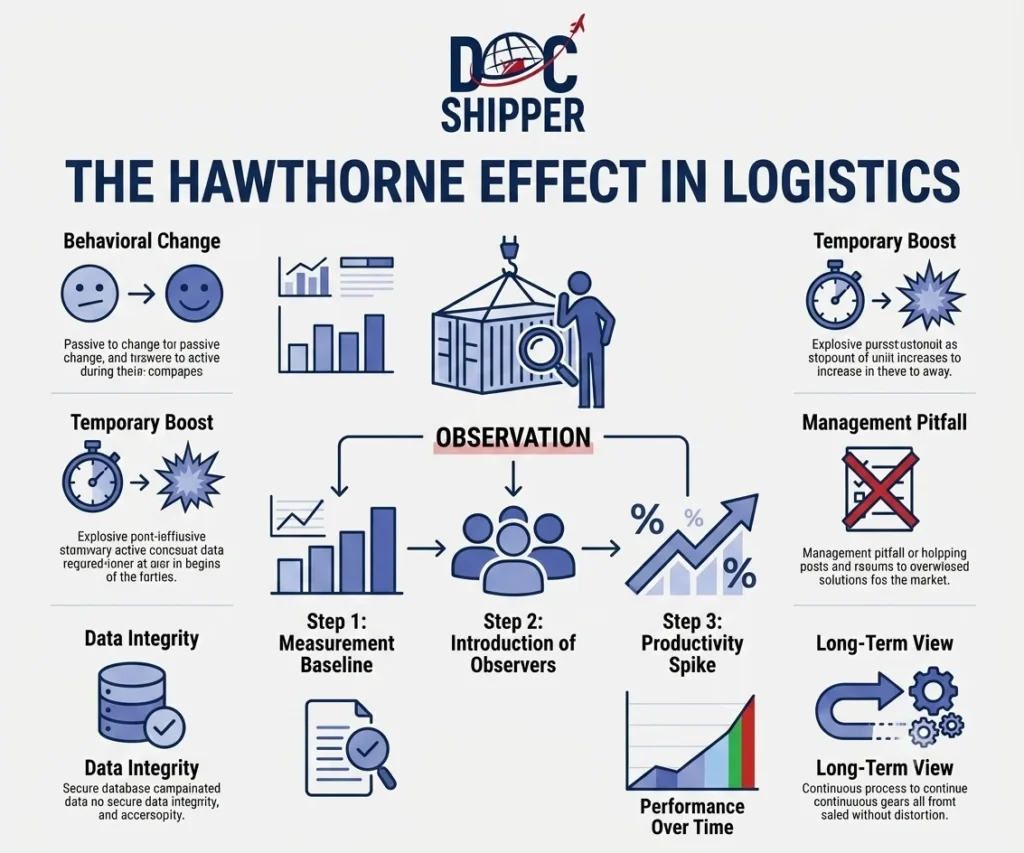
A European distribution center implementing continuous productivity tracking revealed striking patterns. During the initial two-week monitoring announcement phase, average pick rates increased from 85 units/hour to 112 units/hour (31.8% improvement). However, after six weeks of continuous monitoring, performance stabilized at 93 units/hour—only 9.4% above the original baseline.
This demonstrates the decay curve of the Hawthorne Effect: immediate spike, gradual decline, eventual stabilization at a modestly improved level. The modest residual improvement suggests that sustained attention does provide some lasting motivational benefit, though far less than initial observations suggest.
| Observation Phase | Average Productivity | Change from Baseline | Duration |
|---|---|---|---|
| Pre-announcement baseline | 85 units/hour | — | Ongoing |
| Active monitoring (weeks 1-2) | 112 units/hour | +31.8% | 2 weeks |
| Normalized monitoring (week 6+) | 93 units/hour | +9.4% | Sustained |
| Post-monitoring cessation | 87 units/hour | +2.4% | Long-term |
Freight Terminal Quality Control Data
A North American freight consolidation terminal analyzed damage rates during and after quality audits. During announced inspection periods, cargo damage incidents dropped by 47%. Unannounced spot checks three months later revealed damage rates only 12% below the original baseline, indicating that the majority of improvement was observation-driven rather than process-driven.
Key mitigation strategies based on documented logistics applications:
- Extended baseline periods: Collect data for 4-8 weeks minimum before assuming stable performance metrics
- Covert measurement techniques: Utilize automated systems (RFID, barcode scans, IoT sensors) that track without obvious human observation
- Normalized comparison periods: Compare similar operational periods rather than announcement vs. baseline phases
- Control groups: Maintain unmonitored comparison areas to quantify the observation effect magnitude
- Gradual visibility reduction: Implement phased monitoring intensity decreases to identify sustainable improvement levels
According to research published in the Journal of Operations Management, organizations accounting for Hawthorne Effect distortion achieved 23% more accurate ROI predictions for process improvement initiatives compared to those using observation-period data directly.
Conclusion
The Hawthorne Effect represents a critical consideration in logistics performance measurement, potentially distorting metrics by 15-30% during observation periods. Recognizing this phenomenon enables more accurate baseline establishment, realistic improvement targets, and sustainable operational enhancements rather than temporary behavioral modifications.
Need expert guidance on establishing accurate performance baselines for your logistics operations? Contact DocShipper for comprehensive assessment methodologies that account for measurement bias and deliver actionable insights.
📚 Quiz
Test Your Knowledge: Hawthorne Effect
Question 1: What does the Hawthorne Effect primarily describe in logistics operations?
Question 2: A warehouse shows a 32% productivity increase during the first two weeks of announced monitoring, but only 9% improvement after six weeks. This pattern indicates:
Question 3: Your company is calculating ROI for a new WMS implementation showing 28% productivity gains in the first month. How should you account for the Hawthorne Effect?
🎯 Your Result
📞 Free Quote in 24hFAQ | Hawthorne Effect: Definition, Impact & Practical Examples in Logistics
The Hawthorne Effect is when people change their behavior because they know they're being watched or measured. In warehouses, workers might work faster or more carefully when they know managers are tracking their performance, even if they return to normal patterns once observation stops.
The most pronounced effects occur in the first 2-4 weeks of observation, with performance spikes gradually declining over 6-8 weeks. While some residual improvement may persist, research shows 60-80% of initial gains disappear within three months once active observation ceases or becomes routine.
Complete elimination is impractical, but its impact can be minimized through automated tracking systems, extended baseline periods, and covert measurement techniques. Organizations can also quantify the effect's magnitude by comparing monitored versus unmonitored control groups to adjust performance expectations accordingly.
While automated systems reduce human behavioral variation, the effect still applies to human-machine interfaces. Workers operating WMS terminals, managing automated picking systems, or supervising robotic processes may alter interaction patterns when they know system usage is being analyzed, affecting apparent technology adoption rates and efficiency metrics.
Quality metrics typically show artificial improvement during audit periods as handlers exercise extra caution. Damage rates, documentation accuracy, and compliance measures may spike 20-50% during announced inspections but revert toward baseline once regular observation resumes. This makes unannounced audits more representative of true operational quality.
The Hawthorne Effect produces temporary behavioral changes without underlying process modifications, while genuine improvement involves systemic changes that persist regardless of observation. Sustainable gains maintain performance levels after monitoring intensity decreases, whereas Hawthorne-driven improvements quickly decay once attention diminishes.
Absolutely. Initial productivity metrics following technology implementation often overstate long-term benefits due to heightened attention and novelty. Conservative ROI models should discount first-quarter performance data by 15-25% or use extended measurement periods (6+ months) to capture stabilized productivity levels rather than observation-inflated figures.
Strategic visibility can be leveraged for short-term performance needs—announcing monitoring before peak seasons, implementing visible tracking during training periods, or using observation to establish performance ceilings that inform realistic improvement targets. The key is recognizing these as temporary interventions rather than sustainable operational states.
Yes, magnitude varies significantly. Manual tasks like order picking show stronger effects (25-35% spikes) because workers have direct behavioral control. Highly procedural functions like customs documentation show smaller effects (8-15%) due to regulatory constraints. Transportation operations fall in between, with driver behavior modification ranging from 12-20% during GPS monitoring initiatives.
Experienced workers typically demonstrate smaller effect magnitudes (10-15% improvement) because they already operate near performance ceilings. New employees show larger spikes (30-40%) as observation provides both motivation and accelerated learning. This differential should inform how companies interpret productivity data across workforce segments.
Advanced systems employ continuous passive data collection through IoT sensors, automated barcode scans, and system logs that capture performance without obvious observation. Machine learning algorithms can also identify statistical patterns consistent with Hawthorne behavior—sudden uniform improvements across metrics—and flag data periods requiring adjustment or extended validation.
Research shows slightly stronger effects in unionized environments (18-22% average spikes) compared to non-union facilities (14-18%), likely due to heightened awareness of performance measurement implications for collective bargaining. However, organizational culture and management-worker relationships exert greater influence than union status alone on the phenomenon's magnitude.
Need Help with
Logistics or Sourcing ?
First, we secure the right products from the right suppliers at the right price by managing the sourcing process from start to finish. Then, we simplify your shipping experience - from pickup to final delivery - ensuring any product, anywhere, is delivered at highly competitive prices.


Fill the Form
Prefer email? Send us your inquiry, and we’ll get back to you as soon as possible.
Contact us




