


In short ⚡
Hazardous goods are materials or substances that pose risks to health, safety, property, or the environment during transport. Classified under international regulations like the UN Model Regulations and IMDG Code, they include flammable liquids, corrosives, explosives, and toxic substances. Proper identification, packaging, labeling, and documentation are mandatory to ensure safe international shipment.
Introduction
Many businesses shipping internationally underestimate the complexity of transporting hazardous materials. A single misclassified chemical can lead to shipment delays, hefty fines, or catastrophic incidents during transit. Understanding hazardous goods regulations isn’t optional—it’s a legal requirement that protects lives and ensures supply chain continuity.
In global logistics, hazardous goods represent approximately 15% of all international cargo movements. From lithium batteries in electronics to industrial chemicals, these materials require specialized handling at every stage. Shippers must navigate a complex web of international conventions, mode-specific regulations, and country-specific restrictions.
- Nine hazard classes established by the UN covering everything from explosives to radioactive materials
- Mandatory documentation including Safety Data Sheets (SDS) and Dangerous Goods Declarations
- Packaging specifications that must meet UN performance testing standards
- Transport mode variations with different rules for air, sea, road, and rail shipments
- Criminal and civil liability for non-compliance, including prison sentences in severe cases
Regulatory Framework & Classification Systems
The foundation of hazardous goods regulation lies in the UN Recommendations on the Transport of Dangerous Goods, commonly called the Orange Book. This framework establishes the nine hazard classes that form the backbone of all modal regulations worldwide. Each class addresses specific risk profiles, from Class 1 explosives to Class 9 miscellaneous dangerous substances.
For sea transport, the International Maritime Dangerous Goods (IMDG) Code governs all hazardous cargo movements. Published by the International Maritime Organization, this regulation mandates specific stowage requirements, segregation rules, and emergency procedures. The IMO dangerous goods framework updates biennially to reflect new scientific understanding and emerging chemical compounds.
Air cargo follows the IATA Dangerous Goods Regulations (DGR), which impose stricter limitations due to altitude pressures and aircraft vulnerabilities. Certain substances permitted on vessels are completely prohibited by air. At DocShipper, we systematically cross-reference modal regulations to identify the most compliant and cost-effective routing for your hazardous shipments.
Classification begins with the UN number—a four-digit identifier assigned to each hazardous substance. For example, UN 1203 identifies gasoline, while UN 3480 covers lithium ion batteries. This number determines packaging groups (I, II, or III based on danger level), required labels, and permissible transport modes.
The proper shipping name must appear on all documentation exactly as specified in regulatory tables. Generic descriptions like “chemicals” are unacceptable. Shippers must also provide a technical name in parentheses for certain entries, particularly for “N.O.S.” (not otherwise specified) classifications. Customs authorities and carriers reject shipments with incomplete or inaccurate hazard communication.
Practical Examples & Transportation Requirements
Understanding classification in practice requires examining real-world cargo scenarios. Consider lithium batteries—one of the most commonly shipped hazardous goods. Batteries installed in equipment (UN 3481) have different requirements than standalone batteries (UN 3480). Power ratings determine whether special permits are needed, with batteries exceeding 100 Wh requiring Class 9 labeling.
Here’s a comparative breakdown of requirements across common hazardous goods categories:
| Class | Example Product | Packaging Group | Air Restrictions | Sea Stowage |
|---|---|---|---|---|
| Class 3 (Flammable Liquids) | Paint (UN 1263) | II or III | Limited quantity allowed | On deck or under deck with ventilation |
| Class 8 (Corrosives) | Battery acid (UN 2796) | II | Cargo aircraft only | Away from foodstuffs |
| Class 9 (Miscellaneous) | Lithium batteries (UN 3480) | N/A | 30% state of charge limit | Container shipment acceptable |
| Class 2.1 (Flammable Gas) | Aerosol cans (UN 1950) | N/A | Forbidden on passenger aircraft | Away from heat sources |
| Class 6.1 (Toxic Substances) | Pesticides (UN 2902) | I, II, or III | Packaging Group I forbidden | Segregation from foodstuffs mandatory |
A practical case study illustrates the stakes: An electronics manufacturer shipping 10,000 laptop batteries from China to Germany must comply with Section II packaging requirements. Each package needs specific markings including the lithium battery handling label and UN 3481. The shipment requires a Dangerous Goods Declaration even though batteries are installed in equipment. At DocShipper, we prepare all documentation and verify packaging compliance before cargo leaves the factory.
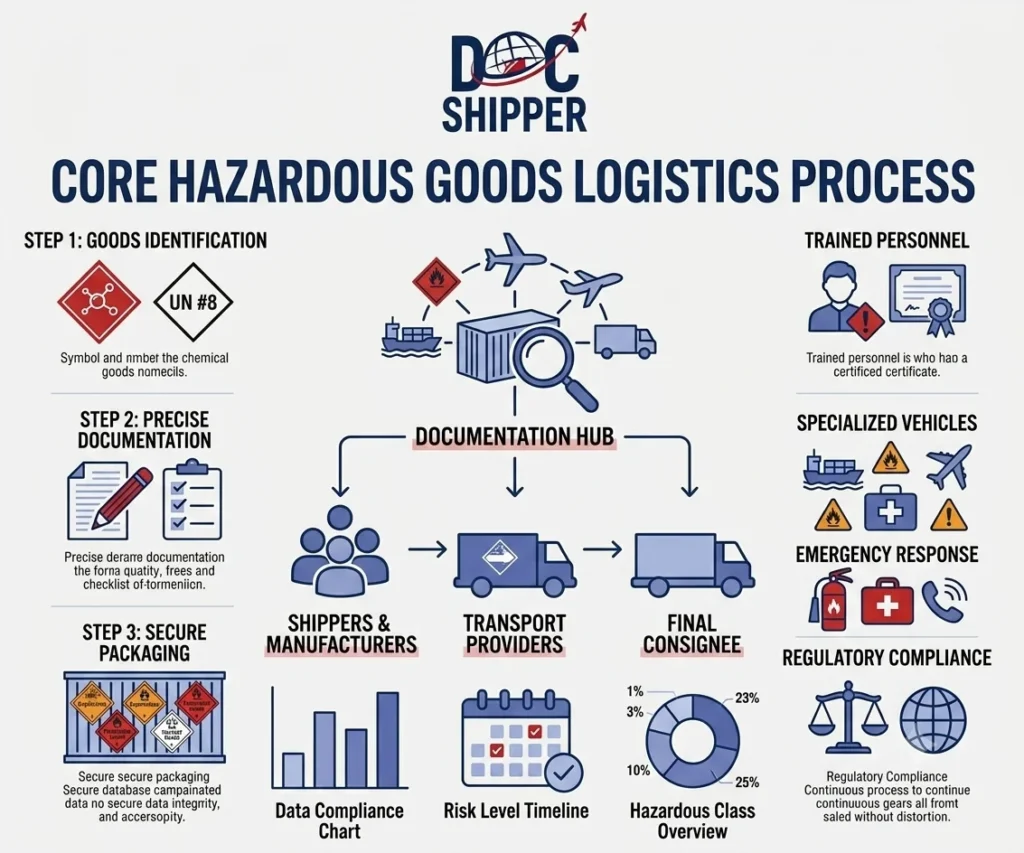
Documentation requirements vary by classification but always include the Shipper’s Declaration for Dangerous Goods. This legally binding document certifies that goods are properly classified, packaged, marked, and labeled. False declarations can result in criminal prosecution under national laws implementing international conventions.
Packaging specifications follow UN testing protocols with performance-oriented standards. Packaging must withstand drop tests, stack tests, and pressure tests depending on the hazard class. Manufacturers mark compliant packaging with UN certification codes indicating tested performance levels.
Labeling systems use diamond-shaped hazard labels with class-specific colors and symbols. Primary hazards require full-size labels (100mm x 100mm for most shipments), while subsidiary hazards need labels without class numbers. Emergency response information must be immediately visible to handlers.
Quantity limitations determine whether shipments qualify as “limited quantities” or “excepted quantities” with simplified requirements. For instance, up to 30ml of flammable liquid per inner packaging may qualify as limited quantity, reducing labeling and documentation burdens significantly.
Training certification for personnel handling dangerous goods is mandatory every two years. Employers must maintain training records and ensure staff understand classification, packaging, marking, labeling, documentation, and emergency response procedures specific to their roles.
Conclusion
Hazardous goods transportation demands precision, expertise, and unwavering compliance. Mishandling these materials creates legal exposure and operational risks that far outweigh the cost of proper procedures. With regulations constantly evolving and enforcement intensifying globally, partnering with specialists ensures your cargo moves safely and legally.
Need expert guidance on your hazardous shipments? Contact DocShipper for comprehensive dangerous goods logistics support tailored to your specific requirements.
📚 Quiz
Test Your Knowledge: Hazardous Goods
What is the primary purpose of classifying materials as hazardous goods?
A shipper describes their cargo as "chemicals" on the dangerous goods declaration. What is the compliance status of this documentation?
Your company ships lithium batteries installed in laptops from Shanghai to Rotterdam. Which UN classification and regulatory requirement applies?
🎯 Your Result
📞 Free Quote in 24hFAQ | Hazardous Goods: Definition, Classification & Practical Examples
The UN system classifies dangerous goods into nine classes: Class 1 (Explosives), Class 2 (Gases), Class 3 (Flammable Liquids), Class 4 (Flammable Solids), Class 5 (Oxidizing Substances and Organic Peroxides), Class 6 (Toxic and Infectious Substances), Class 7 (Radioactive Material), Class 8 (Corrosive Substances), and Class 9 (Miscellaneous Dangerous Goods). Some classes have subdivisions based on specific hazard characteristics.
Yes, but with strict compliance requirements. Lithium batteries must be classified under UN 3480 (standalone) or UN 3481 (contained in equipment). Air shipments require state of charge limitations, specific packaging, handling labels, and documentation. Sea freight has fewer restrictions but still requires proper classification and marking. Section II packaging allows simplified procedures for batteries meeting certain power thresholds.
The Dangerous Goods Declaration (DGD) is a mandatory document certifying that hazardous cargo is properly classified, packed, marked, labeled, and in proper condition for transport. It includes details like UN number, proper shipping name, hazard class, packing group, quantity, and shipper certification. The person signing assumes legal responsibility for accuracy and compliance with all applicable regulations.
Consult the product's Safety Data Sheet (SDS), which should list the UN number in Section 14 (Transport Information). If not listed, identify the product's hazard properties and cross-reference with the UN Dangerous Goods List in relevant modal regulations (IMDG Code for sea, IATA DGR for air). When no specific entry exists, use an N.O.S. (not otherwise specified) classification with appropriate technical name.
Limited quantities allow small amounts of dangerous goods to ship with reduced regulatory requirements. Specific quantity limits per inner packaging vary by class and packing group. When qualifying, shipments need only the limited quantity mark (diamond with "Y" inside) rather than full hazard labels. Documentation simplifies significantly, though packaging must still meet basic performance standards.
Standard cargo insurance often excludes or limits coverage for dangerous goods. Specialized hazardous cargo insurance addresses risks like contamination, environmental damage, and cleanup costs. Premiums vary based on hazard class, quantity, and transport mode. Shippers should declare hazardous nature to insurers; failure to disclose can void coverage entirely in event of claims.
Consequences range from shipment refusal and financial penalties to criminal prosecution. Carriers may impose penalty fees exceeding $10,000 per incident. Aviation authorities can levy fines up to $500,000 and impose prison sentences for willful violations. Beyond legal penalties, misdeclaration creates liability for injuries, environmental damage, and cleanup costs that can reach millions of dollars.
Yes. Each transport mode prohibits certain dangerous goods entirely. Air transport forbids explosives above certain classifications, large quantities of poisonous gases, and substances with extreme reactivity. Some countries ban specific chemicals domestically. The IMDG Code lists materials forbidden from vessel transport. Regulatory tables clearly indicate "FORBIDDEN" for prohibited items by mode and route.
Personnel involved in preparing, offering, or transporting hazardous goods must complete mode-specific dangerous goods training every 24 months. Training covers classification, packaging, marking, labeling, documentation, emergency response, and security awareness. Employers must maintain training records including employee names, dates, course content, and trainer qualifications. Untrained personnel cannot legally handle dangerous goods shipments.
Use UN-certified packaging appropriate for your material's packing group and hazard class. Packaging must display UN certification marks indicating successful performance testing. Follow combination packaging rules with proper inner and outer packaging. Ensure adequate cushioning, absorbent materials for liquids, and compatibility between product and packaging materials. Overpacking may be required when consolidating multiple hazardous items or combining with non-hazardous goods.
Yes, with proper segregation and compatibility assessment. Certain hazard classes must be separated from others according to segregation tables in modal regulations. Foodstuffs require special separation from toxic substances. Flammable materials need distance from oxidizers. Consolidation in containers requires expertise to ensure compliance with stowage and segregation requirements while maximizing space utilization.
IMDG governs sea transport while IATA DGR covers air cargo. Air regulations impose stricter quantity limits, additional packing requirements, and outright prohibitions on substances acceptable by sea. Aircraft altitude and pressurization create unique hazards not present in maritime transport. Both derive from UN Recommendations but adapt requirements to mode-specific risks. Shippers must comply with the regulation applicable to their chosen transport method.
Need Help with
Logistics or Sourcing ?
First, we secure the right products from the right suppliers at the right price by managing the sourcing process from start to finish. Then, we simplify your shipping experience - from pickup to final delivery - ensuring any product, anywhere, is delivered at highly competitive prices.


Fill the Form
Prefer email? Send us your inquiry, and we’ll get back to you as soon as possible.
Contact us




