


In short ⚡
Heijunka is a Japanese lean manufacturing technique that means "production leveling" or "smoothing." It eliminates fluctuations in production schedules by distributing work volume and variety evenly over time, reducing waste, inventory costs, and operational stress while improving delivery predictability in supply chain operations.Introduction
Many international logistics operations suffer from erratic production patterns that create bottlenecks, excessive inventory, and delayed shipments. When manufacturers produce in large batches or respond reactively to orders, the entire supply chain experiences volatility that increases costs and damages customer relationships.
Heijunka addresses this challenge by creating predictable workflows. Originating from the Toyota Production System, this approach has become essential for businesses engaged in import-export operations where timing, consistency, and resource optimization directly impact profitability.
Key characteristics of Heijunka include:
- Production leveling: Distributing manufacturing volume evenly across time periods rather than creating peaks and valleys
- Mix smoothing: Producing different product variants in small batches sequentially instead of large single-product runs
- Takt time synchronization: Aligning production pace with actual customer demand rates
- Visual management: Using Heijunka boxes or boards to schedule and track leveled production sequences
- Just-in-time enabler: Creating stable conditions necessary for pull-based inventory systems and reduced lead times
Heijunka Methodology & Implementation Expertise
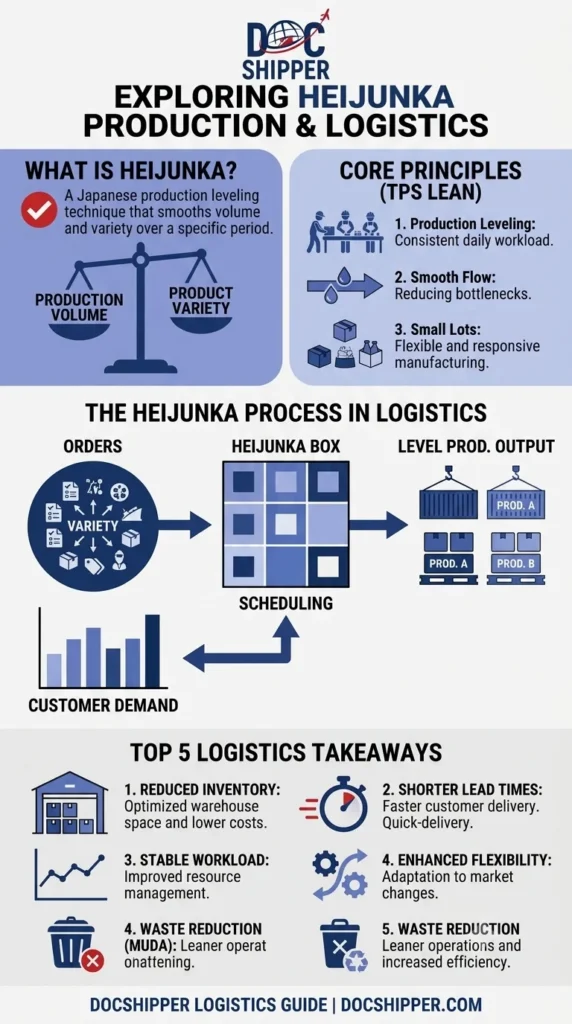
Implementing Heijunka requires understanding both volume leveling and product mix leveling. Volume leveling distributes total production quantities uniformly, while mix leveling sequences different product types to avoid long changeovers and resource imbalances.
The calculation begins with determining takt time, which represents the pace at which products must be completed to meet customer demand. Takt time = Available production time ÷ Customer demand rate. Once established, production schedules are designed to maintain this rhythm consistently.
A critical component is the Heijunka box, a visual scheduling tool with columns representing time intervals and rows representing product types. Kanban cards are placed in boxes to indicate production sequence, creating transparency across teams and preventing overproduction or underutilization.
From a regulatory perspective, leveled production patterns facilitate compliance with international trade requirements. Consistent output volumes enable more accurate customs declarations, predictable shipping schedules, and better coordination with freight forwarders. The World Customs Organization emphasizes the importance of supply chain visibility, which Heijunka naturally enhances.
The methodology reduces three fundamental wastes: mura (unevenness), muri (overburden), and muda (non-value-adding activities). By eliminating production spikes, organizations avoid overtime costs, rushed shipments, and quality defects associated with stressed operations.
At DocShipper, we help clients align their production leveling strategies with international shipping schedules. Our logistics coordination ensures that smoothed manufacturing outputs translate into optimized container loading, reduced demurrage fees, and improved delivery reliability across global supply chains.
Practical Examples & Performance Data
Consider an electronics manufacturer exporting to European markets. Previously, they produced 500 units of Product A on Monday, 300 units of Product B on Wednesday, and 400 units of Product C on Friday. This created 40% idle capacity on Tuesday and Thursday, followed by 30% overtime during peak days.
After implementing Heijunka, they redistributed production to 240 units daily across all three products in a repeating sequence (A-B-C-A-B). This resulted in:
| Metric | Before Heijunka | After Heijunka | Improvement |
|---|---|---|---|
| Lead Time | 12 days | 6 days | 50% reduction |
| Inventory Levels | €280,000 | €140,000 | 50% reduction |
| Labor Utilization | 68% | 92% | 24% increase |
| Shipping Frequency | Weekly | 3x per week | 200% increase |
| Overtime Costs | €15,000/month | €2,500/month | 83% reduction |
Another example involves an automotive parts supplier shipping components from Thailand to North American assembly plants. By applying pitch increment scheduling (grouping work into fixed time boxes matching container loading cycles), they synchronized production completion with vessel departure schedules.
The quantifiable results included:
- Container utilization: Increased from 73% to 96% through predictable production volumes that matched standard container capacities
- Demurrage charges: Eliminated $42,000 annual penalties by ensuring containers arrived at ports with cargo ready for immediate loading
- Quality defects: Reduced by 35% as workers maintained consistent processes without rushing during artificial deadlines
- Inventory turns: Improved from 8 to 14 annually, freeing capital for business expansion rather than warehouse storage
- On-time delivery rate: Increased from 81% to 97%, strengthening customer relationships and reducing expedited freight costs
Industry research shows that companies implementing Heijunka typically achieve 30-50% reductions in work-in-process inventory and 20-40% improvements in throughput time. These operational gains translate directly into supply chain advantages, particularly for international operations where shipping windows and customs clearance timing require precision.
Conclusion
Heijunka transforms volatile production environments into predictable, efficient operations that align seamlessly with international logistics requirements. By leveling both volume and mix, businesses reduce costs, improve quality, and enhance their competitive position in global markets.
Need support implementing production leveling strategies that integrate with your international shipping operations? Contact DocShipper for expert guidance on synchronizing manufacturing and logistics for optimal supply chain performance.
📚 Quiz
Test Your Knowledge: Heijunka
What is the primary purpose of Heijunka in manufacturing operations?
Which statement correctly describes the relationship between Heijunka and just-in-time (JIT) manufacturing?
A manufacturer ships to European markets weekly with erratic production causing 40% idle capacity some days and 30% overtime on others. How would implementing Heijunka most likely impact their international shipping operations?
🎯 Your Results
📞 Free Quote in 24hFAQ | Heijunka: Definition, Calculation & Practical Examples
Heijunka is a prerequisite for successful just-in-time (JIT) implementation. While JIT focuses on producing only what is needed when it is needed, Heijunka creates the stable, level production flow necessary for JIT to function effectively. Without production leveling, JIT systems experience disruptions from demand volatility, making inventory reduction and pull-based replenishment unreliable.
Yes, Heijunka is particularly valuable in high-mix environments where product variety creates scheduling complexity. By sequencing small batches of different products in repeating patterns, manufacturers avoid long changeovers and resource bottlenecks. The key is establishing appropriate pitch intervals that balance changeover efficiency with demand responsiveness, typically using visual scheduling boards to manage sequence complexity.
Production leveling creates predictable output volumes that align with container loading cycles and vessel departure schedules. Instead of rushing partial shipments or delaying full containers, leveled production ensures consistent cargo availability. This reduces demurrage charges, improves container utilization rates, and enables more accurate shipping forecasts for freight forwarders and customs brokers.
Initial implementation typically requires 3-6 months, including value stream mapping, takt time calculation, production sequence design, and team training. Full maturity often takes 12-18 months as organizations refine scheduling patterns, eliminate hidden constraints, and develop cultural acceptance of leveled workflows. Quick wins often appear within 6-8 weeks as basic volume smoothing reduces obvious bottlenecks.
Takt time equals available production time divided by customer demand rate. For example, if a facility operates 480 minutes per day and customers require 240 units daily, takt time is 2 minutes per unit. This establishes the production rhythm. Heijunka then distributes different product types within this cadence to maintain consistent flow while accommodating variety in customer orders.
Basic Heijunka implementation uses simple visual tools like physical scheduling boards with kanban cards. Advanced applications may incorporate manufacturing execution systems (MES) or enterprise resource planning (ERP) modules that automate leveling calculations and schedule adjustments. However, the underlying methodology emphasizes visual management accessible to all team members, making sophisticated software optional rather than mandatory for effective implementation.
Heijunka operates within defined planning horizons, typically freezing schedules for immediate periods while maintaining flexibility for future intervals. Sudden demand spikes are absorbed through safety stock buffers or managed through controlled schedule adjustments at natural replenishment points. The goal is stabilizing core operations while accommodating variation through strategic buffers rather than chaotic production changes that cascade disruption throughout the supply chain.
Frequent errors include attempting to level without first stabilizing basic processes, ignoring changeover time reduction before sequencing variety, setting pitch intervals too short or too long, failing to involve frontline workers in schedule design, and neglecting supplier coordination that creates upstream volatility. Successful implementations address process capability and changeover efficiency before imposing leveled schedules on unstable foundations.
Leveled production eliminates the need for large finished goods buffers that protect against erratic manufacturing output. By producing consistent daily volumes, companies can ship smaller, more frequent batches that reduce in-transit inventory and warehousing costs. This also minimizes obsolescence risk for products with short lifecycles, particularly important in industries like electronics, fashion, and perishable goods traded internationally.
Yes, service operations use production leveling concepts to smooth workload distribution. Call centers level agent schedules to match demand patterns, hospitals distribute elective procedures across available capacity, and logistics providers sequence shipment processing to avoid end-of-day bottlenecks. The fundamental principle—distributing work evenly to reduce waste and improve flow—applies broadly beyond manufacturing contexts.
Key performance indicators include production volume variance (coefficient of variation in daily output), schedule attainment rate, inventory turnover, lead time consistency, labor utilization stability, changeover frequency and duration, container fill rates for export shipments, and on-time delivery performance. Tracking these metrics reveals whether leveling efforts actually translate into operational and financial improvements rather than simply creating smoother-looking schedules.
Production leveling uses medium-term demand forecasts to establish baseline production rates, then adjusts incrementally as actual orders materialize. For international markets with longer lead times, leveled schedules provide stable foundations that accommodate forecast uncertainty through controlled flexibility rather than reactive chaos. This approach works particularly well when combined with sales and operations planning (S&OP) processes that align commercial forecasts with manufacturing capacity.
Need Help with
Logistics or Sourcing ?
First, we secure the right products from the right suppliers at the right price by managing the sourcing process from start to finish. Then, we simplify your shipping experience - from pickup to final delivery - ensuring any product, anywhere, is delivered at highly competitive prices.


Fill the Form
Prefer email? Send us your inquiry, and we’ll get back to you as soon as possible.
Contact us




