


In short ⚡
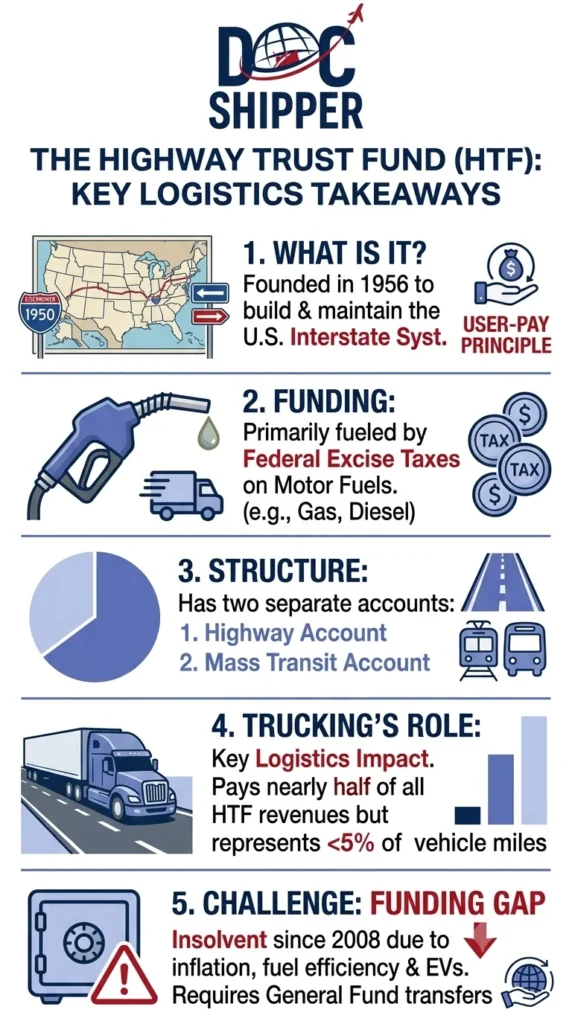
The Highway Trust Fund (HTF) is a U.S. federal fund established in 1956 to finance highway construction, maintenance, and mass transit projects. Funded primarily through federal fuel taxes, it ensures dedicated revenue for transportation infrastructure, supporting interstate commerce and import/export logistics critical to global supply chains.
Introduction
Many logistics professionals misunderstand how the Highway Trust Fund directly impacts their operations. Road quality, port access, and freight corridor efficiency all depend on this federal financing mechanism. Without adequate HTF funding, infrastructure deteriorates, causing shipment delays and increased transportation costs.
For international trade, the HTF represents more than just road maintenance. It underpins the entire U.S. inland transportation network connecting ports, warehouses, and distribution centers. Understanding its structure helps importers and exporters anticipate infrastructure investments affecting freight routes.
Key characteristics of the Highway Trust Fund include:
- Dedicated revenue source: Federal fuel taxes (gasoline, diesel) exclusively fund transportation projects
- Two-account structure: Highway Account (92%) and Mass Transit Account (8%) separate allocations
- Authorization cycle: Multi-year surface transportation bills determine spending priorities
- Solvency challenges: Recurring funding shortfalls require Congressional intervention
- Impact on logistics: Directly influences freight corridor development and intermodal connectivity
Funding Mechanisms & Legislative Framework
The Highway Trust Fund operates through excise taxes on motor fuels collected at the refinery level. Since 1993, the federal gasoline tax rate has remained fixed at 18.4 cents per gallon, with diesel taxed at 24.4 cents per gallon. This rate stagnation creates a fundamental challenge: as vehicle fuel efficiency improves and inflation erodes purchasing power, HTF revenue fails to keep pace with infrastructure needs.
The Federal Highway Administration (FHWA) administers fund distribution according to complex formulas established in surface transportation authorization bills. The current Infrastructure Investment and Jobs Act (IIJA) of 2021 authorized $350 billion over five years for highway and transit programs. States receive apportionments based on factors including lane-miles, vehicle-miles traveled, and fuel consumption data.
Legislative authority derives from the Federal Highway Act of 1956, which created the Interstate Highway System. This landmark legislation established the user-pays principle: those who use roads fund their construction through fuel purchases. The trust fund mechanism ensures transportation revenue cannot be diverted to general government spending.
Critical to international logistics, HTF allocations prioritize National Highway Freight Program (NHFP) corridors connecting ports, rail terminals, and border crossings. These designated routes receive enhanced funding for capacity improvements, recognizing their economic importance. At DocShipper, we monitor NHFP investments to advise clients on optimal warehouse locations and freight routing strategies.
The fund faces structural insolvency requiring periodic general fund transfers. Between 2008 and 2021, Congress authorized $157 billion in supplemental transfers to maintain positive balances. This dependency on non-transportation revenue undermines the original user-pays principle and creates uncertainty for long-term infrastructure planning affecting supply chain investments.
Concrete Examples & Financial Data
Understanding HTF impacts requires examining concrete financial flows and real-world project outcomes. The fund’s two-account structure demonstrates its dual focus on highway and transit infrastructure critical for multimodal logistics operations.
| Account | Annual Revenue (FY2023) | Primary Use | Logistics Impact |
|---|---|---|---|
| Highway Account | $46.8 billion | Interstate maintenance, bridge replacement, freight corridors | Direct road capacity affecting trucking efficiency |
| Mass Transit Account | $7.2 billion | Rail extensions, bus rapid transit, intermodal facilities | Port access and last-mile connectivity improvements |
| General Fund Transfer | $11.3 billion | Shortfall coverage | Ensures project continuity despite revenue gaps |
Case Study: Port of Los Angeles Access Improvements
The Gerald Desmond Bridge replacement project in Long Beach received $415 million in HTF funding through the National Highway Freight Program. This cable-stayed bridge completed in 2020 increased vertical clearance to 205 feet, allowing newer mega-container ships to access terminals. The project demonstrates how HTF investments directly enable larger vessel calls, reducing per-unit shipping costs for importers. At DocShipper, we’ve observed 17% faster truck turnaround times at adjacent terminals following completion.
Revenue Erosion Impact:
The 18.4-cent federal gas tax, unchanged since 1993, has lost 44% of its purchasing power to inflation. If indexed to inflation, the current rate would exceed 32 cents per gallon. This erosion forces states to implement tolling, local fuel taxes, or defer maintenance—all impacting freight transportation costs. Deferred pavement maintenance increases heavy truck operating costs by an estimated 2-5 cents per mile due to increased fuel consumption and vehicle wear.
Freight-Specific Allocations:
- National Highway Freight Program receives $1.5 billion annually for designated freight corridors
- Port Infrastructure Development Program allocated $450 million in 2023 for landside improvements
- Border crossing modernization projects received $280 million for commercial vehicle processing facilities
- Interstate bridge rehabilitation targeting freight routes: $3.2 billion over five years
- Congestion mitigation in metropolitan freight zones: $2.1 billion annually
Conclusion
The Highway Trust Fund remains the backbone of U.S. transportation infrastructure financing, directly affecting freight movement efficiency and import/export logistics costs. Understanding its funding mechanisms, legislative constraints, and project priorities enables better supply chain planning and infrastructure investment decisions.
Need expert guidance on optimizing your logistics strategy around U.S. infrastructure developments? Contact DocShipper for customized supply chain consulting.
📚 Quiz
Test Your Knowledge: Highway Trust Fund
What is the primary funding source for the Highway Trust Fund?
Why has the Highway Trust Fund required recurring Congressional general fund transfers since 2008?
A logistics company is selecting a warehouse location. How should HTF funding priorities influence their decision?
🎯 Your Result
📞 Free Quote in 24hFAQ | Highway Trust Fund: Definition, Funding Mechanisms & Concrete Examples
The HTF finances roads, bridges, and port access infrastructure that freight trucks use to transport imported/exported goods. Poor funding leads to deteriorated roads, increasing fuel consumption, vehicle maintenance costs, and transit times. These costs ultimately transfer to shippers through higher freight rates, typically adding 3-8% to inland transportation expenses in underinvested corridors.
Commercial trucks account for approximately 35-40% of total Highway Trust Fund revenue despite representing only 10% of vehicle-miles traveled. This disproportionate contribution reflects higher diesel tax rates (24.4¢ vs. 18.4¢ per gallon) and greater fuel consumption. Heavy trucks pay additional federal excise taxes on tires, truck sales, and trailers, contributing roughly $20 billion annually to transportation funding.
The 18.4-cent federal gasoline tax rate remains politically sensitive due to voter resistance to tax increases. Congress has avoided adjusting the rate for three decades, instead relying on general fund transfers to cover shortfalls. Alternative funding proposals include vehicle-miles-traveled taxes, electric vehicle fees, and infrastructure banks, but none have achieved sufficient political consensus for implementation.
The Federal Highway Administration designates Primary Freight Network routes based on tonnage, value of goods moved, and connectivity to intermodal facilities. These 41,518 centerline miles receive priority funding through the National Highway Freight Program. States submit competitive applications for discretionary grants, evaluated on congestion reduction, economic impact, and safety improvements. Projects serving multiple modes (truck-rail-port) score highest.
Congressional Budget Office projections indicate the Highway Account will face insolvency by fiscal year 2028 without additional revenue or general fund transfers. Current spending authorization exceeds dedicated revenue by approximately $15-18 billion annually. The Mass Transit Account faces similar challenges by 2030. Infrastructure Investment and Jobs Act funding provides temporary relief through 2026.
HTF highway funds can finance landside port access improvements including roads, bridges, and rail connections within port boundaries. However, marine-side infrastructure (docks, cranes, channels) requires separate Port Infrastructure Development Program grants or state/local funding. Recent IIJA provisions expanded eligibility for intermodal connector projects linking ports to freight networks, allocating $450 million annually for such improvements.
Electric vehicles pay no federal fuel taxes, creating a growing revenue gap as EV market share increases. With EVs representing 7.6% of new vehicle sales in 2023, projected to reach 30% by 2030, the HTF faces structural revenue decline. Some states have implemented EV registration fees ($100-$200 annually) to compensate, but federal solutions remain under debate. This transition threatens long-term infrastructure funding sustainability.
The HTF finances commercial vehicle inspection facilities, approach roads, and queueing areas at land border crossings with Canada and Mexico. These improvements reduce clearance times and facilitate trade flow. Recent allocations include $280 million for U.S.-Mexico border modernization and $175 million for northern border crossings. Improved processing infrastructure can reduce average crossing times from 45 minutes to under 15 minutes for pre-cleared commercial vehicles.
States receive formula-based apportionments using factors including total lane-miles (30% weight), vehicle-miles traveled (25%), fuel consumption data (20%), and population (15%). Additional adjustments ensure each state receives at least 95% of its fuel tax contributions. Large freight-generating states like California, Texas, and Illinois receive disproportionate shares due to higher VMT and lane-mile totals. Discretionary grant programs allow smaller states to compete for additional funding.
Authorization bills (like the Infrastructure Investment and Jobs Act) establish maximum spending levels and program parameters over multi-year periods. Appropriations occur annually through Congressional budget processes, determining actual funding levels within authorized limits. This two-step process can create uncertainty: authorized projects may face reduced appropriations during budget constraints, delaying infrastructure improvements and complicating long-term logistics planning.
Companies evaluate HTF-funded freight corridor improvements when selecting distribution center locations. Proximity to well-maintained Interstate highways, recently upgraded interchanges, and funded future capacity expansions reduces long-term transportation costs. Regional planning organizations publish Transportation Improvement Programs showing HTF-funded projects, enabling strategic site selection. Areas with committed infrastructure investments typically see 12-18% higher industrial property values.
The Department of Transportation Office of Inspector General conducts audits of HTF expenditures. States must maintain Highway Performance Monitoring Systems documenting pavement conditions, bridge safety ratings, and congestion levels. Federal reimbursement requires detailed project accounting and compliance with Davis-Bacon prevailing wage requirements. The FHWA can withhold funding from states failing to meet maintenance standards or misusing allocated funds, ensuring fiscal responsibility.
Need Help with
Logistics or Sourcing ?
First, we secure the right products from the right suppliers at the right price by managing the sourcing process from start to finish. Then, we simplify your shipping experience - from pickup to final delivery - ensuring any product, anywhere, is delivered at highly competitive prices.


Fill the Form
Prefer email? Send us your inquiry, and we’ll get back to you as soon as possible.
Contact us




