


In short ⚡
I/A (Import Administration) is a division within the U.S. Department of Commerce's International Trade Administration responsible for enforcing trade remedies, administering antidumping and countervailing duty investigations, and monitoring compliance with U.S. trade laws. It protects domestic industries from unfair foreign competition through rigorous enforcement mechanisms.Introduction
Importers frequently underestimate the regulatory complexity surrounding U.S. trade remedies. A single miscalculation in duty classification or origin determination can trigger costly investigations by the Import Administration, resulting in retroactive penalties, bond forfeitures, or even import bans.
The Import Administration operates as the primary enforcement arm for trade law compliance, directly impacting supply chain costs and market access strategies. Its decisions affect pricing structures, supplier relationships, and competitive positioning in the U.S. market.
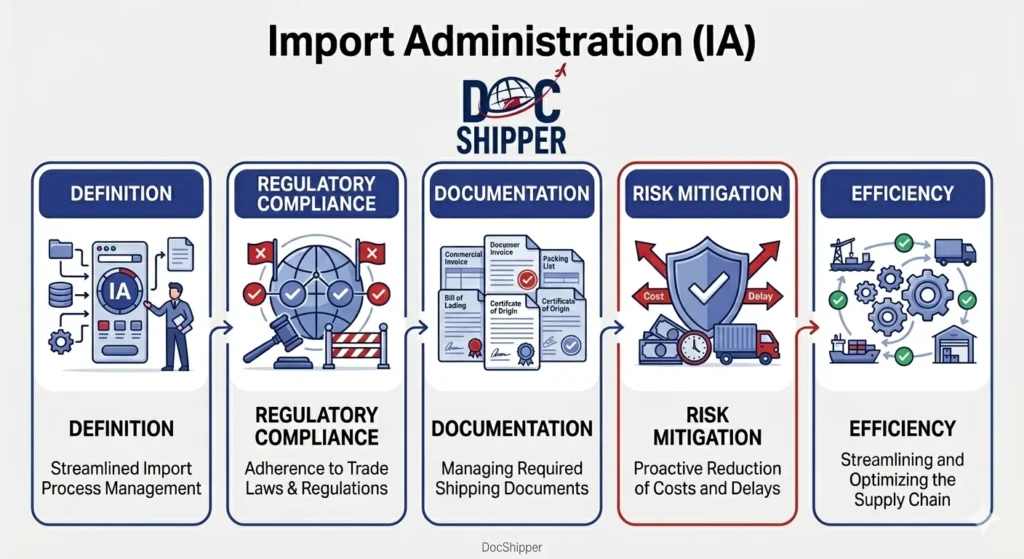
Key functions of the Import Administration include:
- Conducting antidumping (AD) and countervailing duty (CVD) investigations
- Calculating dumping margins and subsidy rates
- Issuing administrative reviews and scope rulings
- Monitoring compliance with trade remedy orders
- Coordinating with U.S. Customs and Border Protection (CBP) on enforcement
Legal Framework & Enforcement Powers
The Import Administration derives its authority from the Tariff Act of 1930, as amended, which empowers it to investigate allegations of unfair trade practices. When a domestic industry petitions for relief, the I/A initiates an investigation to determine whether foreign goods are being sold in the U.S. at less than fair value (dumping) or benefit from foreign government subsidies.
The investigation process follows strict timelines mandated by U.S. law. Preliminary determinations must occur within 140 days for antidumping cases and 65 days for countervailing duty cases. Final determinations follow within 75 days of preliminary findings. These deadlines create predictable milestones for importers and exporters alike.
Once the I/A issues an affirmative determination, antidumping or countervailing duties are imposed. These duties are calculated based on dumping margins or subsidy rates established through complex financial analysis of foreign producers’ operations. The rates can range from negligible percentages to over 200%, fundamentally altering product economics.
The I/A also conducts administrative reviews annually to recalculate duty rates based on updated sales data. This creates ongoing compliance obligations for importers, who must maintain detailed records of transactions, pricing, and supplier relationships. At DocShipper, we assist clients in preparing documentation for these reviews to minimize duty exposure.
Perhaps most critically, the Import Administration issues scope determinations that define precisely which products fall under existing trade remedy orders. A single scope ruling can determine whether a shipment faces additional duties of 0% or 100%+, making proper classification essential. The International Trade Administration publishes all active orders and scope rulings for public reference.
Investigation Process & Case Examples
Understanding how the Import Administration operates requires examining real investigation scenarios. The process begins when a domestic industry files a petition alleging injury from unfairly traded imports. The I/A then has 20 days to determine whether the petition contains sufficient evidence to warrant investigation.
Consider the 2018 aluminum foil investigation. The I/A found dumping margins ranging from 48.64% to 106.09% for Chinese producers, based on comparison between U.S. sale prices and normal values in the home market. Importers who failed to anticipate these findings faced retroactive duty assessments on shipments already cleared through customs.
| Investigation Phase | Timeline | Key Actions | Importer Impact |
|---|---|---|---|
| Petition Filing | Day 0 | Industry submits evidence of dumping/subsidies | Monitor product scope closely |
| Initiation | Day 20 | I/A announces formal investigation | Begin documenting supplier transactions |
| Preliminary Determination | Day 140 (AD) / 65 (CVD) | Estimated duty rates published | Post cash deposits on all entries |
| Final Determination | Day 215 (AD) / 140 (CVD) | Confirmed duty rates issued | Assess supply chain alternatives |
| Annual Review | Yearly thereafter | Recalculate rates based on new data | Maintain detailed cost records |
The steel industry provides another instructive example. Following Section 232 investigations and subsequent AD/CVD cases, the I/A maintains over 150 active trade remedy orders on various steel products. Importers must navigate this complex landscape by verifying country of origin, manufacturer identity, and precise product specifications for every shipment.
Practical compliance strategies include:
- Maintaining supplier certifications documenting production costs and pricing
- Conducting due diligence on manufacturer financial statements
- Implementing internal controls to track duty deposits and final assessments
- Engaging customs brokers with AD/CVD expertise before finalizing purchases
- Reviewing quarterly I/A Federal Register notices for scope changes
For importers subject to I/A oversight, the stakes extend beyond monetary penalties. Repeated non-compliance can result in increased bonding requirements, mandatory prior disclosure obligations, or CBP audits. At DocShipper, we conduct pre-shipment compliance assessments to identify potential I/A issues before goods leave the foreign port.
Conclusion
The Import Administration serves as a critical gatekeeper in U.S. trade policy, wielding substantial authority over market access and pricing dynamics. Its enforcement mechanisms demand proactive compliance strategies rather than reactive problem-solving.
Need assistance navigating antidumping or countervailing duty compliance? Contact DocShipper for expert guidance on I/A investigations, administrative reviews, and trade remedy strategies.
📚 Quiz
Test Your Knowledge: I/A (Import Administration)
What is the primary regulatory function of the Import Administration within U.S. trade law?
An importer believes their product may fall under an existing AD/CVD order but the product description is ambiguous. What mechanism should they use to clarify duty liability before importing?
A manufacturer who did not export during the original investigation period now wants to ship to the U.S. under their own company-specific duty rate rather than the higher all-others rate. Which procedure applies?
🎯 Your Results
📞 Free Personalized QuoteFAQ | I/A (Import Administration): Definition, Role & Key Functions
An I/A investigation begins when a domestic industry files a petition alleging material injury from dumped or subsidized imports. The petition must contain evidence of unfair pricing, import volume data, and injury indicators like lost sales or declining profitability. The I/A has 20 days to review the petition and decide whether to initiate a formal investigation.
Dumping margins represent the difference between a product's normal value (typically the home market price) and its export price to the U.S. The I/A analyzes detailed transaction data from foreign producers, adjusting for differences in physical characteristics, quantities, and sales circumstances. When home market sales are inadequate, the I/A may use third-country prices or constructed value based on production costs.
Yes, importers can request administrative reconsideration or appeal I/A decisions to the U.S. Court of International Trade. However, challenges must be filed within strict deadlines and supported by substantial evidence. Many importers engage trade attorneys to navigate the appellate process, which can extend 18-24 months beyond the initial determination.
Administrative reviews are annual proceedings where the I/A recalculates antidumping or countervailing duty rates based on the most recent 12-month period of review. Interested parties must request a review by the anniversary date of the order's publication. Reviews result in updated cash deposit rates that apply prospectively to future entries, while also establishing final liability for entries during the review period.
Scope determinations define which products are subject to an existing AD/CVD order. The I/A issues these rulings when there's ambiguity about whether specific merchandise falls within an order's product description. A scope determination can either expand or narrow coverage, directly impacting duty liability. Importers should request scope clarifications before committing to large purchases of potentially covered products.
Penalties include retroactive duty assessments on all entries from the date of preliminary determination, plus interest charges. Importers may also face increased bonding requirements, mandatory prior disclosure obligations, and potential civil penalties up to the domestic value of the merchandise. In cases of intentional evasion, criminal prosecution is possible under the Enforce and Protect Act.
The I/A establishes duty rates and maintains policy oversight, while CBP collects deposits and enforces compliance at ports of entry. CBP relies on I/A instructions regarding rate application, scope interpretations, and investigation timelines. The agencies share data through the Automated Commercial Environment (ACE) system, enabling real-time tracking of entries subject to trade remedies.
Essential records include commercial invoices showing actual transaction prices, supplier certifications regarding production costs, country of origin documentation, and correspondence evidencing negotiated terms. Importers should retain these records for five years, as the I/A can request verification during administrative reviews. Organized documentation significantly reduces assessment risks during compliance examinations.
Yes, the I/A conducts new shipper reviews for producers who did not export subject merchandise during the investigation period. Successful applicants receive company-specific duty rates rather than the all-others rate. However, eligibility requires proving no affiliation with exporters who received high rates, and the review process can take 12-18 months to complete.
Changed circumstances reviews allow interested parties to request revocation or modification of AD/CVD orders when conditions have fundamentally changed. The I/A examines whether dumping or subsidization is likely to recur if the order is lifted. These reviews are resource-intensive and rarely succeed without overwhelming evidence of sustained fair pricing over multiple years.
While Section 232 investigations are led by the Department of Commerce's Bureau of Industry and Security (BIS), the I/A provides technical support regarding import data analysis and trade remedy implementation. Once Section 232 tariffs are imposed, the I/A may become involved if subsequent AD/CVD petitions are filed on the same products, creating layered duty obligations.
Effective strategies include diversifying supplier bases across multiple countries, conducting thorough due diligence on manufacturer pricing practices, implementing internal classification controls, and engaging trade counsel before entering high-risk markets. Importers should also monitor Federal Register notices for investigation initiations and participate in comment periods to protect their commercial interests.
Need Help with
Logistics or Sourcing ?
First, we secure the right products from the right suppliers at the right price by managing the sourcing process from start to finish. Then, we simplify your shipping experience - from pickup to final delivery - ensuring any product, anywhere, is delivered at highly competitive prices.


Fill the Form
Prefer email? Send us your inquiry, and we’ll get back to you as soon as possible.
Contact us




:%20Definition,%20Role%20&%20Key%20Functions)