


In short ⚡
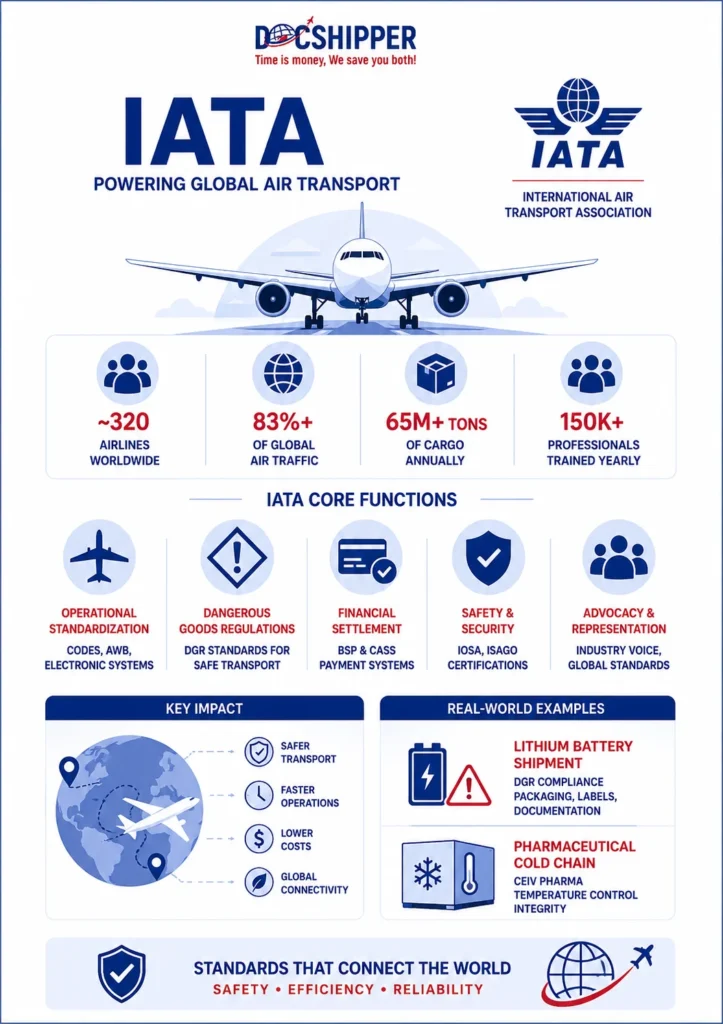
IATA (International Air Transport Association) is the global trade association representing approximately 320 airlines worldwide, accounting for over 83% of total air traffic. Founded in 1945, IATA standardizes aviation operations, establishes safety protocols, and facilitates international air cargo and passenger transport through unified codes, regulations, and commercial frameworks essential for global logistics.
Introduction
When shipping goods internationally by air, you’ve likely encountered three-letter airport codes or specific packaging requirements. These aren’t arbitrary. They’re part of IATA’s comprehensive standardization system that makes global air freight possible.
Without IATA’s unified framework, each airline would operate under different codes, safety standards, and documentation processes. This would create chaos in international logistics, where speed and precision are paramount.
IATA’s influence extends across the entire air transport ecosystem:
- Airport and airline codes: Universal three-letter identifiers (e.g., JFK, CDG, DXB)
- Dangerous Goods Regulations (DGR): Global standards for shipping hazardous materials
- Cargo documentation: Air Waybill (AWB) formats and electronic data interchange
- Financial settlement: BSP (Billing and Settlement Plan) and CASS (Cargo Accounts Settlement Systems)
- Safety and training: Certification programs for ground handlers, freight forwarders, and airlines
For freight forwarders and importers, understanding IATA standards is non-negotiable. These regulations directly impact shipping costs, transit times, and customs clearance efficiency.
IATA Framework & Industry Impact
IATA operates as a non-governmental organization headquartered in Montreal, Canada, with executive offices in Geneva, Switzerland. Unlike regulatory bodies such as ICAO (International Civil Aviation Organization), IATA is a trade association that facilitates cooperation between commercial airlines.
The organization’s primary functions include:
1. Operational Standardization
IATA develops and maintains the Universal Air Travel Plan (UATP) and standardized ticketing procedures. For cargo, the Air Waybill (AWB) follows IATA Resolution 600b, ensuring uniform documentation across all member carriers. This standardization eliminates confusion when shipments transfer between multiple airlines.
2. Dangerous Goods Regulation
The IATA Dangerous Goods Regulations (DGR) manual, updated annually, governs how hazardous materials are classified, packaged, labeled, and transported by air. Compliance is mandatory. Non-compliance can result in shipment rejection, fines, or safety incidents. At DocShipper, we systematically verify DGR compliance before booking air freight to prevent delays and ensure regulatory adherence.
3. Financial Settlement Systems
IATA’s Clearing House processes over $450 billion annually in airline transactions. The BSP and CASS systems simplify payments between airlines, agents, and freight forwarders, reducing administrative overhead and accelerating cash flow across 200+ countries and territories.
4. Safety and Security Protocols
Through programs like IOSA (IATA Operational Safety Audit) and ISAGO (IATA Safety Audit for Ground Operations), IATA ensures that airlines and ground handlers meet rigorous safety benchmarks. These audits are increasingly required by governments and insurers worldwide.
5. Advocacy and Industry Representation
IATA lobbies governments on behalf of airlines regarding taxation, environmental regulations, and infrastructure investment. The organization played a central role in developing the CEIV Fresh certification for perishables and the CEIV Pharma program for pharmaceutical logistics.
Understanding these frameworks is critical when selecting carriers or planning complex shipments. For instance, shipping lithium batteries requires strict adherence to IATA Packing Instructions 965-970. At DocShipper, our specialists ensure all hazardous cargo documentation complies with current IATA standards to avoid costly shipping rejections.
Practical Applications & Data
IATA’s standards directly influence daily logistics operations. Here are concrete scenarios where IATA regulations determine success or failure:
Case Study 1: Lithium Battery Shipment
A U.S. electronics manufacturer needs to ship 500 lithium-ion batteries to Germany. Under IATA DGR Section 4.4, these fall under UN 3480 (Class 9 dangerous goods). The shipment requires:
- Specific packaging per Packing Instruction 965 (Section IB for batteries alone)
- Shipper’s Declaration for Dangerous Goods (DGD)
- Specialized labeling (Class 9 hazard diamond + handling labels)
- Carrier acceptance check by IATA-certified staff
Failure to comply results in automatic shipment rejection and potential fines up to $75,000 per violation under U.S. DOT regulations.
Case Study 2: Pharmaceutical Cold Chain
A pharmaceutical company ships temperature-sensitive vaccines from Brussels (BRU) to Nairobi (NBO). IATA’s CEIV Pharma certification ensures handling agents maintain the required 2-8°C range throughout transit. Airlines without CEIV Pharma certification risk vaccine spoilage, resulting in losses exceeding $35 billion annually across the industry.
IATA Code System Efficiency
The three-letter airport code system eliminates ambiguity. Consider “Springfield” — there are over 30 cities with this name in the U.S. alone. IATA codes (SGF for Springfield, Missouri; SPI for Springfield, Illinois) prevent misdirection. This system saves the industry an estimated $2.5 billion yearly in misdirected cargo costs.
| IATA Service | Purpose | Impact |
|---|---|---|
| Airport Codes | Unique three-letter identifiers | Prevents routing errors across 9,000+ airports |
| DGR Manual | Hazardous materials regulations | Ensures safe transport of 1.3M tons of dangerous goods yearly |
| e-AWB | Electronic air waybill | Reduces processing time by 40%, adopted for 76% of cargo |
| IOSA Audit | Safety certification for airlines | Required by 400+ airlines; improves safety 50% vs. non-certified |
| CASS | Cargo billing settlement | Processes $28B annually, reduces payment cycles from 45 to 7 days |
Key Statistics:
- IATA member airlines carry 83% of global air traffic
- Over 65 million tons of cargo transported annually under IATA standards
- The e-AWB initiative has saved the industry $200 million in paper and processing costs
- IATA training programs certify 150,000+ professionals yearly
- DGR compliance prevents an estimated 12,000 incidents annually
At DocShipper, we leverage IATA’s electronic systems to expedite bookings and documentation. Our team holds current IATA certifications in dangerous goods handling, ensuring your shipments meet all regulatory requirements from origin to destination.
Conclusion
IATA’s standardized systems form the backbone of international air cargo operations. From airport codes to dangerous goods regulations, these frameworks ensure safety, efficiency, and global connectivity. Understanding IATA requirements isn’t just beneficial — it’s essential for avoiding costly delays and compliance issues.
Need expert guidance on IATA regulations for your next shipment? Contact DocShipper for comprehensive air freight solutions backed by certified logistics professionals.
📚 Quiz
Test Your Knowledge: IATA Standards
What is IATA's primary organizational function?
Which statement about IATA Dangerous Goods Regulations (DGR) is correct?
A pharmaceutical company needs to ship temperature-sensitive vaccines internationally. Which IATA certification ensures proper cold chain handling?
🎯 Your Result
📞 Free Quote in 24hFAQ | IATA (International Air Transport Association): Definition, Role & Concrete Examples
IATA (International Air Transport Association) is a trade association representing commercial airlines, focused on industry standards and commercial practices. ICAO (International Civil Aviation Organization) is a United Nations agency that establishes international aviation regulations and technical standards. IATA standards often build upon ICAO's regulatory framework.
Shippers don't require IATA certification, but freight forwarders and ground handlers must be IATA-certified to handle dangerous goods. When shipping hazardous materials, you must work with certified agents and provide compliant documentation. Non-certified parties cannot legally handle DG shipments.
The IATA DGR manual is updated annually, with the new edition effective January 1st each year. The 65th edition (2024) includes amendments reflecting changes in UN Model Regulations and national authority requirements. Airlines and handlers must use the current year's edition.
Non-compliant shipments are rejected at origin, resulting in delays, storage fees, and potential fines. For dangerous goods violations, penalties can reach $75,000 per incident in the U.S. Repeat violations may result in loss of shipping privileges and criminal prosecution in severe cases.
No. IATA uses three-letter codes (JFK, LHR, SIN), while ICAO uses four-letter codes (KJFK, EGLL, WSSS). IATA codes are used commercially for ticketing and cargo, whereas ICAO codes are used in air traffic control and flight planning. Both systems coexist without conflict.
An Air Waybill is a non-negotiable transport document issued by airlines or freight forwarders. It serves as proof of contract, receipt of goods, and customs declaration. The AWB contains 11 digits: the first three identify the airline (e.g., 020 for Lufthansa), followed by an eight-digit serial number.
IATA membership fees vary based on airline size and revenue. Annual contributions range from approximately $10,000 for small regional carriers to over $500,000 for major international airlines. Members gain access to BSP/CASS systems, training programs, and industry lobbying representation.
Yes, IATA membership is voluntary. Non-member airlines can operate internationally if they comply with national and ICAO regulations. However, they cannot access IATA settlement systems, standardized ticketing platforms, or benefit from collective industry agreements, which limits commercial flexibility.
IATA established the Carbon Offsetting and Reduction Scheme for International Aviation (CORSIA) and set targets for net-zero carbon emissions by 2050. The association promotes Sustainable Aviation Fuel (SAF) adoption and collaborates with governments on environmental policies affecting aviation operations.
Electronic Air Waybills eliminate paper documentation, reducing processing time by 40% and cutting costs by approximately $6.50 per shipment. E-AWB accelerates customs clearance, minimizes data entry errors, and provides real-time tracking visibility. Currently, 76% of global air cargo uses e-AWB.
Packing Instructions are detailed specifications for packaging dangerous goods by air. Each DG classification has specific PIs (e.g., PI 965 for lithium-ion batteries alone). These instructions specify container types, quantity limits, cushioning requirements, and labeling. Compliance is mandatory for air transport acceptance.
IATA doesn't mandate cargo insurance but recommends carriers offer liability coverage per the Montreal Convention (approximately $22 per kilogram). Shippers should purchase additional all-risk insurance for high-value goods. IATA provides standardized insurance clauses to facilitate coverage arrangements between parties.
Need Help with
Logistics or Sourcing ?
First, we secure the right products from the right suppliers at the right price by managing the sourcing process from start to finish. Then, we simplify your shipping experience - from pickup to final delivery - ensuring any product, anywhere, is delivered at highly competitive prices.


Fill the Form
Prefer email? Send us your inquiry, and we’ll get back to you as soon as possible.
Contact us




