


In short ⚡
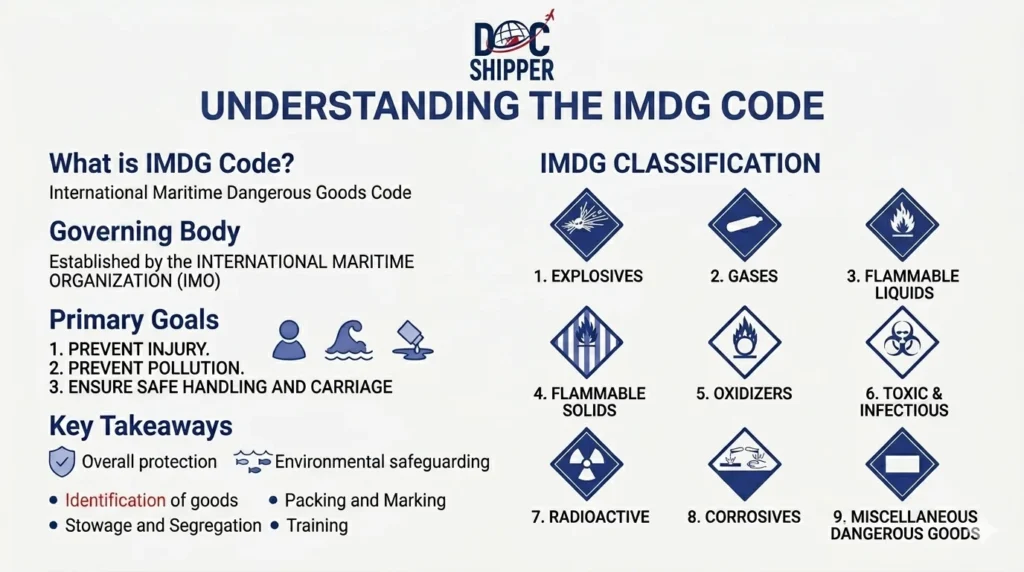
The IMDG Code (International Maritime Dangerous Goods Code) is the international regulatory framework established by the International Maritime Organization (IMO) that governs the safe transport of hazardous materials by sea. It provides comprehensive classification, packaging, labeling, and documentation requirements for dangerous goods to prevent accidents, protect marine environments, and ensure crew safety during maritime shipping operations.
Introduction
Every year, shipping lines reject thousands of containers due to improper dangerous goods documentation. A single misclassified chemical can result in port detention, hefty fines, or catastrophic accidents at sea. For businesses shipping products ranging from batteries to industrial chemicals, understanding the IMDG Code isn’t optional—it’s essential for legal compliance and operational continuity.
The IMDG Code serves as the global standard for maritime dangerous goods transport, harmonizing regulations across 174 member states. Whether you’re exporting lithium batteries from Asia, shipping pharmaceuticals to Europe, or transporting industrial solvents across the Atlantic, this regulatory framework dictates every aspect of your shipment’s journey.
Key characteristics of the IMDG Code include:
- Nine hazard classes covering everything from explosives to corrosive substances
- Mandatory packaging specifications (UN-approved containers with specific markings)
- Documentation requirements including the Dangerous Goods Declaration and Container Packing Certificate
- Segregation rules preventing incompatible substances from being stowed together
- Emergency response procedures (EmS codes) for each substance type
- Biennial amendments ensuring regulations reflect emerging chemical technologies and safety data
Classification System & Regulatory Framework
The IMDG Code organizes hazardous materials into nine primary classes, each representing distinct risk profiles. Class 1 covers explosives, Class 2 addresses gases (compressed, liquefied, or dissolved), while Class 3 encompasses flammable liquids like acetone or gasoline. Classes 4 through 6 handle flammable solids, oxidizing substances, and toxic materials respectively. Class 7 regulates radioactive materials, Class 8 covers corrosives, and Class 9 includes miscellaneous dangerous goods like lithium batteries and dry ice.
Each substance receives a UN number—a four-digit identifier linking it to specific handling requirements. For example, UN 1203 designates gasoline, while UN 3480 identifies lithium ion batteries. This universal numbering system enables port authorities, carriers, and emergency responders worldwide to instantly recognize a material’s hazards and required precautions.
The Code mandates proper shipping names and technical names for documentation. Generic entries like “Flammable Liquid, N.O.S.” (Not Otherwise Specified) require supplementary technical identification in parentheses. This precision prevents confusion during cargo handling and customs clearance, particularly critical when multiple languages are involved in the supply chain.
Packaging requirements form the Code’s operational backbone. The framework defines three packaging groups (PG I, II, III) based on danger degree—PG I representing high danger substances requiring the most robust containers. All packaging must display UN certification marks proving they’ve passed drop tests, pressure tests, and other standardized trials. At DocShipper, we verify packaging compliance before container loading to prevent costly rejections at the port of departure.
The segregation matrix dictates physical separation requirements between incompatible goods. Acids must be separated from bases, oxidizers from flammable materials, and foodstuffs from toxic substances. Violations can trigger chemical reactions, fires, or explosions during transport. The Code specifies separation distances—”away from” (3 meters), “separated from” (6 meters), or “separated by a complete compartment.” For detailed regulatory text, consult the official IMO IMDG Code portal.
Practical Applications & Compliance Requirements
Understanding theoretical classifications means little without practical implementation knowledge. Consider a manufacturer exporting lithium ion battery packs (UN 3480) from Shenzhen to Rotterdam. The Code requires Section II certification (batteries under 100Wh), specific package markings including the Class 9 label and lithium battery handling label, a Dangerous Goods Declaration signed by a certified DG shipper, and container inspection documentation.
Documentation forms the compliance foundation. The Dangerous Goods Declaration must contain 27 specific data points including shipper details, consignee information, UN numbers, proper shipping names, class, packing group, flash point (for flammables), number and type of packages, net and gross weight, and the shipper’s certification statement. A single omission can delay clearance by days. The Container Packing Certificate confirms goods were properly loaded, secured, and segregated according to IMDG requirements.
Real-world compliance costs vary significantly. A 2023 industry survey found that IMDG-compliant packaging adds 15-40% to container costs compared to standard shipping, depending on hazard class. However, non-compliance costs dramatically exceed these figures—port fines range from $5,000 to $50,000, while contamination incidents can trigger liability claims exceeding millions of dollars.
| Hazard Class | Common Examples | Primary Documentation | Average Compliance Cost |
|---|---|---|---|
| Class 2.2 (Non-flammable gases) | Fire extinguishers, refrigerants | DG Declaration + Gas cylinder test cert | +18% vs standard |
| Class 3 (Flammable liquids) | Paint, adhesives, perfumes | DG Declaration + Flash point cert | +25% vs standard |
| Class 8 (Corrosives) | Battery acid, cleaning agents | DG Declaration + UN packaging cert | +30% vs standard |
| Class 9 (Miscellaneous) | Lithium batteries, dry ice | DG Declaration + Battery test summary | +22% vs standard |
Training requirements cannot be overlooked. The Code mandates that anyone involved in dangerous goods transport—from warehouse staff to documentation specialists—complete certified IMDG training every two years. This includes understanding classification methods, emergency procedures, and documentation protocols. Many shipping delays trace back to untrained personnel making critical errors in paperwork or packaging selection.
The 2023 Amendment 41-23 introduced significant updates including revised lithium battery provisions, new UN numbers for emerging chemicals, and updated emergency response procedures. Companies shipping dangerous goods must implement these changes by January 2024 or risk non-compliance. At DocShipper, we systematically verify that client shipments align with the latest amendment to avoid regulatory violations at destination ports.
Conclusion
The IMDG Code represents the essential framework protecting global maritime trade from the inherent risks of dangerous goods transport. Mastering its classification system, documentation requirements, and packaging specifications transforms regulatory compliance from a burden into a competitive advantage, ensuring smooth customs clearance and avoiding costly delays.
Need expert guidance on IMDG compliance for your shipments? Contact DocShipper for specialized support in dangerous goods documentation, classification, and regulatory compliance management.
📚 Quiz
Test Your Knowledge: IMDG Code
What is the primary scope of the IMDG Code?
A manufacturer wants to ship industrial paint (Class 3 flammable liquid) with battery acid (Class 8 corrosive) in the same container. What does the IMDG Code require?
Your warehouse staff will handle dangerous goods shipments. According to IMDG requirements, what training obligation applies?
🎯 Your Result
📞 Free Quote in 24hFAQ | IMDG Code (International Maritime Dangerous Goods Code): Definition, Classification & Practical Examples
The IMDG Code governs maritime transport of dangerous goods, while ADR (European Agreement concerning the International Carriage of Dangerous Goods by Road) regulates road transport. Though both use similar UN classification systems, they differ in packaging specifications, segregation requirements, and documentation formats. Multimodal shipments require compliance with both frameworks at different transport stages.
Only substances meeting dangerous goods criteria require IMDG compliance. Many industrial chemicals, consumer products, and foodstuffs don't qualify as dangerous goods despite containing chemical compounds. Classification depends on concentration levels, flash points, toxicity profiles, and physical properties. When uncertain, consult the IMDG Dangerous Goods List or request a professional classification assessment.
The IMO publishes amendments biennially, typically in even-numbered years with implementation the following odd year. Amendment 41-23 (published 2023, effective 2024) represents the current edition. Companies must monitor these updates as new UN numbers, packaging requirements, and emergency procedures are regularly introduced to address emerging chemical technologies and safety data.
Consequences range from container detention and cargo refusal to substantial fines imposed by port authorities. In severe cases, undeclared dangerous goods can result in criminal prosecution, especially if they cause environmental damage or endanger personnel. Insurance typically becomes void for non-compliant shipments, leaving shippers liable for all damages and remediation costs.
Lithium batteries qualify as Class 9 dangerous goods, but exemptions exist for batteries meeting specific criteria. Batteries contained in equipment under certain watt-hour ratings, properly protected batteries packed with equipment, and button cells meeting size limitations may qualify for exceptions. However, documentation still requires special provisions notation even when exempted from full dangerous goods requirements.
Many dangerous goods can utilize standard 20' or 40' containers provided they meet specific conditions. The container must be structurally sound, properly placarded with hazard labels, and equipped with necessary ventilation (for gases). However, certain substances require specialized tank containers, refrigerated units, or explosive-rated containers. Container selection depends on the substance's UN number and packing group classification.
Legal responsibility primarily rests with the shipper who declares and certifies the goods. However, freight forwarders and carriers also bear liability if they knowingly accept non-compliant shipments or fail to verify documentation accuracy. Most carriers require forwarders to provide indemnity guarantees for dangerous goods, creating a shared responsibility chain throughout the logistics network.
The Emergency Schedules (EmS) Guide provides emergency response procedures for fire (F-codes) and spillage (S-codes) incidents involving specific dangerous goods. Each substance's IMDG entry includes assigned EmS codes—for example, EmS F-E, S-D indicates specific firefighting and spillage response protocols. Ship crews use these codes to implement appropriate emergency measures during maritime incidents.
Start by identifying your product's hazard characteristics using Safety Data Sheets (SDS). Match these properties against the IMDG Dangerous Goods List, considering factors like chemical composition, concentration, flash point, and physical state. For complex mixtures or products not explicitly listed, consult a certified dangerous goods classifier or contact your destination country's maritime authority for classification guidance.
Limited quantity (LQ) provisions allow reduced packaging and documentation requirements for small amounts of certain dangerous goods. These quantities vary by substance—typically ranging from 120ml to 30kg per package depending on hazard class and packing group. LQ shipments still require specific package markings and carrier notification but benefit from simplified declaration procedures and reduced compliance costs.
Personnel involved in dangerous goods operations must complete IMDG-certified training covering classification, packaging, marking, labeling, documentation, and emergency response. Training validity extends two years, after which refresher courses are mandatory. Certification must be documented and available for inspection by port authorities. Employers bear legal responsibility for ensuring staff maintain current training credentials.
Consolidation depends on segregation requirements specified in the IMDG segregation table. Some classes can be stowed together without restriction, others require physical separation, and certain combinations are absolutely prohibited. For example, Class 3 flammable liquids generally cannot share containers with Class 5.1 oxidizers. Proper segregation planning prevents chemical reactions and ensures compliance with carrier acceptance policies.
Need Help with
Logistics or Sourcing ?
First, we secure the right products from the right suppliers at the right price by managing the sourcing process from start to finish. Then, we simplify your shipping experience - from pickup to final delivery - ensuring any product, anywhere, is delivered at highly competitive prices.


Fill the Form
Prefer email? Send us your inquiry, and we’ll get back to you as soon as possible.
Contact us




:%20Definition,%20Classification%20&%20Practical%20Examples)