


In short ⚡
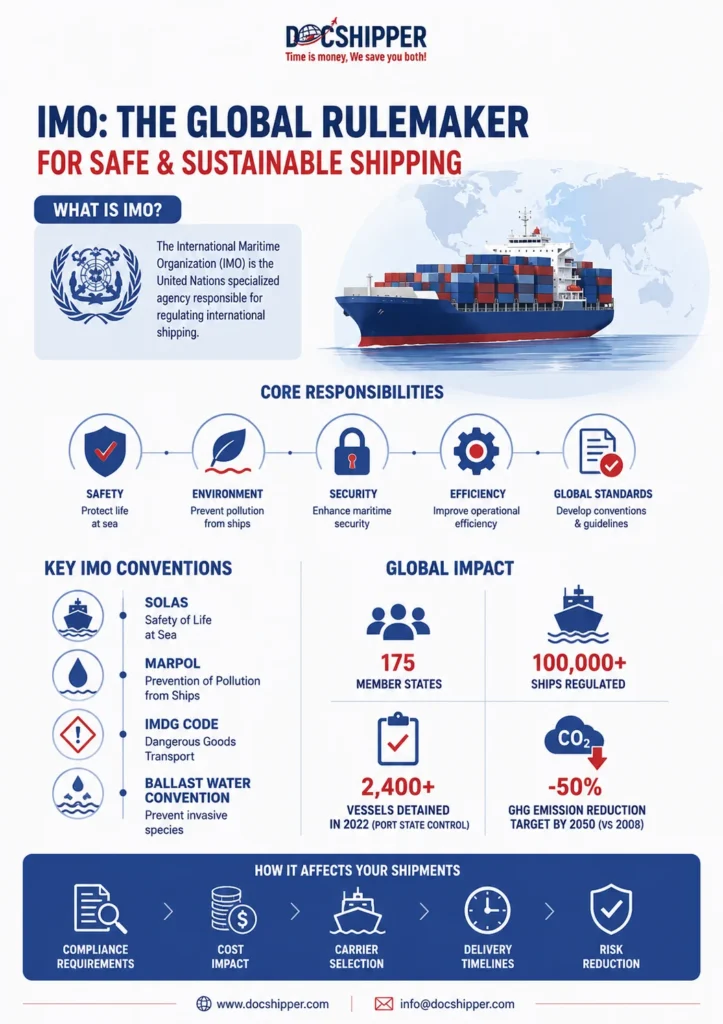
The International Maritime Organization (IMO) is the United Nations specialized agency responsible for regulating international shipping. Established in 1948, it develops global standards for maritime safety, security, environmental protection, and operational efficiency across all vessels engaged in international trade.
Introduction
Every container crossing oceans, every tanker navigating straits, every bulk carrier delivering raw materials operates under rules you’ve likely never heard of. Yet these regulations prevent disasters, protect marine environments, and keep global trade flowing smoothly.
The IMO sits at the heart of this system. As the only international body with authority over shipping practices, it creates binding conventions that 175 member states must implement. For importers and exporters, understanding IMO standards isn’t academic—it directly affects vessel compliance, insurance costs, and delivery timelines.
Key characteristics of the IMO include:
- Universal jurisdiction: Regulations apply to all ships in international waters regardless of flag
- Convention-based authority: SOLAS, MARPOL, and other treaties form legally binding frameworks
- Technical committees: Specialized bodies address safety, environment, legal matters, and facilitation
- Continuous evolution: Amendments respond to technological advances and emerging risks
- Enforcement through port states: Coastal nations inspect foreign vessels for compliance
IMO Regulatory Framework & Expertise
The IMO operates through major international conventions that govern different aspects of maritime operations. The Safety of Life at Sea (SOLAS) convention mandates structural standards, life-saving equipment, and navigation systems. The International Convention for the Prevention of Pollution from Ships (MARPOL) sets limits on oil discharge, air emissions, sewage, and garbage disposal.
Understanding the amendment process is crucial for supply chain professionals. The IMO doesn’t create static rules—it continuously updates regulations through its Marine Environment Protection Committee (MEPC) and Maritime Safety Committee (MSC). Recent amendments include the 2020 sulfur cap (limiting bunker fuel sulfur content to 0.5%) and upcoming carbon intensity requirements.
The organization enforces standards through port state control mechanisms. When a vessel enters foreign waters, local authorities can inspect it for compliance with IMO conventions. Non-compliant ships face detention, fines, or operational restrictions. According to official IMO data, port state control inspections detained over 2,400 vessels in 2022 alone.
Classification societies play a supporting role by conducting statutory surveys on behalf of flag states. These organizations verify that vessels meet IMO construction and equipment standards. At DocShipper, we verify that chartered vessels hold valid certificates from recognized classification societies to prevent delays during port inspections.
The IMO’s technical cooperation program helps developing nations implement maritime regulations. This matters for international trade because weak enforcement in one jurisdiction creates bottlenecks elsewhere. A vessel operating below standard in one port may face detention when arriving at a port with rigorous controls.
Practical Examples & Industry Data
The IMO 2020 sulfur regulation provides a clear example of how these standards affect logistics costs. Before January 1, 2020, ships could use fuel with up to 3.5% sulfur content. The new limit of 0.5% forced carriers to either install scrubbers (costing $2-10 million per vessel) or switch to compliant fuel.
Here’s how major IMO conventions impact different cargo types:
| Convention | Primary Focus | Logistics Impact | Compliance Cost Range |
|---|---|---|---|
| SOLAS | Vessel safety standards | Container weight verification (VGM requirement) | $15-50 per container |
| MARPOL Annex VI | Air pollution control | Fuel cost increases or scrubber installation | 20-30% fuel surcharge |
| IMDG Code | Dangerous goods transport | Special packaging and documentation | $200-2,000 per shipment |
| Ballast Water Convention | Invasive species prevention | Treatment system installation on vessels | $1-5 million per vessel |
A practical scenario illustrates the importance: An exporter books a container from Shanghai to Rotterdam. The ocean carrier must provide a Verified Gross Mass (VGM) for each container under SOLAS Amendment requirements. Without this weight certification, the container cannot be loaded. This single IMO regulation affects over 200 million containers annually.
The organization’s greenhouse gas strategy targets at least 50% emission reductions by 2050 compared to 2008 levels. This drives three major changes: mandatory Energy Efficiency Design Index (EEDI) for new ships, Ship Energy Efficiency Management Plans (SEEMP) for all vessels, and upcoming carbon intensity indicators (CII) that affect charter rates and vessel selection.
For dangerous goods shippers, the International Maritime Dangerous Goods (IMDG) Code classifies 9 hazard categories and prescribes packaging, labeling, and segregation requirements. Non-compliance results in cargo rejection or terminal delays. At DocShipper, we validate IMDG documentation before booking to prevent costly port-side rejections.
Conclusion
The IMO shapes every aspect of ocean freight through safety standards, environmental protections, and operational protocols. Understanding these regulations helps shippers anticipate cost changes, avoid compliance delays, and select appropriate carriers.
Need guidance on IMO compliance for your shipments? Contact DocShipper for expert support navigating maritime regulations.
📚 Quiz
Test Your Knowledge: IMO (International Maritime Organization)
What is the primary scope of IMO's regulatory authority?
How does the IMO enforce its conventions despite being an international body?
A shipper books a container from Asia to Europe but fails to provide Verified Gross Mass (VGM) documentation. What happens?
🎯 Your Result
📞 Free Quote in 24hFAQ | IMO (International Maritime Organization): Definition, Role & Global Impact
The IMO regulates maritime shipping for ocean freight, while IATA (International Air Transport Association) governs air cargo standards. IMO focuses on vessel safety, marine pollution, and seafarer welfare, whereas IATA addresses aircraft operations, dangerous goods in air transport, and aviation security. Both create binding regulations, but IMO conventions are ratified by governments while IATA operates through airline industry agreements.
The IMO creates conventions, but enforcement happens through flag states (countries where ships are registered) and port states (countries where vessels dock). Port state control officers inspect foreign vessels for compliance with IMO standards. If violations are found, they can detain ships, issue fines, or require repairs before departure. This dual enforcement mechanism ensures global standards despite varying national capabilities.
Yes, the 0.5% sulfur limit applies to all ships operating outside designated Emission Control Areas (ECAs), where the limit is stricter at 0.1%. Vessels can comply by using low-sulfur fuel, installing exhaust gas cleaning systems (scrubbers), or using alternative fuels like LNG. The only exceptions are ships operating exclusively in territorial waters of countries that haven't ratified MARPOL Annex VI.
The Verified Gross Mass requirement mandates that shippers provide the total weight of packed containers before loading. The shipper or their authorized agent must obtain VGM through either weighing the packed container or calculating cargo weight plus tare weight. This information must reach the ocean carrier and terminal operator before the cargo cutoff time, typically 24-48 hours before vessel departure.
The IMO's committees meet multiple times yearly to review and amend conventions. Major changes typically follow a two-year adoption cycle: proposals are discussed, drafts are circulated, and amendments are formally adopted at committee sessions. After adoption, amendments enter into force following specified timelines—usually 6-18 months later—giving the industry time to implement changes. Emergency amendments can be fast-tracked for critical safety issues.
ECAs are designated sea areas where stricter emission controls apply to protect coastal environments. Currently, ECAs include the Baltic Sea, North Sea, North American coasts, and US Caribbean. Within these zones, sulfur content in fuel must not exceed 0.1% (versus 0.5% globally), and nitrogen oxide (NOx) limits are more stringent for newer vessels. Ships must switch fuels when entering or leaving ECAs.
No, the IMO is an intergovernmental organization where only member states have voting rights. Private companies, shipping lines, and trade associations can participate as observers and provide technical input during committee meetings, but they cannot directly challenge adopted conventions. Industry concerns must be raised through national maritime authorities or industry bodies with consultative status at the IMO.
The International Maritime Dangerous Goods Code classifies and regulates hazardous material transport by sea. It applies whenever shipping chemicals, flammable materials, gases, explosives, toxic substances, or other dangerous goods in containers or breakbulk. The code specifies packaging standards, labeling requirements, segregation rules, and emergency procedures. Compliance is mandatory for all IMO member states under SOLAS Chapter VII.
Starting January 2023, the CII rating system grades ships from A (most efficient) to E (least efficient) based on carbon emissions per cargo ton-mile. Ships rated D for three consecutive years or E for one year must submit improvement plans. This pushes carriers to optimize speeds, upgrade engines, or deploy newer vessels—potentially increasing freight rates by 5-15% as operational costs rise for compliance.
This convention requires ships to manage ballast water to prevent transferring invasive aquatic species between ecosystems. Vessels must install treatment systems that filter or neutralize organisms in ballast water before discharge. The convention entered into force in 2017, with implementation timelines tied to vessel survey dates. Non-compliant ships risk detention and fines when entering ports of ratifying states.
Yes, through the Maritime Labour Convention (MLC 2006), often called the "seafarers' bill of rights." It establishes minimum standards for working conditions, accommodation, food, health protection, and social security for crew members. Ships over 500 gross tonnage in international trade must carry a Maritime Labour Certificate proving compliance. Port states can inspect crew conditions and detain vessels with serious violations.
Non-compliance with IMO conventions can void Protection and Indemnity (P&I) insurance coverage for incidents resulting from violations. For example, a ship without proper MARPOL certificates that causes an oil spill may face uninsured liability claims. Additionally, the International Convention on Civil Liability for Bunker Oil Pollution Damage requires vessels over 1,000 gross tonnage to carry insurance certificates, directly linking IMO compliance to operational legality.
Need Help with
Logistics or Sourcing ?
First, we secure the right products from the right suppliers at the right price by managing the sourcing process from start to finish. Then, we simplify your shipping experience - from pickup to final delivery - ensuring any product, anywhere, is delivered at highly competitive prices.


Fill the Form
Prefer email? Send us your inquiry, and we’ll get back to you as soon as possible.
Contact us




