


In short ⚡
Inbound logistics refers to the complete process of receiving, storing, and managing raw materials, components, or finished goods from suppliers to production facilities or warehouses. It encompasses transportation, vendor management, quality control, and inventory coordination to ensure seamless material flow into the supply chain.Introduction
Many businesses struggle with delayed production, excess inventory, or quality issues—all stemming from poorly managed inbound logistics. The first half of the supply chain directly impacts manufacturing efficiency, cost structures, and customer satisfaction.
Unlike outbound logistics (which focuses on delivering finished products to customers), inbound logistics controls what enters your operation. Mastering this process means better supplier relationships, optimized storage, and predictable production schedules.
Key characteristics of effective inbound logistics include:
- Supplier coordination: Synchronized delivery schedules aligned with production needs
- Transportation management: Optimized routing and carrier selection for cost-efficiency
- Quality assurance: Inspection protocols ensuring materials meet specifications
- Warehouse integration: Streamlined receiving and storage processes
- Inventory visibility: Real-time tracking from supplier dispatch to production floor
In-Depth Process & Strategic Components
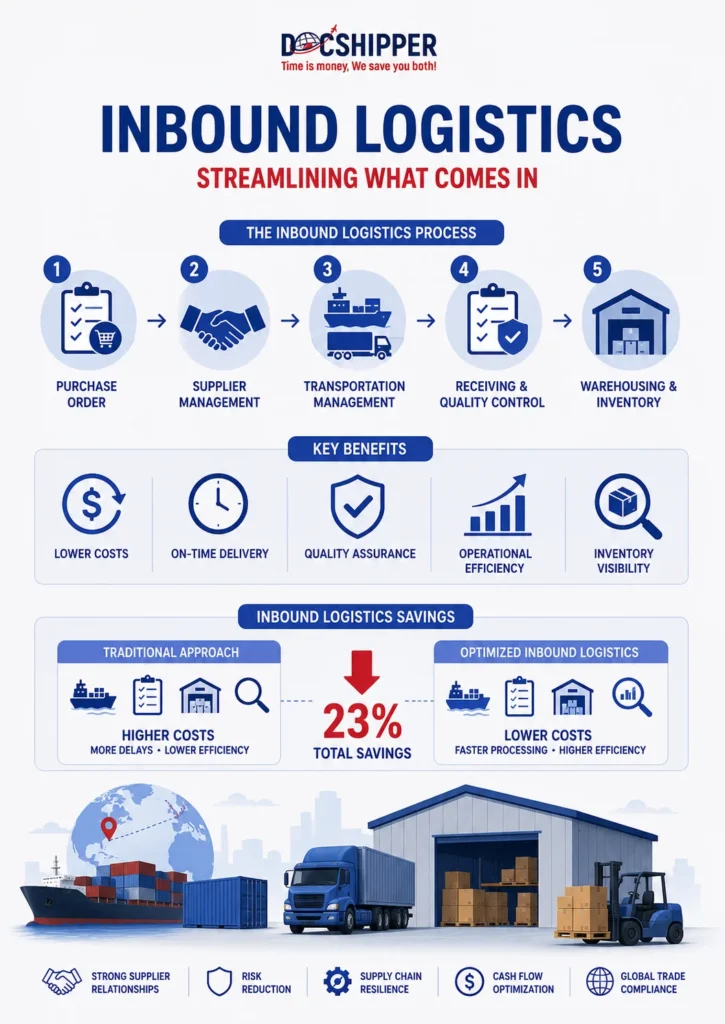
The inbound logistics cycle begins with purchase order creation, where procurement teams specify quantities, quality standards, and delivery timelines. This document becomes the foundation for supplier performance measurement and dispute resolution.
Next comes supplier selection and relationship management. Companies evaluate vendors based on reliability, cost, compliance with international standards (ISO 9001, ISO 14001), and geographic proximity. Long-term partnerships often yield better pricing and priority treatment during supply shortages.
Transportation coordination involves choosing between modes (ocean freight, air cargo, trucking, rail) based on urgency, volume, and budget. Consolidated shipments reduce per-unit costs, while dedicated transport offers speed and security. At DocShipper, we negotiate carrier contracts and handle all customs formalities to prevent delays at borders.
Upon arrival, receiving and inspection procedures verify quantities against packing lists and assess quality through sampling or full inspections. Discrepancies trigger immediate supplier communication and potential claims. This stage prevents defective materials from entering production lines.
Finally, warehousing and inventory allocation positions materials for efficient retrieval. Modern systems use barcode scanning, RFID tags, or WMS (Warehouse Management Systems) to track location and status. Just-in-time methodologies minimize storage costs, while safety stock buffers protect against supply disruptions.
According to World Trade Organization data, trade facilitation improvements can reduce import costs by 14.5%, with inbound logistics optimization accounting for the majority of savings.
Practical Examples & Cost Analysis
Consider a European electronics manufacturer sourcing components from three Asian suppliers. By consolidating shipments into weekly container loads rather than individual air freight, they reduced per-unit transportation costs by €12 to €3—a 75% saving.
Here’s a comparative breakdown of inbound logistics costs for a typical manufacturing operation importing 500 pallets monthly:
| Cost Component | Traditional Approach | Optimized Inbound Logistics | Savings (%) |
|---|---|---|---|
| Ocean Freight | $85,000 | $68,000 | 20% |
| Customs Clearance | $12,500 | $9,200 | 26% |
| Warehousing (30 days) | $18,000 | $11,500 | 36% |
| Quality Inspection | $8,000 | $6,500 | 19% |
| TOTAL | $123,500 | $95,200 | 23% |
Use Case: A pharmaceutical company importing active ingredients from India faced recurring delays due to uncoordinated supplier shipments. After implementing a vendor-managed inventory (VMI) system, they achieved:
- 40% reduction in emergency air shipments
- 18-day average lead time improvement
- $2.3M annual savings in expedited logistics and production downtime
- Zero stockouts over a 12-month period
Technology integration plays a critical role. Companies using cloud-based TMS (Transportation Management Systems) report 15-25% faster processing times and improved carrier compliance. DocShipper’s platform provides real-time shipment visibility, automated documentation, and predictive analytics for demand forecasting.
Conclusion
Inbound logistics forms the backbone of operational efficiency, directly influencing production costs, quality outcomes, and market responsiveness. Strategic supplier partnerships, transportation optimization, and technology integration transform this function from a cost center into a competitive advantage.
Need expert guidance on streamlining your inbound supply chain? Contact DocShipper for customized logistics solutions tailored to your industry and volume requirements.
📚 Quiz
Test Your Knowledge: Inbound Logistics
What is the primary scope of inbound logistics?
A company implements vendor-managed inventory (VMI) for their inbound logistics. What is the primary benefit?
A manufacturer notices frequent production line stoppages. Which inbound logistics improvement would most directly address this issue?
🎯 Your Result
📞 Free Quote in 24hFAQ | Inbound Logistics: Definition, Process & Practical Examples
Inbound logistics manages the flow of raw materials and components into a company from suppliers, while outbound logistics handles the distribution of finished products to customers. Inbound focuses on procurement and receiving; outbound concentrates on order fulfillment and delivery. Both require distinct strategies, technologies, and performance metrics.
Cost reduction strategies include consolidating shipments to achieve volume discounts, negotiating long-term supplier contracts, optimizing transportation modes based on urgency, implementing cross-docking to minimize warehousing, and using technology for route optimization. Vendor-managed inventory (VMI) systems also transfer some logistics responsibilities to suppliers, reducing administrative overhead.
Typical obstacles include unpredictable supplier lead times, customs delays, quality inconsistencies, inadequate warehouse capacity, poor inventory visibility, and communication gaps between procurement and logistics teams. Global disruptions like port congestion or regulatory changes can further complicate coordination. Proactive monitoring and contingency planning mitigate these risks.
Key technologies include Warehouse Management Systems (WMS) for inventory control, Transportation Management Systems (TMS) for carrier optimization, RFID and barcode scanning for tracking, EDI (Electronic Data Interchange) for automated supplier communication, and AI-powered demand forecasting tools. Cloud platforms enable real-time collaboration across global supply chains.
Reliable inbound logistics ensures materials arrive on schedule, enabling accurate production forecasting and preventing costly line stoppages. Delayed or inconsistent deliveries force manufacturers to maintain excess safety stock, increasing holding costs. Real-time visibility into inbound shipments allows dynamic production schedule adjustments and resource allocation.
Essential documents include commercial invoices, packing lists, bills of lading, certificates of origin, import licenses, customs declarations, and compliance certificates (e.g., phytosanitary for agricultural products). Proper documentation prevents customs holds, fines, and shipment rejections. Electronic submission systems accelerate clearance processes.
JIT minimizes inventory by synchronizing supplier deliveries with production schedules, reducing warehousing costs and waste. This requires precise supplier coordination, reliable transportation, and real-time communication systems. While JIT lowers holding costs, it increases vulnerability to supply disruptions, necessitating strong supplier relationships and backup plans.
Third-party logistics (3PL) providers offer specialized expertise in carrier negotiation, customs brokerage, warehousing, and supply chain technology. They provide scalability during demand fluctuations and access to global networks without capital investment. Companies typically outsource inbound logistics to focus internal resources on core competencies like product development and marketing.
Key performance indicators (KPIs) include on-time delivery rates, cost per unit received, order accuracy percentages, average lead times, supplier defect rates, inventory turnover ratios, and warehouse utilization rates. Dashboard analytics provide visibility into trends, enabling continuous improvement initiatives and supplier performance evaluations.
Eco-friendly approaches include optimizing transportation routes to reduce fuel consumption, consolidating shipments to minimize trips, selecting carriers with carbon offset programs, using recyclable packaging materials, implementing reverse logistics for reusable containers, and sourcing from local suppliers to shorten transportation distances. Many companies now include environmental criteria in supplier selection processes.
Efficient inbound processes enable lower safety stock levels by improving delivery predictability. Accurate receiving data feeds inventory management systems, preventing stock discrepancies. Automated replenishment triggers based on real-time inbound shipment tracking optimize stock levels, balancing availability with storage costs. Poor inbound coordination leads to overstocking or stockouts.
Critical quality checks include verifying quantities against purchase orders, inspecting for physical damage, testing product specifications through sampling, confirming proper labeling and documentation, checking expiration dates for perishables, and ensuring compliance with safety regulations. Automated inspection systems using machine vision accelerate this process while maintaining accuracy standards.
Need Help with
Logistics or Sourcing ?
First, we secure the right products from the right suppliers at the right price by managing the sourcing process from start to finish. Then, we simplify your shipping experience - from pickup to final delivery - ensuring any product, anywhere, is delivered at highly competitive prices.


Fill the Form
Prefer email? Send us your inquiry, and we’ll get back to you as soon as possible.
Contact us




