


In short ⚡
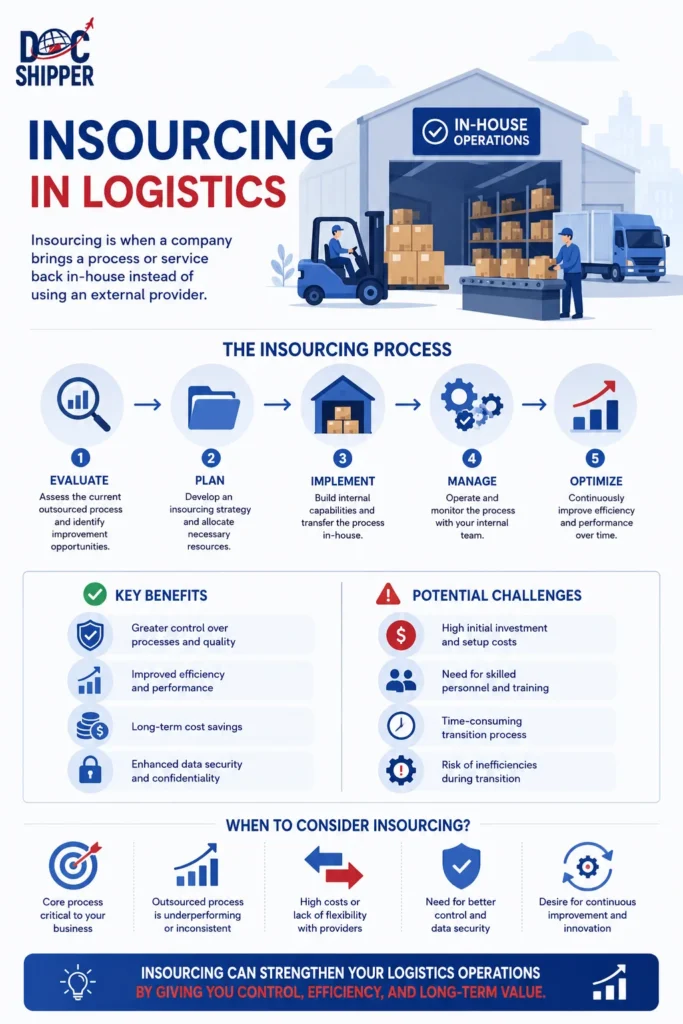
Insourcing is the strategic decision to perform business functions, manufacturing processes, or logistics operations internally using a company's own resources and workforce, rather than outsourcing them to external providers. This approach allows businesses to maintain direct control over quality, timelines, intellectual property, and operational efficiency while developing in-house expertise and reducing dependency on third-party vendors.
Introduction
Many businesses struggle with the dilemma of whether to handle critical operations internally or delegate them to specialized providers. The decision becomes particularly complex in international logistics, where control over supply chain visibility can determine competitive advantage. As global trade becomes increasingly fragmented, companies face mounting pressure to either develop internal capabilities or risk losing strategic oversight.
Insourcing represents a fundamental shift in organizational strategy. Unlike outsourcing, which transfers responsibility to external contractors, insourcing builds permanent internal capacity. This approach has regained prominence as businesses recognize the limitations of fragmented supply chains exposed during recent global disruptions.
Key characteristics of insourcing include:
- Direct operational control: Complete authority over processes, quality standards, and execution timelines
- Internal resource allocation: Investment in personnel, technology, and infrastructure owned by the company
- Intellectual property protection: Sensitive knowledge remains within organizational boundaries
- Long-term capability development: Building sustainable competitive advantages through proprietary expertise
- Cost structure transformation: Converting variable outsourcing costs into predictable internal operational expenses
Strategic Depth & Operational Expertise
Insourcing fundamentally alters how organizations approach value creation and risk management. By bringing operations in-house, companies gain granular visibility into every process step, enabling continuous improvement methodologies that external providers rarely deliver with the same commitment.
The decision to insource typically stems from five strategic imperatives. First, quality control requirements that exceed what third-party contractors can reliably deliver. Manufacturing sectors with stringent regulatory compliance—pharmaceuticals, aerospace, medical devices—often insource critical production stages to ensure traceability and consistency.
Second, intellectual property concerns drive insourcing when proprietary technologies or processes represent core competitive differentiators. Sharing production secrets with external manufacturers creates vulnerability to knowledge leakage, particularly in jurisdictions with weak IP enforcement. Companies developing innovative logistics technologies or specialized packaging solutions frequently insource to protect these advantages.
Third, supply chain resilience has emerged as a critical factor following global disruptions. Organizations discovered that over-reliance on outsourced logistics created dangerous fragility. Insourcing transportation management, warehousing, or customs clearance operations provides buffer capacity during market volatility.
Fourth, cost predictability becomes achievable through insourcing. While initial capital investment may be substantial, long-term operational costs become more stable compared to fluctuating contractor fees influenced by market conditions, fuel prices, or capacity constraints. At DocShipper, we observe clients insourcing customs documentation teams after analyzing the total cost of ownership compared to per-shipment broker fees.
Finally, customer experience differentiation requires control that only insourcing provides. Direct management of last-mile delivery, customer service touchpoints, or returns processing enables brand consistency impossible when mediated through third parties with competing priorities.
Legal and regulatory frameworks increasingly support insourcing strategies. The EU Authorized Economic Operator (AEO) program provides tangible benefits—expedited customs clearance, reduced inspections—to companies demonstrating internal control systems. These certifications reward organizations that insource compliance functions rather than delegating them to freight forwarders.
Concrete Examples & Industry Data
Real-world insourcing applications demonstrate measurable impacts across industries. Consider the logistics sector itself, where vertical integration has reshaped competitive dynamics. Amazon’s development of internal delivery networks exemplifies strategic insourcing at scale.
Between 2018 and 2023, Amazon insourced what had been outsourced to UPS, FedEx, and USPS. The company now delivers approximately 60% of its own packages in the United States through Amazon Logistics, its insourced delivery network. This transformation required massive capital investment—aircraft purchases, sorting facility construction, driver recruitment—but delivered strategic independence from third-party carrier capacity constraints during peak seasons.
Manufacturing insourcing demonstrates different dynamics. A European automotive supplier case study reveals the financial implications:
| Metric | Outsourced Model | Insourced Model | Change |
|---|---|---|---|
| Annual Production Volume | 850,000 units | 850,000 units | — |
| Per-Unit Variable Cost | €42.50 | €38.20 | -10.1% |
| Quality Defect Rate | 2.8% | 0.9% | -67.9% |
| Lead Time (Order to Delivery) | 18 days | 6 days | -66.7% |
| Initial Capital Investment | — | €12.4M | ROI: 3.2 years |
This manufacturer achieved breakeven on insourcing investment within 38 months through combined savings from reduced defects, faster turnaround, and lower per-unit costs. The defect reduction alone eliminated €850,000 in annual warranty claims.
Logistics insourcing patterns vary by function. A 2023 industry survey of 500 international importers revealed selective insourcing preferences:
- Customs documentation: 34% insourced, citing compliance control and cost reduction on high-volume shipments
- Warehousing: 28% insourced, primarily for inventory visibility and integration with internal systems
- Freight booking: 19% insourced, leveraging enterprise agreements with carriers
- Last-mile delivery: 12% insourced, focused on customer experience differentiation
- International freight forwarding: 7% insourced, limited to large corporations with dedicated trade departments
A practical use case illustrates insourcing economics for customs clearance. A European electronics retailer importing 2,400 containerized shipments annually from Asia compared outsourced brokerage against insourcing:
Outsourced scenario: Average brokerage fee €280 per container = €672,000 annually. Additional coordination time averaged 4 hours per problematic shipment (estimated 15% of volume), consuming internal resources worth approximately €18,000 yearly.
Insourced scenario: Three full-time customs specialists (€180,000 total compensation), software licensing (€24,000), training and compliance updates (€12,000) = €216,000 annually. Clearance times reduced by 40%, decreasing demurrage charges by €95,000.
The insourcing model delivered €551,000 net annual savings with improved shipment predictability. At DocShipper, we’ve helped clients navigate these transition analyses, particularly when evaluating whether insourcing specific logistics functions aligns with their operational maturity and volume thresholds.
Technology enablement has lowered insourcing barriers. Cloud-based customs management platforms, transportation management systems, and warehouse management software now provide enterprise-grade capabilities previously requiring massive IT investments. A mid-sized importer can deploy comprehensive trade compliance software for €3,000-€8,000 monthly, making insourcing feasible at lower shipment volumes than historically viable.
Conclusion
Insourcing represents a strategic choice to build internal capabilities that deliver control, resilience, and long-term competitive advantage in international logistics. While requiring upfront investment, the approach offers predictable costs, enhanced quality, and operational independence that outsourcing cannot match when aligned with business objectives.
Need expert guidance evaluating insourcing versus outsourcing for your logistics operations? Contact DocShipper for a customized analysis of your supply chain requirements.
📚 Quiz
Test Your Knowledge: Insourcing
1. What is the core definition of insourcing in logistics operations?
2. A European automotive supplier insourced production and achieved a defect rate reduction from 2.8% to 0.9%. Which strategic benefit does this primarily demonstrate?
3. A mid-sized electronics retailer handles 2,400 annual containerized shipments. When would insourcing customs clearance operations make strategic sense?
🎯 Your Result
📞 Free Personalized QuoteFAQ | Insourcing: Definition, Strategic Benefits & Concrete Examples
Insourcing means performing business functions using internal employees, infrastructure, and resources owned by the company. Outsourcing transfers those functions to external third-party providers. The core distinction lies in control and ownership—insourced operations remain under direct management, while outsourced functions are governed by contracts with external entities.
Insourcing becomes strategically valuable when volume reaches sufficient scale to justify fixed costs, when quality control requirements exceed external provider capabilities, when intellectual property protection is critical, or when supply chain resilience demands direct operational control. Companies should evaluate total cost of ownership, strategic importance of the function, and internal capability development requirements.
Key risks include substantial upfront capital investment, difficulty achieving economies of scale compared to specialized providers, complexity of maintaining regulatory compliance across multiple jurisdictions, and opportunity cost of diverting management attention from core business activities. Insufficient volume can result in higher per-unit costs than outsourcing alternatives.
Insourced customs teams develop deep familiarity with a company's specific products, HS classifications, and regulatory requirements, often accelerating clearance times compared to brokers handling diverse client portfolios. However, this requires continuous investment in training, software systems, and maintaining relationships with customs authorities across operating jurisdictions.
Small businesses can selectively insource specific functions where control delivers disproportionate value—such as customer service, last-mile delivery in local markets, or inventory management. However, complex international functions like freight forwarding or multi-jurisdiction customs compliance typically remain more cost-effective when outsourced until reaching substantial volume thresholds.
Effective insourcing requires transportation management systems (TMS), warehouse management systems (WMS), customs compliance software, and integration capabilities with carrier networks and government systems. Cloud-based solutions have dramatically reduced implementation costs, making enterprise-grade technology accessible at monthly subscription models rather than requiring massive capital expenditure.
Break-even analysis compares total outsourcing costs (per-transaction fees, coordination overhead, quality failure costs) against insourcing costs (personnel, technology, infrastructure, training). Companies should project costs across 3-5 years, accounting for volume growth, efficiency improvements through learning curves, and strategic benefits like intellectual property protection that may not have immediate financial quantification.
Insourcing typically enhances visibility because data flows directly through internal systems without intermediary handoffs. Companies gain real-time access to shipment status, inventory positions, and operational metrics without relying on external provider portals. This integrated visibility enables faster exception management and more accurate demand planning.
Insourced trade compliance teams develop specialized knowledge of product-specific regulations, free trade agreement requirements, and corporate duty optimization strategies. This expertise supports Authorized Economic Operator certifications, reduces audit risks, and enables proactive regulatory adaptation. Companies maintain direct accountability rather than contractual liability through third-party brokers.
Building internal logistics capabilities creates career development pathways that improve employee retention. Specialists develop deep expertise in company-specific supply chain challenges, increasing their value and engagement. However, organizations must invest in continuous training and competitive compensation to prevent skilled employees from being recruited by competitors or service providers.
Hybrid models are increasingly common, where companies insource strategic functions requiring control while outsourcing commodity services. For example, maintaining internal customs compliance teams while outsourcing freight transportation, or managing warehousing internally while contracting last-mile delivery. This approach optimizes resource allocation based on strategic value and operational efficiency.
Key success indicators include cost per transaction compared to previous outsourcing baseline, quality metrics like defect rates or customs clearance delays, cycle time reductions, customer satisfaction improvements, and strategic benefits such as intellectual property protection or regulatory compliance achievement. Comprehensive measurement should extend beyond pure cost comparison to capture total value creation.
Need Help with
Logistics or Sourcing ?
First, we secure the right products from the right suppliers at the right price by managing the sourcing process from start to finish. Then, we simplify your shipping experience - from pickup to final delivery - ensuring any product, anywhere, is delivered at highly competitive prices.


Fill the Form
Prefer email? Send us your inquiry, and we’ll get back to you as soon as possible.
Contact us




