


In short ⚡
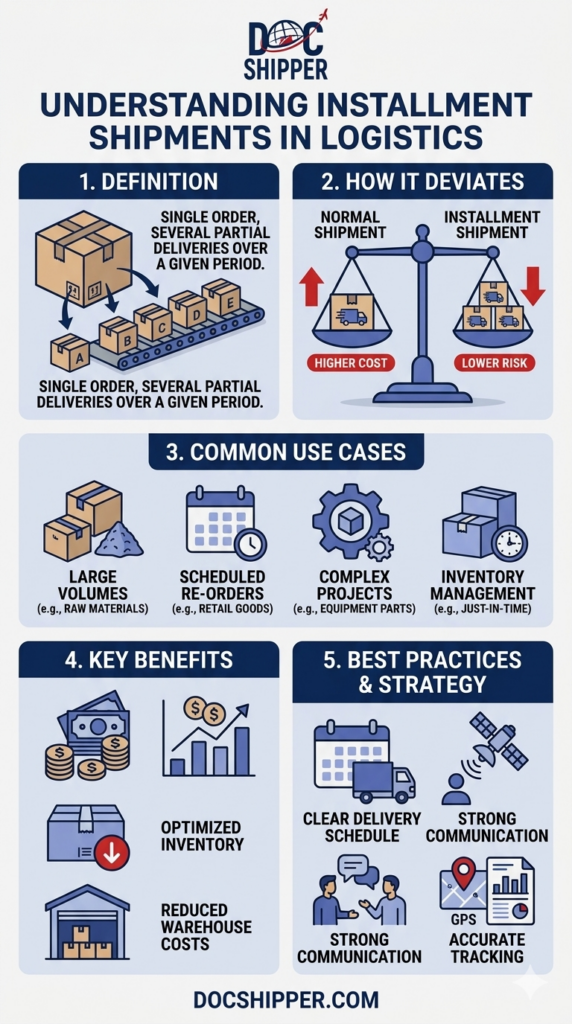
Installment Shipments refer to the practice of dividing a single commercial contract into multiple partial deliveries sent at different intervals. This logistics strategy allows exporters and importers to manage large-volume orders by spreading shipments over time, optimizing cash flow, warehouse capacity, and production schedules while maintaining contractual obligations.
Introduction
One of the most misunderstood aspects of international trade is the assumption that all orders must ship in a single batch. Many businesses face warehouse limitations, production constraints, or cash flow challenges that make complete shipments impractical. Installment shipments solve these operational bottlenecks while preserving commercial relationships.
This delivery method is particularly relevant for high-value contracts, seasonal merchandise, or manufacturing orders requiring staggered production cycles. Understanding installment shipments is essential for negotiating Incoterms® and managing trade finance instruments like letters of credit.
Key characteristics include:
- Contractual stipulation: Terms must explicitly define delivery schedules, quantities per shipment, and payment conditions
- Risk distribution: Each installment is treated as an independent transaction for insurance and liability purposes
- Documentation requirements: Separate commercial invoices, bills of lading, and customs declarations for each shipment
- Payment flexibility: Allows progressive payments tied to delivery milestones rather than full upfront payment
- Supply chain optimization: Reduces warehousing costs and inventory holding periods for both parties
In-Depth Analysis & Technical Expertise
Installment shipments require meticulous contractual planning to avoid disputes. The sales contract must specify the exact number of installments, delivery dates (or date ranges), quantities per batch, and consequences of delayed shipments. Without these details, one party may claim breach of contract if expectations differ.
From a customs perspective, each installment constitutes a separate importation. This means duty payments, import licenses, and compliance checks apply individually. Countries like the United States require distinct entry filings for each shipment, even under the same purchase order. The U.S. Customs and Border Protection treats partial shipments as independent transactions unless explicitly linked through continuous bonds.
Letters of credit (LCs) must be structured carefully for installment shipments. Standard LCs require full shipment before payment, but installment-compatible LCs allow partial drawings. Banks issue tranched credits where each shipment triggers a proportional payment upon presentation of compliant documents. At DocShipper, we systematically verify LC clauses to ensure they align with your installment schedule, preventing payment delays.
The Incoterms® rules apply independently to each installment. If the contract specifies FOB Shanghai for five installments, risk transfers to the buyer five separate times when goods cross the ship’s rail. This affects insurance coverage—importers must ensure their policies cover multiple arrival dates and potential gaps between shipments.
Finally, inventory management becomes critical. Retailers using installment shipments for seasonal goods must coordinate deliveries with shelf space availability and promotional calendars. Manufacturing buyers receiving raw materials in batches must synchronize installments with production schedules to avoid line stoppages. Poor coordination leads to demurrage charges, rushed air freight costs, or production delays that negate the financial benefits of installment arrangements.
Concrete Examples & Data
Consider a European furniture retailer ordering 10,000 chairs from a Vietnamese manufacturer. Full shipment requires six 40-foot containers costing $18,000 total. Instead, they arrange four monthly installments of 2,500 chairs (1.5 containers each), paying $4,500 per shipment.
| Installment | Quantity | Shipping Cost | Warehouse Days | Payment Terms |
|---|---|---|---|---|
| Month 1 | 2,500 chairs | $4,500 | 15 days | 30% upfront |
| Month 2 | 2,500 chairs | $4,500 | 12 days | 25% on delivery |
| Month 3 | 2,500 chairs | $4,500 | 10 days | 25% on delivery |
| Month 4 | 2,500 chairs | $4,500 | 8 days | 20% final payment |
Financial impact: By receiving chairs as sold (rather than warehousing 10,000 units), the retailer reduces storage costs by $6,200 (calculated at $2/unit/month for avoided inventory). The manufacturer benefits from continuous production flow, avoiding factory downtime between large orders.
Another scenario involves a U.S. electronics importer receiving smartphone components from Taiwan. Due to tariff engineering, they split a $500,000 order into five installments of $100,000 each. Under the de minimis exemption (not applicable here but illustrating strategy), smaller shipments sometimes qualify for different duty treatments. More importantly, the importer syncs deliveries with assembly schedules, eliminating $18,000 in warehouse rental fees.
Key benefits observed in installment shipments:
- Cash flow optimization: 63% of SMEs report improved liquidity when payments align with delivery milestones
- Reduced warehousing: Average storage cost reduction of 40-55% for high-volume importers
- Production alignment: Manufacturers maintain 78% higher capacity utilization with steady installment orders
- Risk mitigation: Quality issues detected in early installments allow contract adjustments before full delivery
- Market responsiveness: Retailers adjust later installment quantities based on initial sales performance
Conclusion
Installment shipments transform rigid trade transactions into flexible logistics strategies, balancing operational efficiency with financial prudence. Proper structuring prevents disputes while optimizing cash flow and warehouse utilization. Need expert guidance structuring your installment shipment terms? Contact DocShipper for tailored logistics solutions.
📚 Quiz
Test Your Knowledge: Installment Shipments
What is the primary defining characteristic of installment shipments?
How do customs authorities treat each installment shipment for duty assessment purposes?
A European retailer receives furniture in four monthly installments instead of one full shipment. Which operational benefit does this arrangement provide?
🎯 Your Results
📞 Free Personalized QuoteFAQ | Installment Shipments: Definition, Calculation & Concrete Examples
Installment shipments are pre-planned divisions specified in the original contract with scheduled delivery dates. Partial shipments are unplanned splits occurring due to unforeseen circumstances like production delays or shipping capacity issues. Installment arrangements require explicit contractual terms, while partial shipments often violate standard contracts unless the buyer consents.
Banks issue installment LCs (also called revolving or tranched credits) that permit multiple drawings. Each installment requires separate document presentation—bill of lading, commercial invoice, packing list—matching the shipped quantity. The LC stipulates tolerance percentages (typically ±5-10%) and deadlines for each installment. Failure to ship one installment may void the entire credit unless the LC includes "independent installments" language.
Customs duties apply to each installment's declared value independently. Authorities treat each shipment as a separate transaction, assessing duties, VAT, and compliance requirements at each border crossing. This means 10 installments generate 10 duty payment events. However, total annual import volumes may trigger different tariff brackets or quotas, affecting effective rates.
Contractual terms dictate cancellation rights. Well-drafted installment contracts include inspection periods and quality thresholds that permit cancellation of future installments without penalty if defect rates exceed agreed levels (e.g., 2% failure rate). Without such clauses, cancellation may constitute breach of contract, exposing you to damages claims for the undelivered portion.
Marine cargo insurance typically covers each installment separately under an open policy. You declare each shipment's value, pay proportional premiums, and receive individual certificates of insurance. The policy's aggregate limit must accommodate all installments. Gaps between deliveries aren't covered unless you purchase warehouse-to-warehouse or annual policy extensions that bridge storage periods.
FOB, CIF, and DAP are commonly used because they clearly define when risk transfers for each installment. Avoid EXW for installments—it places full logistics responsibility on the buyer for each pickup, creating coordination nightmares. DDP works if the seller manages all installments door-to-door, but increases their risk exposure across multiple deliveries.
Yes, absolutely. Customs authorities require individual commercial invoices matching each shipment's contents and value. Each invoice should reference the master sales contract number but show only the specific installment's details. This prevents valuation disputes and ensures proper duty assessment. Consolidated invoicing for multiple installments violates most countries' import documentation requirements.
Optimal spacing depends on your inventory turnover rate and production capacity. Retailers typically schedule 2-4 weeks between installments to match sales velocity. Manufacturers receiving raw materials align installments with production runs, often 1-2 weeks apart. Longer gaps (60+ days) may trigger contract expiration clauses or create financing complications with banks.
Consequences depend on your contract's force majeure and delay provisions. Common remedies include proportional price reductions (e.g., 0.5% per day late), extension of later installment deadlines, or cancellation rights after a cure period (typically 10-15 days). Without explicit late-delivery terms, you're limited to general breach-of-contract remedies, which vary by jurisdiction.
Technically yes, but it's operationally complex and rarely advisable. Different Incoterms® per installment create confusion about responsibility for freight, insurance, and customs clearance. If circumstances require varied terms (e.g., first installment by air, rest by sea), clearly specify in the contract which Incoterm® applies to which installment numbers to avoid disputes.
Installment arrangements reduce working capital strain by aligning payments with deliveries. Instead of financing 100% of inventory upfront, you pay incrementally as goods arrive and sell. This improves cash conversion cycles—studies show importers reduce tied-up capital by 35-50% compared to full-shipment models. However, you may face slightly higher per-unit shipping costs due to smaller container volumes.
Maintain a delivery log cross-referencing the master contract with each installment's bill of lading, commercial invoice, and signed delivery receipt. Final acceptance documents or a completion certificate signed by both parties legally confirm all installments were delivered per terms. This documentation becomes critical if disputes arise or for audit purposes when claiming tax deductions on imported goods.
Need Help with
Logistics or Sourcing ?
First, we secure the right products from the right suppliers at the right price by managing the sourcing process from start to finish. Then, we simplify your shipping experience - from pickup to final delivery - ensuring any product, anywhere, is delivered at highly competitive prices.


Fill the Form
Prefer email? Send us your inquiry, and we’ll get back to you as soon as possible.
Contact us




