


In short ⚡
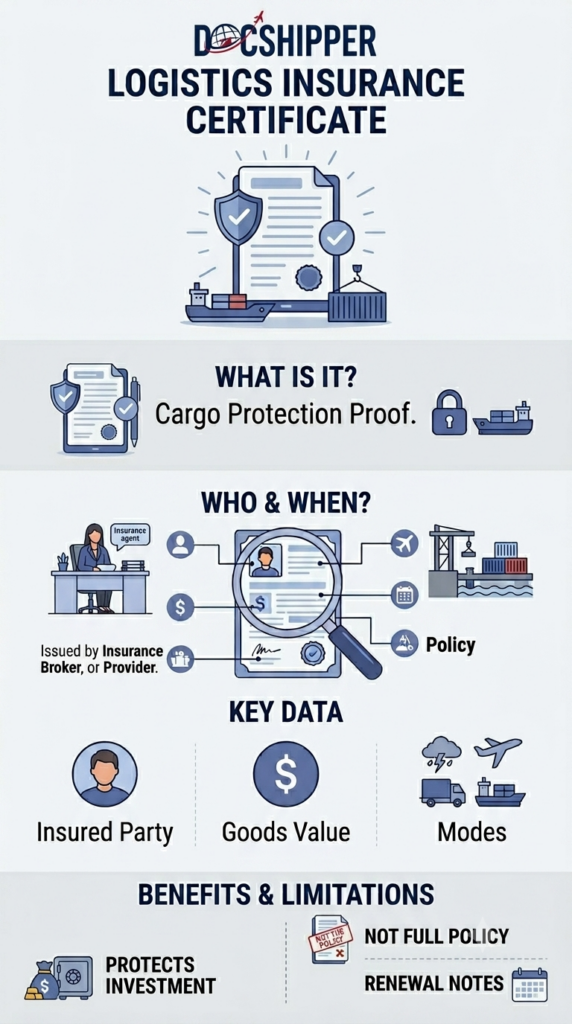
An Insurance Certificate is a document issued by an insurer or insurance broker that provides evidence of insurance coverage for goods in transit. It details the type of coverage, insured value, voyage specifics, and policy terms, serving as proof that cargo is protected against loss or damage during international shipment.
Introduction
In international trade, one of the most common misunderstandings involves the difference between an insurance certificate and an insurance policy. While a policy is the master contract between insurer and insured, the certificate is the specific document proving coverage for a particular shipment. Without this certificate, banks may refuse payment under Letters of Credit, and customs authorities may delay clearance.
The insurance certificate plays a critical role in the documentary chain of import/export operations. It protects all parties involved—exporters, importers, freight forwarders, and financial institutions—by guaranteeing compensation in case of unforeseen events during transit.
Key characteristics of an insurance certificate include:
- Proof of Coverage: Confirms that specific goods are insured for a defined voyage
- Negotiable Document: Can be transferred to third parties, typically the consignee or bank
- Letter of Credit Compliance: Must match LC requirements precisely regarding coverage type and value
- Claims Foundation: Serves as primary evidence when filing claims for loss or damage
- Legal Validity: Carries the same legal weight as the underlying insurance policy for the specific shipment
Legal Framework & Coverage Mechanics
The insurance certificate operates within a complex regulatory framework governed by international conventions and national insurance laws. The Institute Cargo Clauses (ICC), established by the London Market Association, define three main coverage levels: ICC(A) for comprehensive all-risk coverage, ICC(B) for named perils with broader scope, and ICC(C) for basic risks only.
When a freight forwarder or exporter issues a certificate under an open cargo policy, they’re drawing upon a master agreement with predetermined terms. The certificate must explicitly state the insured value, typically calculated as CIF value plus 10% to cover potential profit and additional costs. This percentage, known as the insurance margin, ensures adequate compensation even when market values fluctuate.
The warehouse-to-warehouse clause represents a critical coverage component. It extends protection from the moment goods leave the seller’s premises until delivery at the buyer’s warehouse, including temporary storage periods subject to specified time limits (usually 60 days after discharge).
Under Incoterms regulations, the party responsible for arranging insurance varies. With CIF and CIP terms, the seller must provide insurance, while under FOB or EXW, the buyer typically arranges coverage. However, the insurance certificate must always be issued in a transferable form to protect the buyer’s interests.
At DocShipper, we systematically verify that insurance certificates match Letter of Credit stipulations before shipment. This proactive approach has prevented countless payment delays for our clients by ensuring documentary compliance from the outset.
Types of Certificates & Real-World Applications
Insurance certificates come in various forms depending on the shipper’s insurance arrangement and the specific requirements of the transaction. Understanding these distinctions is crucial for smooth documentary processing and risk management.
| Certificate Type | Characteristics | Typical Use Case |
|---|---|---|
| Specific Certificate | Issued for single shipment, standalone policy | Occasional exporters, high-value one-off shipments |
| Open Policy Certificate | Issued under master policy, multiple shipments | Regular importers/exporters, freight forwarders |
| Broker’s Certificate | Issued by insurance broker on behalf of underwriter | Complex risks, specialized cargo types |
| Combined Certificate | Includes both insurance and other documents | LCL shipments, consolidated cargo |
Real-World Case Study: Electronics Shipment
A French electronics importer ordered €250,000 worth of smartphones from China under CIF Le Havre terms. The exporter arranged insurance through their freight forwarder’s open policy. The insurance certificate specified:
- Insured Value: €275,000 (110% of CIF value)
- Coverage Type: ICC(A) All Risks including theft and pilferage
- Deductible: €500 per claim
- Voyage: Shenzhen to Le Havre via container vessel
- Special Clauses: Temperature-controlled container requirement noted
During transit, the container experienced refrigeration failure, causing damage to 30% of the cargo. Because the certificate explicitly covered temperature control failure and was issued for the correct amount, the claim was settled within 45 days for €82,500, demonstrating the importance of comprehensive coverage specification.
DocShipper manages insurance certificates for over 3,000 shipments annually, ensuring that coverage terms align with client risk profiles. Our due diligence process includes verification of insurer financial ratings, coverage limit adequacy, and clause compatibility with destination country requirements.
Conclusion
The insurance certificate serves as an indispensable component of international trade documentation, providing financial protection and documentary compliance throughout the supply chain. Proper understanding of its types, legal implications, and coverage mechanics empowers traders to mitigate risks effectively.
Need assistance ensuring your insurance certificates meet all regulatory and contractual requirements? Contact DocShipper for expert guidance on cargo insurance and complete documentary support.
📚 Quiz
Test Your Knowledge: Insurance Certificate
An insurance certificate is best defined as:
Under CIF Incoterms, what is the minimum required insured value specified in an insurance certificate?
A French importer receives an insurance certificate with a minor error in the cargo description. What is the most likely outcome if cargo damage occurs?
🎯 Your Result
📞 Free Personalized QuoteFAQ | Insurance Certificate: Definition, Types & Practical Use Cases
An insurance policy is the master contract between the insured and insurer covering multiple shipments over time, while an insurance certificate is a document issued for a specific shipment evidencing coverage under that policy. The certificate contains voyage-specific details like cargo description, vessel name, insured value, and coverage dates. Only the certificate is presented to banks and buyers as proof of insurance for a particular transaction.
While not universally mandatory by law, insurance certificates are required in most documentary credit transactions and recommended for all international shipments. Under CIF and CIP Incoterms, the seller must provide insurance documentation. Even when not contractually required, having a certificate protects both parties financially and facilitates customs clearance in many countries that require proof of insurance for high-value goods.
Insurance certificates cannot typically be altered once issued, as they're legal documents. If details are incorrect or coverage needs adjustment, you must request a new certificate or an endorsement from the issuing party. For Letter of Credit transactions, any discrepancies between the certificate and LC terms may result in payment refusal by banks, making accuracy critical before issuance.
The validity period depends on the coverage type and policy terms. For marine cargo insurance, the standard warehouse-to-warehouse clause typically provides coverage for 60 days after vessel discharge at the destination port. The certificate itself remains valid as long as the cargo is within the coverage period specified in the document. Extended storage beyond standard terms requires separate arrangement with the insurer.
Insurance certificates can be issued by licensed insurance companies, authorized insurance brokers, or parties holding an open cargo policy (like freight forwarders) with authority to certify coverage. The issuing party must have a valid insurance arrangement in place. Banks scrutinize the issuer's credentials carefully during documentary credit examination to ensure the certificate provides genuine coverage backed by a reputable insurer.
Minor discrepancies in the certificate generally don't affect claim validity if the underlying policy covers the loss and the shipment can be clearly identified. However, significant errors regarding cargo description, insured value, or voyage details may complicate or delay claims. Insurers assess each case individually, but accurate documentation from the outset avoids potential disputes during the claims process.
Under CIF Incoterms, the seller must provide minimum coverage under Institute Cargo Clauses (C) or equivalent, insuring for 110% of the contract value in the contract currency. However, ICC(C) provides only limited coverage for major casualties. Buyers often negotiate for broader coverage under ICC(A) or ICC(B) to protect against more comprehensive risks including theft, water damage, and breakage.
Yes, insurance certificates are typically issued as transferable documents, allowing the consignee or their bank to claim compensation directly from the insurer if loss occurs. The certificate should be endorsed to the party entitled to make claims, usually the buyer or their financing bank. This transferability is essential in Letter of Credit transactions where banks require security over the insured goods.
To file a claim, notify the insurer or their agent immediately upon discovering damage or loss. Submit the original insurance certificate along with supporting documents including the commercial invoice, packing list, bill of lading, survey report detailing damage, and any correspondence with the carrier. Most policies require notification within specific timeframes (typically 30-60 days) to preserve claim rights.
Insurance premiums generally range from 0.2% to 2% of the insured value, depending on cargo type, route, packaging, vessel quality, and coverage level. High-risk goods like electronics or fragile items command higher premiums, while bulk commodities may have lower rates. The premium is typically built into the CIF price, and the certificate doesn't always explicitly show the premium amount paid.
Yes, some countries impose specific requirements. For example, certain Middle Eastern nations require certificates from insurers with local presence or specific financial ratings. Some countries mandate coverage through national insurance companies for imports above certain values. Additionally, sanctioned countries may have restrictions on which insurers can provide valid coverage. Always verify destination-specific requirements before arranging insurance.
If the original certificate is lost, immediately contact the issuing party to request a certified duplicate. Most insurers can reissue certificates upon receipt of a letter of indemnity. For Letter of Credit transactions, banks may accept a duplicate marked as such, though this depends on LC terms. Maintain digital copies of all insurance documents as backup to expedite replacement if needed.
Need Help with
Logistics or Sourcing ?
First, we secure the right products from the right suppliers at the right price by managing the sourcing process from start to finish. Then, we simplify your shipping experience - from pickup to final delivery - ensuring any product, anywhere, is delivered at highly competitive prices.


Fill the Form
Prefer email? Send us your inquiry, and we’ll get back to you as soon as possible.
Contact us




