


In short ⚡
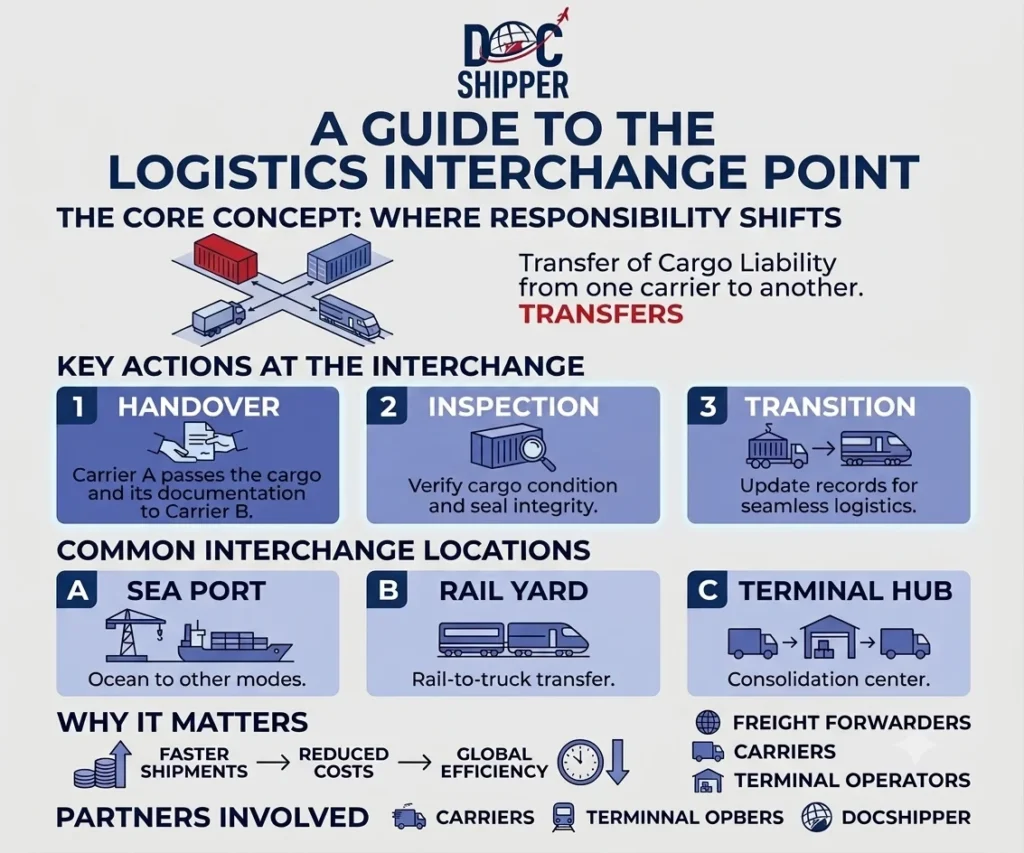
An Interchange Point is a strategic location where cargo is transferred between different transport modes (rail, truck, vessel) or carriers within the same supply chain. It serves as a critical node for optimizing transit times, reducing costs, and ensuring seamless coordination between multiple logistics operators during international shipments.
Introduction
In international logistics, one of the most common challenges is managing cargo transfers between different carriers or transport modes. Many shipment delays occur precisely at these transition points due to poor coordination, documentation errors, or infrastructure bottlenecks.
Understanding how interchange points function is essential for any business involved in import/export operations. These nodes directly impact delivery speed, handling costs, and overall supply chain reliability.
Key characteristics of interchange points include:
- Multimodal connectivity: They connect rail terminals, seaports, airports, and trucking hubs.
- Carrier transition: Cargo changes custody from one logistics provider to another.
- Documentation checkpoint: Critical location for customs clearance and cargo verification.
- Temporary storage: Often includes warehousing facilities for short-term consolidation.
- Strategic positioning: Located near major trade routes to minimize transit distance.
Technical Framework & Operational Expertise
Interchange points operate under strict regulatory and operational frameworks. When cargo arrives at these facilities, a handover protocol is executed between the outgoing and incoming carriers. This includes physical inspection, liability transfer, and updating of tracking systems.
The Equipment Interchange Receipt (EIR) is the primary document used at these points. It records container condition, seals, and confirms responsibility transfer. Any discrepancy noted at this stage can trigger insurance claims or delay investigations.
From a customs perspective, interchange points often serve as bonded warehouses where goods can be stored without immediate duty payment. This is particularly important for consolidation operations where smaller shipments are grouped before final dispatch.
At DocShipper, we coordinate directly with interchange facilities to ensure proper documentation flow and minimize dwell time—the period cargo sits idle waiting for the next transport leg. Reducing dwell time by even 24 hours can save significant detention fees and accelerate delivery schedules.
Three critical operational aspects define interchange efficiency:
- Digital integration: Real-time data exchange between carriers through EDI or API systems.
- Physical infrastructure: Adequate loading docks, cranes, and handling equipment for various cargo types.
- Regulatory compliance: Adherence to international conventions like the TIR Convention for cross-border movements.
The choice of interchange point can significantly affect total landed costs. For example, routing through a well-equipped inland terminal instead of a congested port can reduce handling fees by 15-20% while improving delivery predictability.
Practical Examples & Industry Data
Understanding interchange points becomes clearer through real-world applications. Consider a shipment from Shanghai to Munich: the cargo might transfer at Rotterdam port (sea-to-rail interchange), then at Duisburg inland terminal (rail-to-truck interchange) before final delivery.
According to 2023 logistics industry data, approximately 68% of intercontinental cargo passes through at least two interchange points during transit. European networks show the highest interchange efficiency, with average dwell times of 18-24 hours compared to 48-72 hours in emerging markets.
| Interchange Type | Average Dwell Time | Handling Cost (per TEU) | Primary Risk |
|---|---|---|---|
| Sea-to-Rail | 24-48 hours | $150-250 | Port congestion |
| Rail-to-Truck | 12-24 hours | $80-120 | Documentation delays |
| Truck-to-Air | 6-12 hours | $200-400 | Security screening |
| Carrier-to-Carrier (same mode) | 4-8 hours | $50-90 | Equipment mismatch |
Use Case: A European electronics importer consolidates weekly shipments from three Asian suppliers at Singapore’s Pasir Panjang Terminal (interchange point). Instead of three separate LCL shipments, goods are combined into one FCL container, reducing per-unit shipping costs by 42% and simplifying customs clearance at destination.
Another critical consideration is demurrage and detention charges at interchange points. Industry data shows that containers exceeding free time at these facilities incur average daily charges of $75-150, making efficient scheduling essential.
Key operational metrics for interchange point selection:
- Infrastructure capacity: Can the facility handle your cargo type and volume?
- Connectivity index: How many carriers and transport modes are accessible?
- Processing speed: Historical average for cargo clearance and transfer completion.
- Geographic position: Proximity to final destination versus cost savings from alternative routing.
- Technology adoption: Digital tracking systems and automated documentation processing.
Conclusion
Interchange points represent critical junctions in the global supply chain where efficiency gains or delays can cascade throughout the entire logistics process. Proper management of these transition nodes requires understanding both technical requirements and strategic positioning within your distribution network.
Need expert guidance on optimizing your interchange operations or reducing transit costs? Contact DocShipper for professional support tailored to your specific logistics challenges.
📚 Quiz
Test Your Knowledge: Interchange Point
What is the primary function of an Interchange Point in logistics?
When does legal responsibility for cargo transfer at an Interchange Point?
Your electronics shipment from Shanghai to Munich will pass through Rotterdam port and Duisburg terminal. What is the main advantage of using these interchange points for cargo consolidation?
🎯 Your Result
📞 Free Quote in 24hFAQ | Interchange Point: Definition, Role & Practical Examples in Logistics
An interchange point specifically refers to locations where cargo custody changes between carriers or transport modes, while a transshipment hub is a broader term for facilities handling cargo transfers, consolidation, and storage. All interchange points can be transshipment hubs, but not all transshipment hubs function as interchange points—some only handle cargo for a single carrier network.
Legal responsibility transfers at the moment the Equipment Interchange Receipt (EIR) or similar document is signed by both parties. Until that point, the outgoing carrier remains liable. After signature, the incoming carrier assumes responsibility. This makes precise documentation critical, as any damage or loss claims will reference the EIR condition notes.
Many interchange points operate as customs-bonded facilities, allowing goods to remain "in transit" without immediate duty payment. Customs clearance can occur either at the interchange point or at the final destination, depending on your chosen procedure. Strategic use of bonded warehousing at these points can defer duties and simplify multi-country shipments.
Free time varies by facility and carrier agreement but typically ranges from 24-72 hours. Ocean carrier containers often receive longer free time (5-7 days) when transferred to rail, while air cargo at truck interchanges may only have 12-24 hours. Exceeding free time triggers demurrage or detention charges averaging $75-150 per day.
Not all interchange points offer consolidation services. Facilities must have appropriate warehousing, staffing, and customs authorizations. Major transshipment hubs like Singapore, Rotterdam, or Dubai typically provide full consolidation capabilities, while smaller rail-truck interchange points may only handle direct transfers without cargo manipulation.
Technologies like Electronic Data Interchange (EDI), blockchain tracking, and Internet of Things (IoT) sensors enable real-time visibility and automated documentation. These systems reduce manual errors, accelerate handover processes, and provide predictive alerts for potential delays. Facilities with full digital integration can reduce average dwell time by 30-40%.
If damage is discovered during the interchange inspection, it must be documented on the EIR or equivalent receipt before custody transfers. The outgoing carrier remains responsible for pre-existing damage, while the incoming carrier is liable for any damage occurring after acceptance. Undocumented damage creates liability disputes requiring insurance claims investigation.
Yes, facilities handling international cargo must comply with conventions like the CMR (road transport), CIM/COTIF (rail), and the Hamburg Rules (maritime). The TIR Convention specifically governs cross-border interchange operations for sealed containers. Non-compliance can result in cargo detention, fines, or bond forfeiture.
Selection criteria should include: total transit time impact, handling costs, carrier connectivity, customs facilitation services, historical reliability data, and alignment with your distribution network. Running comparative scenarios for different interchange routing options typically reveals cost differences of 10-25% and delivery time variations of 2-5 days.
Current high-congestion facilities include Los Angeles/Long Beach port complex (sea-rail transfers), Felixstowe UK (port operations), and several Chinese inland rail terminals. Seasonal peaks during holiday shipping periods can triple normal dwell times. Alternative routing through less congested interchange points often justifies slightly longer distances for time-sensitive cargo.
Major interchange facilities typically have infrastructure for temperature-controlled cargo, hazardous materials, and oversized freight. However, capabilities vary significantly—a rail-truck interchange might lack cold storage, while a seaport facility could have extensive reefer container yards. Always verify specific handling capabilities before routing specialized cargo through an interchange point.
Severe weather can halt operations entirely at outdoor facilities, particularly rail yards and truck terminals. Indoor interchanges with covered loading areas maintain higher operational continuity. Historical weather disruption data for specific facilities should factor into route planning—some locations experience seasonal delays exceeding 48 hours during winter months or monsoon periods.
Need Help with
Logistics or Sourcing ?
First, we secure the right products from the right suppliers at the right price by managing the sourcing process from start to finish. Then, we simplify your shipping experience - from pickup to final delivery - ensuring any product, anywhere, is delivered at highly competitive prices.


Fill the Form
Prefer email? Send us your inquiry, and we’ll get back to you as soon as possible.
Contact us




