


In short ⚡
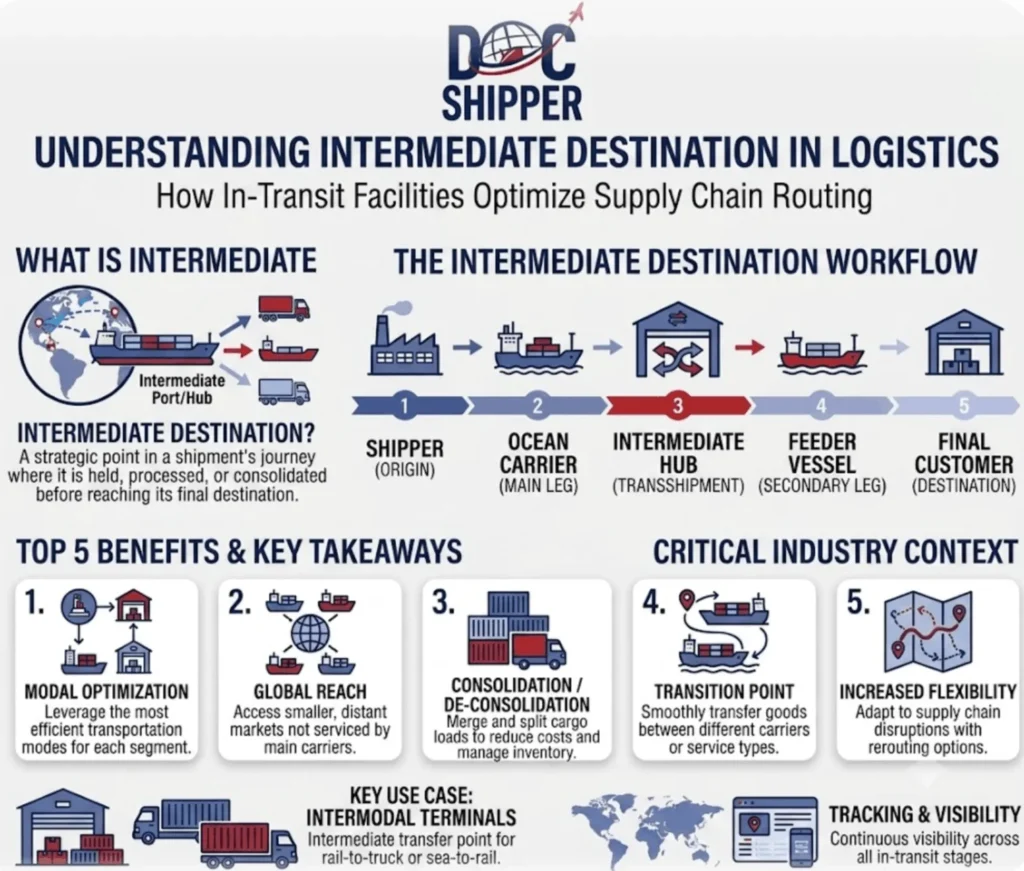
Intermediate Destination refers to a temporary stop or transit point in an international shipment's journey before reaching its final destination. This logistical waypoint serves for customs clearance, cargo consolidation, transshipment, or storage, playing a critical role in optimizing global supply chains and reducing transportation costs.
Introduction
Many importers confuse direct shipping with optimized routing. In reality, most international cargo passes through one or more intermediate destinations before final delivery.
Understanding intermediate destinations is essential for controlling costs, managing customs procedures, and ensuring supply chain flexibility. Strategic use of transit hubs can reduce freight expenses by up to 30% on certain routes.
Key characteristics of intermediate destinations include:
- Transit Hubs: Major ports or airports serving as connection points between origin and final destination
- Customs Clearance Zones: Locations where goods undergo administrative processing before continuing their journey
- Consolidation Centers: Facilities where multiple shipments are grouped to optimize container loads
- Break-Bulk Points: Sites where cargo is separated from larger shipments and redistributed
- Free Trade Zones: Special economic areas offering tax advantages and simplified procedures
Strategic Role & Operational Mechanics
Intermediate destinations serve multiple strategic functions within international logistics networks. Understanding these functions helps businesses optimize their shipping strategies.
Transshipment Operations constitute the primary use of intermediate destinations. Cargo arrives at a hub port like Singapore or Rotterdam, gets transferred to another vessel, and continues to its final destination. This hub-and-spoke model enables economies of scale by consolidating volumes.
Customs Pre-Clearance represents another critical function. Certain countries require goods to clear customs at an intermediate point before final entry. The European Union, for example, allows customs processing at any member state port, facilitating faster distribution across borders.
Cargo Deconsolidation and Distribution occurs when full container loads arrive at distribution centers. Here, shipments are separated and routed to multiple final destinations. This process optimizes last-mile delivery costs significantly.
Value-Added Services frequently take place at intermediate destinations. These include quality inspections, repackaging, labeling modifications, or light assembly work. Free Trade Zones offer particular advantages for these activities without triggering import duties.
Risk Mitigation and Flexibility benefit from strategic intermediate stops. If final destination ports face congestion or labor disputes, cargo can be rerouted from intermediate points. According to World Trade Organization data, such flexibility reduces supply chain disruption costs by approximately 15-25%.
At DocShipper, we systematically analyze routing options to identify optimal intermediate destinations for our clients, balancing cost efficiency with delivery speed requirements.
Practical Examples & Cost Analysis
Real-world scenarios demonstrate the financial and operational advantages of strategic intermediate destination selection.
Cost Comparison: Direct vs. Intermediate Routing
| Route Type | Origin | Intermediate Stop | Final Destination | Transit Time | Cost (40′ Container) |
|---|---|---|---|---|---|
| Direct | Shanghai | None | Hamburg | 32 days | $4,200 |
| Via Hub | Shanghai | Singapore | Hamburg | 36 days | $3,100 |
| Multi-Stop | Shanghai | Dubai + Rotterdam | Hamburg | 40 days | $2,850 |
This comparison reveals that routing through intermediate destinations can reduce costs by 26-32% depending on carrier availability and seasonal demand fluctuations.
Use Case: Electronics Distribution from Asia to Europe
A European electronics retailer imports 200 containers monthly from various Asian suppliers. Previously using direct shipping to individual European ports, they reorganized their logistics strategy.
Previous Model: Direct shipments to 8 European ports resulted in fragmented volumes, higher per-unit costs, and complicated customs procedures across multiple jurisdictions.
Optimized Model: All cargo now routes through Rotterdam as the intermediate destination. Customs clearance occurs once, containers are deconsolidated, and goods are distributed via road/rail across Europe.
Results achieved:
- Freight cost reduction: 22% annually
- Customs processing time decreased from 5-7 days to 48 hours
- Inventory visibility improved through centralized tracking
- Flexibility to redirect cargo based on demand fluctuations
- Administrative burden reduced by consolidating documentation
DocShipper implements similar intermediate destination strategies for clients across industries, customizing routing based on product characteristics, urgency levels, and budget constraints.
Conclusion
Intermediate destinations represent a fundamental component of efficient international logistics. Strategic use of transit hubs, consolidation centers, and customs processing points delivers substantial cost savings while maintaining supply chain flexibility.
Need expert guidance on optimizing your shipping routes? Contact DocShipper for personalized logistics solutions tailored to your business requirements.
📚 Quiz
Test Your Knowledge: Intermediate Destination
What is the primary defining characteristic of an intermediate destination?
A common misconception about intermediate destinations is regarding customs duties. Which statement is correct?
Your electronics shipment from Shanghai to Hamburg faces port congestion at the final destination. How can intermediate destinations help in this scenario?
🎯 Your Results
📞 Free Quote in 24hFAQ | Intermediate Destination: Definition, Logistics & Practical Examples
An intermediate destination is a temporary stop where cargo undergoes transshipment, customs processing, or consolidation before continuing to its final destination. The final destination is where the goods are ultimately delivered to the consignee. Intermediate stops serve logistical purposes, while final destinations represent the shipment's endpoint.
Generally, no duties are assessed at intermediate destinations if cargo remains in transit status. However, if goods enter customs territory for processing, storage beyond permitted timeframes, or value-added services, duties may apply. Free Trade Zones and bonded warehouses allow extended stays without duty payment until final importation.
Marine cargo insurance typically covers goods throughout their journey, including intermediate stops, under a single policy. However, additional handling at intermediate destinations may increase risk exposure. Ensure your policy explicitly covers transshipment and storage at intermediate points. Premium calculations often factor in the number of handling events.
Yes, shippers can specify preferred intermediate destinations when booking freight. However, carrier routing decisions depend on vessel schedules, alliance agreements, and port capacities. Working with a freight forwarder like DocShipper provides greater control over routing options and access to multiple carrier networks for optimal intermediate destination selection.
Required documentation varies by country but typically includes the original Bill of Lading, commercial invoice, packing list, and transit manifest. Some jurisdictions require advance cargo declarations. Transshipment documents must clearly indicate the intermediate destination as a transit point, not the final delivery location, to avoid unnecessary customs complications.
Permitted dwell times vary significantly by location. Most ports allow 7-14 days for transshipment without additional charges. Bonded warehouses and Free Trade Zones typically permit storage ranging from 30 days to several years. Extended stays beyond standard periods incur demurrage, storage fees, or require special customs authorizations.
Liability depends on the transport contract terms and where damage occurred. Carriers typically bear responsibility during ocean transit, while terminal operators or warehouse facilities may be liable for damage during storage or handling. Comprehensive cargo insurance protects against losses regardless of fault. Always document cargo condition at each transfer point.
Yes, hazardous materials, perishables, and controlled substances face restrictions at many intermediate destinations. Some countries prohibit transit of certain goods entirely. Weapons, narcotics, and items under international sanctions require special permits. Each intermediate destination maintains its own prohibited and restricted goods list, which must be verified before routing selection.
Routing through intermediate destinations typically adds 3-7 days compared to direct shipping, depending on connection schedules and handling efficiency. However, consolidated volumes through major hubs often provide more frequent departures than direct services, potentially reducing overall transit time. Calculating accurate delivery windows requires considering both sailing schedules and ground dwell time.
Absolutely. Strategic use of alternative intermediate destinations provides flexibility when primary ports face congestion, labor strikes, or capacity constraints. Cargo can be rerouted through less congested hubs and reach final destinations via alternative transport modes. This contingency planning reduces demurrage costs and maintains supply chain continuity during disruptions.
Free Trade Zones (FTZ) are designated areas where goods can enter, store, process, or manufacture without immediate customs duty payment. As intermediate destinations, FTZs allow businesses to defer duties until goods enter domestic commerce, potentially reduce tax liability through processing exemptions, and facilitate re-export without ever paying import duties. Over 3,500 FTZs operate worldwide.
Modern tracking systems provide visibility throughout multi-stop journeys. Each handling event at intermediate destinations generates tracking updates via EDI messages, GPS data, or manual scans. Container tracking platforms aggregate data from carriers, terminals, and customs systems. Real-time visibility helps identify delays early and enables proactive exception management throughout the supply chain.
Need Help with
Logistics or Sourcing ?
First, we secure the right products from the right suppliers at the right price by managing the sourcing process from start to finish. Then, we simplify your shipping experience - from pickup to final delivery - ensuring any product, anywhere, is delivered at highly competitive prices.


Fill the Form
Prefer email? Send us your inquiry, and we’ll get back to you as soon as possible.
Contact us




