


In short ⚡
An Intermediately Positioned Warehouse is a logistics facility strategically located between the origin point and final destination, designed to optimize transit times, reduce transportation costs, and facilitate customs clearance. This warehouse acts as a buffer in the supply chain, enabling consolidation, deconsolidation, or temporary storage before final delivery.
Introduction
Many importers struggle with unpredictable delivery times and escalating freight costs. Traditional direct shipping from manufacturer to customer often creates bottlenecks, especially when dealing with multiple suppliers or diverse customer locations.
The intermediately positioned warehouse addresses this challenge by serving as a strategic midpoint. This concept has become essential in modern supply chain management, particularly for businesses managing international trade flows.
Key characteristics of intermediately positioned warehouses include:
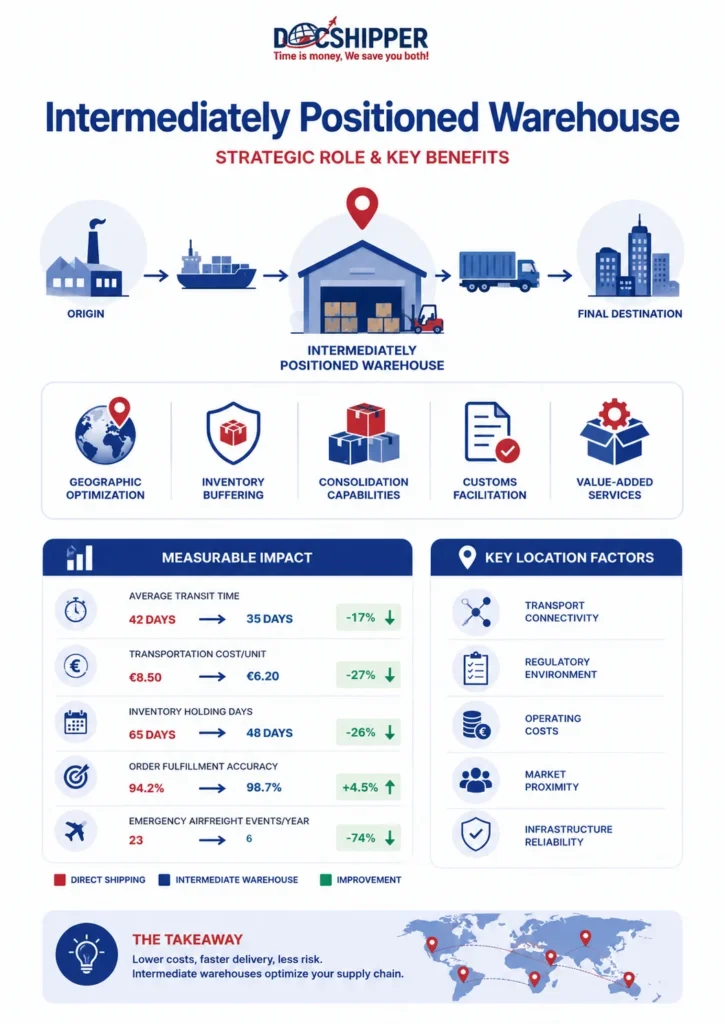
- Geographic optimization: Located at transport hubs to minimize last-mile delivery costs
- Inventory buffering: Maintains safety stock to absorb demand fluctuations
- Consolidation capabilities: Combines shipments from multiple origins before final distribution
- Customs facilitation: Often situated in free trade zones for simplified clearance procedures
- Value-added services: Enables labeling, repackaging, or light assembly operations
Strategic Role & Logistics Expertise
The strategic placement of intermediate warehouses fundamentally transforms supply chain efficiency. These facilities operate as distribution nodes that balance the trade-off between inventory holding costs and transportation expenses.
From a customs perspective, intermediately positioned warehouses offer significant advantages. When located in bonded zones or free trade areas, goods can remain duty-suspended until released to the market. This arrangement provides cash flow benefits and regulatory flexibility. The European Union customs warehouse framework exemplifies how these facilities integrate into international trade compliance.
Network optimization theory identifies three primary warehouse positioning strategies: market-positioned (near customers), production-positioned (near manufacturing), and intermediately positioned (strategic midpoint). The intermediate model excels when serving geographically dispersed markets from centralized origins.
Transportation economics favor intermediate warehouses through freight consolidation. Shipping full container loads (FCL) to a central hub, then distributing smaller less-than-container loads (LCL) to final destinations, typically costs 20-35% less than individual direct shipments.
At DocShipper, we strategically utilize intermediate warehouses across key trade corridors to optimize our clients’ supply chains. Our facilities in Dubai, Singapore, and Rotterdam serve as consolidation hubs that reduce overall logistics costs while improving delivery predictability.
Risk mitigation represents another critical function. Intermediate warehouses provide supply chain resilience by decoupling production schedules from market demand. During port congestion, strikes, or transport disruptions, these facilities maintain product availability without requiring emergency airfreight.
Concrete Examples & Data Analysis
Consider a European electronics retailer sourcing components from five manufacturers across China, Vietnam, and Thailand. Without intermediate warehousing, each supplier would ship directly to distribution centers in Germany, France, and Spain.
Use Case: Electronics Supply Chain Optimization
A client established an intermediately positioned warehouse in Singapore to consolidate Asian shipments before European distribution. The results were substantial:
| Metric | Direct Shipping | Intermediate Warehouse | Improvement |
|---|---|---|---|
| Average Transit Time | 42 days | 35 days | -17% |
| Transportation Cost/Unit | €8.50 | €6.20 | -27% |
| Inventory Holding Days | 65 days | 48 days | -26% |
| Order Fulfillment Accuracy | 94.2% | 98.7% | +4.5% |
| Emergency Airfreight Events/Year | 23 | 6 | -74% |
The Singapore facility enabled weekly consolidated shipments instead of irregular partial loads. Quality control inspections occurred centrally before European distribution, reducing defect-related returns by 38%.
Geographic Location Analysis: The most effective intermediate warehouse locations share common characteristics. Proximity to major ports or airports reduces drayage costs. Access to efficient customs infrastructure accelerates clearance. Labor availability affects operational scalability.
Five critical decision factors for intermediate warehouse placement:
- Transport connectivity: Multi-modal access (sea, air, rail, road)
- Regulatory environment: Customs efficiency and trade agreement benefits
- Operating costs: Warehouse rental, labor, and utilities
- Market proximity: Distance to primary customer concentrations
- Infrastructure reliability: Power stability, IT connectivity, and logistics service providers
According to supply chain research, companies implementing intermediate warehouses in optimal locations achieve 22-31% reduction in total landed costs compared to direct distribution models. The breakeven point typically occurs at annual volumes exceeding 150-200 TEU (twenty-foot equivalent units).
Conclusion
Intermediately positioned warehouses represent a strategic asset in complex international supply chains, delivering measurable improvements in cost efficiency, delivery performance, and operational flexibility. Their value extends beyond simple storage to encompass customs optimization, risk mitigation, and market responsiveness.
Need guidance on implementing intermediate warehousing in your supply chain? Contact DocShipper to discuss how our strategically positioned facilities can optimize your logistics operations.
📚 Quiz
Test Your Knowledge: Intermediately Positioned Warehouse
1. What is the primary defining characteristic of an intermediately positioned warehouse?
2. A common misconception is that intermediate warehouses increase total supply chain costs. What is the correct understanding?
3. Your electronics company sources from five Asian suppliers and serves three European distribution centers. Which scenario correctly applies intermediate warehousing?
🎯 Your Result
📞 Free Personalized QuoteFAQ | Intermediately Positioned Warehouse: Definition, Strategic Role & Concrete Examples
An intermediately positioned warehouse specifically occupies a strategic midpoint in the supply chain between origin and destination, focusing on transit optimization. Traditional distribution centers typically serve as final-stage facilities near end markets. The intermediate model prioritizes consolidation, customs facilitation, and cross-docking operations rather than long-term inventory storage for local fulfillment.
Cost reduction occurs through freight consolidation. Shipping full container loads to an intermediate hub costs significantly less per unit than multiple smaller shipments. The warehouse then redistributes products in optimized loads to final destinations. This two-stage approach exploits economies of scale in long-haul transport while maintaining flexibility in last-mile delivery.
When located in bonded zones or free trade areas, intermediate warehouses allow duty deferral until goods enter final markets. This provides cash flow advantages and enables postponement strategies where products remain in generic form until market demand clarifies. Customs documentation can be consolidated, reducing administrative burden and potential compliance errors.
Economic viability typically requires annual volumes of 150-200 TEU or equivalent. Below this threshold, the fixed costs of warehouse operations and inventory carrying exceed transportation savings. However, factors like product value, market dispersion, and service level requirements influence this calculation. High-value electronics may justify intermediate warehousing at lower volumes than bulk commodities.
Electronics, automotive parts, fashion apparel, and consumer goods industries gain significant advantages. These sectors combine international sourcing, multiple destination markets, and time-sensitive delivery requirements. Products with high value-to-weight ratios particularly benefit since inventory carrying costs remain manageable while transportation savings are substantial.
By decoupling production schedules from market demand, intermediate warehouses absorb disruptions at either end of the supply chain. During port congestion or manufacturing delays, existing inventory continues serving customers. This buffer reduces emergency airfreight needs and maintains service levels during unforeseen events, providing operational stability that direct shipping cannot match.
Beyond storage, these facilities offer quality inspections, product labeling, repackaging for specific markets, kitting, light assembly, and return processing. These services enable market customization without maintaining separate inventory for each destination. Products arrive in standardized form and undergo final configuration based on actual demand signals.
Location analysis considers transport connectivity, customs efficiency, operating costs, market proximity, and infrastructure reliability. Modeling software simulates various scenarios to identify the location minimizing total landed costs. The optimal position balances inbound consolidation economies with outbound distribution efficiency, typically resulting in locations near major transshipment hubs.
Warehouse management systems (WMS) coordinate inventory movements and order fulfillment. Transportation management systems (TMS) optimize inbound and outbound freight. Integration with enterprise resource planning (ERP) systems ensures visibility across the entire supply chain. Real-time tracking technologies provide shipment status updates, enabling proactive exception management and customer communication.
Yes, particularly for international e-commerce where consumers in multiple countries purchase from a single source. The intermediate warehouse receives bulk shipments, then fulfills individual orders or distributes to regional fulfillment centers. This model balances international shipping economies with localized delivery speed, especially effective for businesses expanding into new geographic markets.
They enable postponement strategies where generic inventory remains undifferentiated until market signals clarify. Safety stock positioning shifts from multiple destination warehouses to a single intermediate location, reducing total system inventory. Demand pooling effects mean aggregate forecast accuracy improves, allowing lower overall stock levels while maintaining service targets.
Options include dedicated facilities, shared multi-client warehouses, or third-party logistics (3PL) partnerships. Dedicated leases provide maximum control but require higher volumes to justify fixed costs. Shared warehouses offer flexibility with variable cost structures. 3PL arrangements include warehouse space plus operational services, converting fixed costs to variable expenses that scale with business volume.
Need Help with
Logistics or Sourcing ?
First, we secure the right products from the right suppliers at the right price by managing the sourcing process from start to finish. Then, we simplify your shipping experience - from pickup to final delivery - ensuring any product, anywhere, is delivered at highly competitive prices.


Fill the Form
Prefer email? Send us your inquiry, and we’ll get back to you as soon as possible.
Contact us




