


In short ⚡
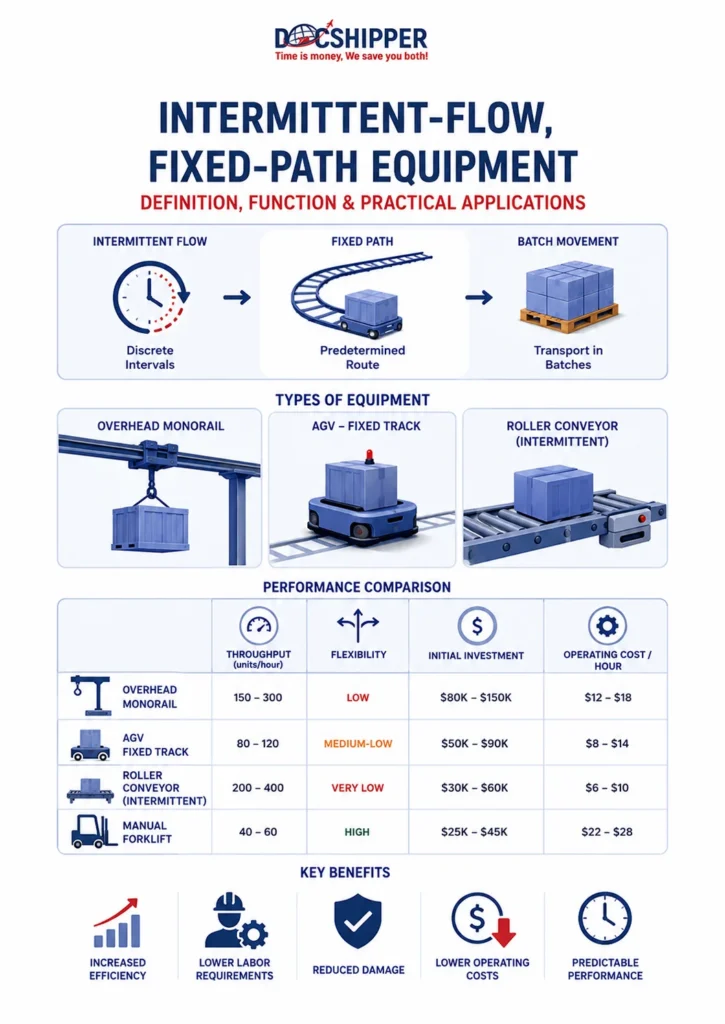
Intermittent-Flow, Fixed-Path Equipment refers to material handling systems that move goods along a predetermined route in discrete batches or intervals rather than continuously. This category includes conveyors, monorails, and automated guided vehicles (AGVs) operating on fixed tracks, enabling controlled, repetitive transport operations within warehouses, manufacturing facilities, and distribution centers.
Introduction
In modern logistics operations, choosing between continuous and intermittent material flow systems significantly impacts throughput, flexibility, and operational costs. Many warehouse managers struggle with determining when fixed-path equipment serves their needs better than flexible alternatives.
Intermittent-flow, fixed-path equipment plays a crucial role in standardized logistics operations where predictable routing and batch processing dominate workflow requirements. This equipment category bridges the gap between fully manual handling and fully automated continuous systems.
Key characteristics include:
- Movement occurs in discrete intervals rather than constant motion
- Equipment follows predetermined paths that cannot be easily modified
- Ideal for repetitive tasks with consistent origin-destination pairs
- Reduces labor costs while maintaining operational control
- Requires significant initial infrastructure investment but lower variable costs
Technical Mechanisms & Operational Principles
The fundamental operation of intermittent-flow, fixed-path equipment relies on scheduled activation cycles triggered by sensors, timers, or manual controls. Unlike continuous conveyors that run constantly, these systems activate only when cargo requires transport.
The fixed-path constraint means infrastructure installation determines routing permanently. Overhead monorails, floor-mounted tracks, or dedicated conveyor lanes create physical boundaries that guide equipment movement. This limitation becomes advantageous in operations requiring consistent material flow patterns.
Load accumulation zones represent critical design elements in these systems. Equipment must accommodate temporary storage at loading/unloading points, preventing bottlenecks when downstream processes operate slower than upstream supply rates.
Control systems typically employ zone-based logic, dividing the fixed path into segments. Each zone operates semi-independently, allowing multiple loads to occupy different path sections simultaneously while preventing collisions. According to Material Handling Industry standards, proper zone configuration increases throughput capacity by 40-60% compared to single-zone operations.
The intermittent activation pattern generates energy savings compared to continuous systems. Motors consume power only during active transport cycles, though start-stop operations may increase mechanical wear on drive components requiring proactive maintenance schedules.
At DocShipper, we frequently evaluate warehouse layouts to determine whether fixed-path equipment integration will optimize our clients’ receiving and dispatch operations, particularly when consolidating shipments from multiple international suppliers.
Practical Applications & Performance Data
Intermittent-flow, fixed-path equipment dominates specific logistics environments where routing predictability outweighs flexibility requirements. Understanding application contexts helps businesses make informed capital equipment decisions.
Comparative Performance Analysis
| Equipment Type | Throughput Capacity | Flexibility Rating | Initial Investment | Operating Cost/Hour |
|---|---|---|---|---|
| Overhead Monorail | 150-300 units/hour | Low | $80,000-$150,000 | $12-18 |
| AGV Fixed Track | 80-120 units/hour | Medium-Low | $50,000-$90,000 | $8-14 |
| Roller Conveyor (Intermittent) | 200-400 units/hour | Very Low | $30,000-$60,000 | $6-10 |
| Manual Forklift | 40-60 units/hour | High | $25,000-$45,000 | $22-28 |
Real-World Implementation Case
A European automotive parts distributor implemented overhead monorail systems connecting receiving docks to quality inspection zones and storage areas. The installation covered 450 meters across three warehouse sections.
Operational Results:
- Processing time reduced from 18 minutes to 7 minutes per pallet batch
- Labor requirements decreased by 35% in material movement roles
- Floor space utilization improved 22% through overhead routing
- Damage rates dropped from 2.1% to 0.4% due to controlled handling
- Return on investment achieved within 31 months
Critical Selection Factors
Volume consistency: Fixed-path equipment requires minimum throughput volumes to justify infrastructure costs. Operations handling fewer than 100 units daily typically cannot economically support these systems.
Route stability: Businesses experiencing frequent layout changes or seasonal routing variations face significant reconfiguration expenses. Equipment suits operations where paths remain constant for 3-5 years minimum.
Load characteristics: Weight, dimensions, and fragility determine equipment specifications. Monorails handle suspended loads up to 2,000 kg, while roller conveyors accommodate broader dimensional ranges but require stable base surfaces.
Integration requirements: Modern systems must interface with Warehouse Management Systems (WMS) and Enterprise Resource Planning (ERP) platforms. Compatibility verification prevents costly middleware development.
Maintenance accessibility: Fixed installations require ongoing mechanical servicing. Facilities must accommodate maintenance access without disrupting operations, particularly for overhead systems.
Conclusion
Intermittent-flow, fixed-path equipment delivers predictable performance and cost efficiency in logistics operations with stable routing requirements. The trade-off between flexibility and operational consistency determines suitability for specific warehouse environments.
Need expert guidance on material handling equipment selection for your international supply chain? Contact DocShipper for comprehensive logistics consultation tailored to your operational requirements.
📚 Quiz
Test Your Knowledge: Intermittent-Flow, Fixed-Path Equipment
What is the fundamental operational characteristic that defines intermittent-flow, fixed-path equipment?
A logistics manager claims that fixed-path equipment offers superior flexibility for facilities experiencing frequent layout changes. Is this assessment correct?
Your warehouse processes 80 units daily with consistent routing patterns. Which statement best describes the economic viability of implementing intermittent-flow, fixed-path equipment?
🎯 Your Result
📞 Free Quote in 24hFAQ | Intermittent-Flow, Fixed-Path Equipment: Definition, Function & Practical Applications
Intermittent-flow equipment operates in discrete cycles, activating only when cargo requires transport, while continuous-flow systems run constantly regardless of immediate demand. Intermittent systems reduce energy consumption by 30-45% but may experience slightly lower maximum throughput rates in peak demand scenarios.
Reconfiguration is technically possible but economically prohibitive in most cases. Overhead monorails require structural modifications, track rewiring, and control system reprogramming. Floor-based systems offer marginally better flexibility but still involve significant downtime and costs. Businesses should plan for 5-7 year operational patterns before committing to fixed infrastructure.
Labor reductions typically range from 25-40% in material movement roles, though specialized maintenance staff requirements increase. The net effect depends on operational scale—facilities processing 500+ units daily generally achieve positive ROI, while smaller operations may not generate sufficient savings to offset capital investment.
Preventive maintenance schedules typically include weekly visual inspections, monthly lubrication cycles, quarterly mechanical assessments, and annual comprehensive overhauls. Roller conveyors require bearing replacements every 18-24 months under standard operating conditions, while monorail systems need track alignment verification semi-annually.
Yes, but equipment specifications must address temperature extremes. Cold storage applications require specialized lubricants, insulated electrical components, and materials resistant to thermal contraction. Equipment rated for -30°C operations costs 35-50% more than standard specifications but prevents operational failures in refrigerated environments.
Most fixed-path equipment accommodates dimensional variations within specified ranges. Adjustable carriers, modular platforms, and flexible mounting systems allow handling of different package sizes along the same path. However, extreme variation (mixing pallets with small parcels) typically requires parallel systems or flexible alternatives like autonomous mobile robots.
Regulatory requirements mandate load securement verification, emergency stop systems accessible at 15-meter intervals, visual/audible warning indicators, and exclusion zones beneath active paths. Operators must receive specialized training on load capacity limits, proper attachment procedures, and emergency response protocols. Annual safety audits are typically required by occupational health authorities.
Integration is technically feasible through synchronized control systems. Fixed-path equipment delivers materials to sorting interfaces where barcode scanners, RFID readers, or vision systems trigger diversion mechanisms. Successful integration requires precise timing coordination—buffer zones absorb speed differentials between transport and sorting operations.
Break-even analysis typically shows positive returns when facilities process 150-200 units daily with consistent routing patterns. Lower volumes cannot justify infrastructure costs compared to forklift operations. Higher volumes (500+ units daily) generate strong economic advantages, with payback periods shortening to 18-30 months depending on labor cost structures.
Inbound operations handling diverse supplier packaging often require more flexible load accommodation and quality inspection integration. Outbound systems prioritize speed and order consolidation efficiency. Many facilities implement hybrid approaches—flexible equipment for receiving areas and fixed-path systems for shipping zones where standardized packaging dominates.
Ceiling height determines overhead monorail feasibility—minimum 5-meter clearance typically required. Floor load capacity affects heavy conveyor installation options. Column spacing influences path routing efficiency. Existing structures may limit options, making comprehensive facility assessment essential before equipment specification.
Fixed capacity represents both advantage and limitation. Systems handle designed throughput reliably but cannot flex beyond specifications without additional infrastructure. Businesses experiencing 2x or greater seasonal peaks often supplement fixed equipment with temporary labor or rental handling equipment during demand surges rather than oversizing permanent installations.
Need Help with
Logistics or Sourcing ?
First, we secure the right products from the right suppliers at the right price by managing the sourcing process from start to finish. Then, we simplify your shipping experience - from pickup to final delivery - ensuring any product, anywhere, is delivered at highly competitive prices.


Fill the Form
Prefer email? Send us your inquiry, and we’ll get back to you as soon as possible.
Contact us




