


In short ⚡
Internal Water Carriers are transportation systems that move freight and passengers via inland waterways such as rivers, canals, and lakes. These carriers play a crucial role in domestic logistics networks, offering cost-effective and environmentally sustainable alternatives to road and rail transport for bulk commodities and containerized cargo.
Introduction
Many logistics managers overlook inland waterway transport when planning multimodal shipments, missing significant cost savings and emission reductions. Internal water carriers represent a strategic component of integrated supply chains, particularly for heavy or bulk goods.
These carriers operate on navigable rivers, canals, and lake systems within national borders. They connect industrial zones, ports, and distribution centers without congesting road networks. The mode remains essential for agricultural products, construction materials, petroleum products, and containers.
Key characteristics of internal water carriers include:
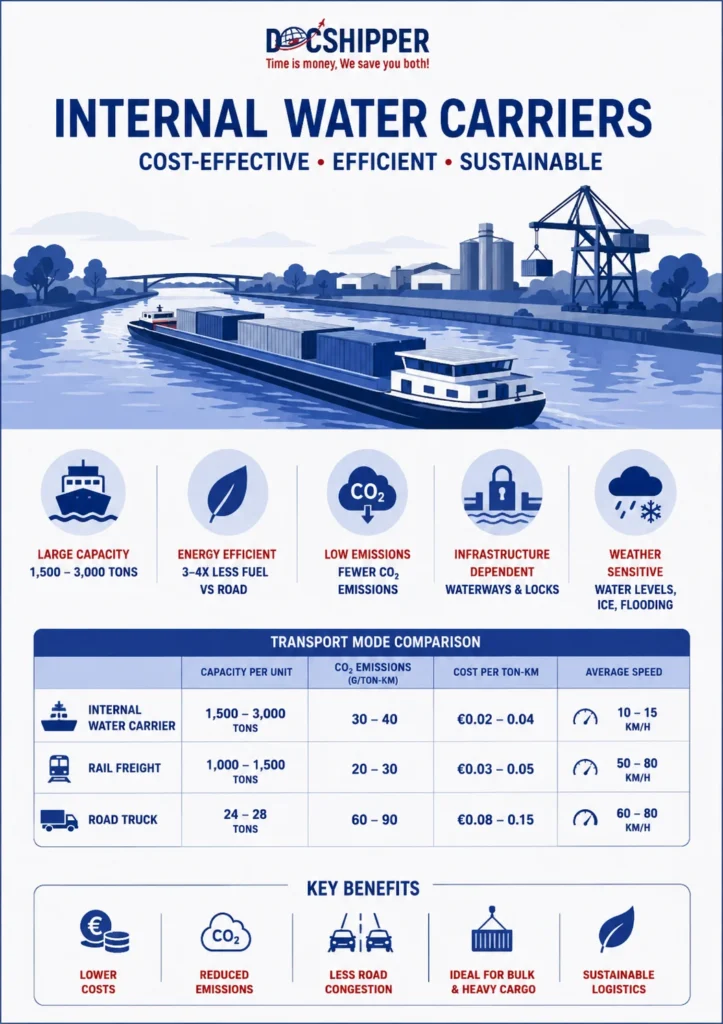
- Large cargo capacity: Individual barges can transport 1,500 to 3,000 tons, equivalent to 60-100 trucks
- Energy efficiency: Consumes 3-4 times less fuel per ton-kilometer than road transport
- Low environmental impact: Produces significantly fewer CO2 emissions and noise pollution
- Infrastructure dependency: Limited to waterway networks with adequate depth and lock systems
- Weather sensitivity: Operations affected by water levels, ice formation, and flooding
Operational Framework & Regulations
Internal water carriers operate under specific regulatory frameworks that vary by country and waterway system. In Europe, the UNECE Inland Transport Committee establishes harmonized standards for vessel classification, crew certification, and safety protocols across international river basins.
The operational structure involves several critical components. Vessel types range from pushed convoys (multiple barges pushed by a single tugboat) to self-propelled cargo vessels. Lock systems enable navigation through elevation changes, though they can create bottlenecks during peak traffic. Port infrastructure includes specialized terminals with cranes, conveyors, and storage facilities adapted to waterside operations.
Navigation regulations govern vessel dimensions, speed limits, and right-of-way rules specific to each waterway. Major rivers like the Rhine, Mississippi, and Yangtze have standardized vessel classes that determine maximum dimensions and tonnage. Environmental compliance increasingly requires double-hull construction, wastewater treatment systems, and low-emission engines meeting IMO Tier II or III standards.
The crew certification system demands specific qualifications for inland waterway navigation, distinct from maritime shipping licenses. Captains must demonstrate knowledge of local waterway characteristics, bridge clearances, and seasonal variations in navigable depth.
At DocShipper, we evaluate waterway options for clients shipping bulk commodities or seeking multimodal solutions that combine river transport with road or rail connections. Our team assesses infrastructure compatibility, transit times, and regulatory requirements to optimize routing decisions.
Practical Cases & Performance Data
Understanding the practical application of internal water carriers requires examining real-world scenarios and performance metrics. These examples demonstrate how companies leverage inland waterways for competitive advantage.
Comparative Performance Analysis
| Transport Mode | Capacity per Unit | CO2 Emissions (g/ton-km) | Cost per ton-km | Average Speed |
|---|---|---|---|---|
| Internal Water Carrier | 1,500-3,000 tons | 30-40 | €0.02-0.04 | 10-15 km/h |
| Rail Freight | 1,000-1,500 tons | 20-30 | €0.03-0.05 | 50-80 km/h |
| Road Truck | 24-28 tons | 60-90 | €0.08-0.15 | 60-80 km/h |
Use Case: Agricultural Export via Rhine River
A German grain exporter ships 50,000 tons of wheat annually from Mannheim to Rotterdam port. The company uses a pushed convoy configuration with four barges, each carrying 1,500 tons. Transit time averages 36 hours for the 430-kilometer journey.
Cost comparison: Waterway transport costs €1,800 per barge (€1.20 per ton), while equivalent road transport would require 60 trucks at approximately €120 each (€7,200 total, or €4.80 per ton). The waterway option delivers 75% cost savings and eliminates 180 truck trips annually.
Environmental impact: The water transport generates approximately 15 tons of CO2 for the entire shipment, compared to 67.5 tons for road transport—a reduction of 78% in carbon emissions.
Key Performance Indicators
- Loading efficiency: Modern terminals achieve 200-400 tons per hour for bulk commodities
- Capacity utilization: Average 85-90% on major European waterways during peak season
- Reliability: 92-95% on-time delivery rate, weather permitting
- Infrastructure bottlenecks: Lock passages add 15-45 minutes per lock depending on traffic
- Seasonal variation: Capacity can decrease 20-30% during low-water periods
Conclusion
Internal water carriers provide a strategic advantage for bulk and heavy cargo transport, combining cost efficiency with environmental sustainability. Their integration into multimodal logistics networks reduces road congestion while delivering measurable savings in transport costs and emissions.
Need expert guidance on integrating waterway transport into your supply chain? Contact DocShipper for a customized logistics assessment.
📚 Quiz
Test Your Knowledge: Internal Water Carriers
Question 1: What is the primary definition of internal water carriers?
Question 2: What is the most significant operational advantage of internal water carriers compared to road transport?
Question 3: A logistics manager needs to transport 50,000 tons of grain from an inland production facility to a seaport 400 kilometers away. The cargo has a flexible 5-day delivery window and high weight-to-value ratio. Which statement correctly applies internal water carrier usage?
🎯 Your Result
📞 Free Quote in 24hFAQ | Internal Water Carriers: Definition, Regulations & Practical Examples
Internal water carriers excel with bulk commodities (grain, coal, ores, aggregates), liquid cargo (petroleum products, chemicals), heavy machinery, construction materials, and containers. Products with flexible delivery schedules and high weight-to-value ratios benefit most from the cost advantages of waterway transport.
Waterway transport is slower than road or rail, typically averaging 10-15 km/h compared to 60-80 km/h for trucks. However, for distances over 300 kilometers, the cost savings often justify the additional 1-2 days in transit time, particularly for non-urgent bulk shipments.
Europe (Rhine-Main-Danube corridor), North America (Mississippi River system, Great Lakes), and China (Yangtze River) possess the most extensive networks. The European inland waterway system connects 37,000 kilometers across 13 countries, while the Mississippi system covers approximately 12,000 navigable miles.
Restrictions vary by waterway classification. European Class Va waterways accommodate vessels up to 110 meters long and 11.4 meters wide carrying 2,500-3,000 tons. Lower-class waterways have proportionally smaller limits. Bridge clearances and lock dimensions create additional constraints that require careful route planning.
Low water levels during drought reduce vessel draft and cargo capacity by 20-40%. Flooding can close waterways temporarily. Winter ice formation halts operations on northern European and North American rivers for 2-4 months annually. Fog and high winds also create safety-related delays.
Inland water carriers require specialized inland marine insurance covering cargo damage, vessel collision, and environmental liability. Coverage differs from ocean marine policies, with specific clauses addressing lock passage risks, bridge strikes, and low-water groundings. Premium rates typically range from 0.15-0.35% of cargo value.
Yes, container-on-barge services operate on major European rivers and the Mississippi system. Specialized container vessels carry 200-500 TEU. The Rhine corridor handles approximately 2 million TEU annually, serving as a cost-effective alternative to road haulage between inland terminals and seaports.
Standard documents include the bill of lading (waterway-specific format), cargo manifest, dangerous goods declarations (if applicable), and customs documentation for cross-border movements within river basins. The CMR convention does not apply to water transport; waterway-specific liability regimes govern claims.
Waterway terminal handling charges range from €8-15 per ton for bulk cargo and €35-60 per container, including crane operations and temporary storage. While higher than simple truck loading, the savings in linehaul transport costs offset terminal fees for shipments exceeding 200 kilometers.
Several European countries offer modal shift grants and subsidies encouraging waterway use to reduce road congestion and emissions. The EU Marco Polo programme provides financial support for projects transferring freight from road to inland waterways. Specific incentive programs vary by country and region.
Major projects include lock modernization (increased dimensions and automation), channel deepening, bridge height increases, and digital traffic management systems. The Seine-Nord Europe Canal project will create a high-capacity link between Paris and Belgium. China has invested over $100 billion in Yangtze River improvements since 2010.
Waterway transport generates 50-75% less CO2 per ton-kilometer than road transport and reduces particulate emissions, noise pollution, and road maintenance needs. Companies with carbon reduction commitments increasingly incorporate inland waterways into their logistics strategies to achieve measurable environmental improvements while maintaining cost competitiveness.
Need Help with
Logistics or Sourcing ?
First, we secure the right products from the right suppliers at the right price by managing the sourcing process from start to finish. Then, we simplify your shipping experience - from pickup to final delivery - ensuring any product, anywhere, is delivered at highly competitive prices.


Fill the Form
Prefer email? Send us your inquiry, and we’ll get back to you as soon as possible.
Contact us




