


In short ⚡
I.S.O. (In Stock Out) is a supply chain metric measuring the percentage of products available in inventory to fulfill customer orders immediately without stockouts. This key performance indicator reflects a company's ability to maintain optimal inventory levels, balancing availability against holding costs. Typical I.S.O. targets range from 95% to 99% depending on industry and product criticality.Introduction
Many businesses struggle to answer one critical question: “Can we fulfill this order right now?” This uncertainty leads to lost sales, disappointed customers, and emergency expediting costs. The I.S.O. (In Stock Out) metric provides the answer by quantifying inventory availability at any given moment.
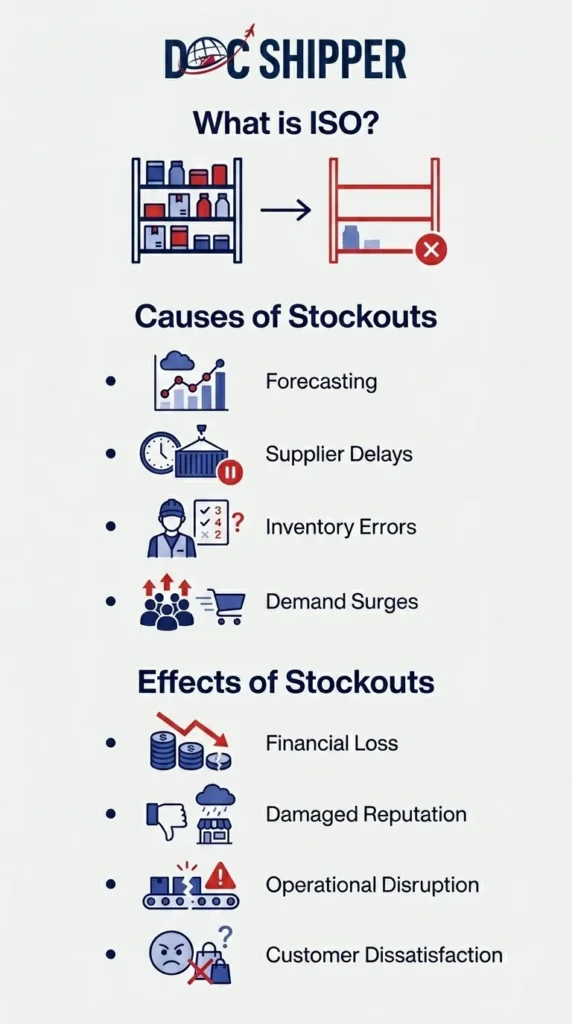
In international trade and logistics, maintaining high I.S.O. rates becomes exponentially more complex. Lead times stretch across continents, customs delays create unpredictability, and demand fluctuations test even sophisticated forecasting systems. Understanding and optimizing this metric separates efficient operations from chaotic ones.
Key characteristics of effective I.S.O. management include:
- Real-time visibility: Accurate tracking across multiple warehouses and transit points
- Safety stock calculation: Statistical buffers accounting for demand variability and lead time uncertainty
- Segmentation strategy: Different targets for A/B/C items based on value and velocity
- Predictive analytics: Forecasting models integrating seasonality, promotions, and market trends
- Supplier coordination: Collaborative planning reducing replenishment cycles
Understanding I.S.O. Mechanisms & Strategic Importance
The I.S.O. calculation appears deceptively simple: divide available inventory units by total demand units, then multiply by 100. However, the operational reality involves sophisticated systems monitoring inventory positions across the entire supply network, not just physical warehouse stock.
Three critical components determine I.S.O. performance. First, demand forecasting accuracy establishes the baseline for inventory requirements. Second, supply chain reliability affects replenishment consistency. Third, inventory policy parameters like reorder points and order quantities directly impact availability levels.
From a financial perspective, I.S.O. optimization represents a delicate balance. Pushing toward 100% availability exponentially increases inventory carrying costs, tying up working capital and increasing obsolescence risk. Conversely, accepting lower I.S.O. rates saves inventory costs but sacrifices revenue through stockouts and customer defection.
International logistics adds complexity layers. Consider customs clearance delays: a container stuck at port for regulatory inspection doesn’t count as “in stock” despite being physically near the destination. Incoterms selection influences when inventory ownership transfers, affecting I.S.O. calculations for both buyers and sellers.
At DocShipper, we implement advanced tracking systems that monitor shipment status throughout international transit. Our clients receive real-time updates allowing accurate I.S.O. projections even before goods physically arrive, enabling proactive inventory allocation decisions.
The service level agreement (SLA) framework directly connects to I.S.O. targets. A 98% I.S.O. commitment means accepting 2% stockout probability. Companies must quantify the revenue impact of that 2% against the cost of inventory required to achieve 99% or higher. This trade-off analysis requires understanding customer behavior, market competitiveness, and product lifecycle stages.
Concrete Examples & Performance Data
Industry benchmarks reveal significant variation in I.S.O. performance across sectors. Pharmaceutical distributors typically maintain 98-99% I.S.O. due to the critical nature of their products, while fashion retailers often operate at 85-90% accepting higher stockout rates on trend-sensitive items.
Consider a practical scenario: An electronics importer maintains 10,000 SKUs with varying demand patterns. Their segmentation strategy assigns different I.S.O. targets based on ABC classification:
| Category | SKU % | Revenue % | I.S.O. Target | Safety Stock Days |
|---|---|---|---|---|
| A Items | 20% | 80% | 98% | 45 |
| B Items | 30% | 15% | 93% | 30 |
| C Items | 50% | 5% | 85% | 15 |
This tiered approach optimizes working capital efficiency while protecting revenue on high-value items. The company achieved a weighted average I.S.O. of 94.2% while reducing total inventory investment by 18% compared to a uniform 95% target across all SKUs.
Another data point comes from automotive spare parts distribution. A regional distributor tracked I.S.O. performance across 12 months, correlating it with customer retention rates. Their analysis showed that maintaining 96% I.S.O. resulted in 8% higher customer retention compared to periods when I.S.O. dropped to 91%. The revenue impact of those retained customers exceeded the additional inventory carrying costs by a 3.2:1 ratio.
For international operations, transit time variability significantly impacts I.S.O. achievement. Ocean freight from Asia to Europe averages 35 days but can range from 28 to 48 days. Companies compensating with higher safety stock see inventory levels inflate by 25-40%. DocShipper’s supply chain optimization services reduce this variability through carrier selection, route optimization, and proactive exception management, allowing clients to maintain target I.S.O. levels with 15-20% less safety stock.
Five critical factors determining I.S.O. success in cross-border trade:
- Forecast accuracy: Companies with <10% MAPE achieve 5-7% higher I.S.O. than those with >20% forecast error
- Lead time consistency: Reducing standard deviation by 3 days allows equivalent I.S.O. with 12% less inventory
- Order frequency: Weekly vs. monthly ordering cycles improve I.S.O. by 4-6 percentage points for volatile products
- System integration: Real-time ERP-WMS connectivity prevents the phantom inventory problem affecting 23% of companies
- Supplier performance: On-time delivery rates above 95% correlate with 8-10 point higher I.S.O. achievement
Conclusion
Mastering I.S.O. (In Stock Out) management transforms inventory from a cost center into a competitive advantage, directly impacting customer satisfaction and profitability. The metric’s simplicity belies the sophisticated planning, execution, and continuous optimization required to maintain target performance levels.
Need expert guidance optimizing your inventory availability across international supply chains? Contact DocShipper for customized solutions balancing service levels with capital efficiency.
📚 Quiz
Test Your Knowledge: I.S.O. (In Stock Out)
What does I.S.O. (In Stock Out) primarily measure?
Which statement about I.S.O. and inventory costs is correct?
In international logistics, when does a container stuck at customs for inspection count toward I.S.O.?
🎯 Your Results
📞 Free Quote in 24hFAQ | I.S.O. (In Stock Out): Definition, Application & Concrete Examples
I.S.O. measures inventory availability at a specific point in time (percentage of SKUs in stock), while fill rate measures order fulfillment performance over a period (percentage of ordered quantities delivered complete). A company might have 95% I.S.O. but only 88% fill rate if popular items frequently stock out. Both metrics complement each other in comprehensive inventory performance management.
Optimal I.S.O. targets balance stockout costs (lost sales, expediting fees, customer defection) against inventory carrying costs (capital, warehousing, obsolescence). Start by segmenting products by value and demand variability. Calculate the incremental cost of achieving each percentage point increase in I.S.O., then compare against measured revenue loss from stockouts. Most companies find optimal targets between 92-97% for standard products.
Seasonal demand spikes amplify forecast errors and stress supply chain capacity. Lead times extend as suppliers and carriers face congestion. Safety stock calculations based on normal demand patterns prove insufficient. Successful peak season I.S.O. management requires increasing inventory builds 8-12 weeks before peak periods, establishing backup suppliers, and implementing dynamic safety stock adjustments based on real-time demand signals.
Goods in customs don't count as available inventory, creating I.S.O. gaps lasting 2-14 days typically. Unpredictable clearance delays introduce variability requiring additional safety stock. Companies mitigate this through customs brokerage expertise, proper documentation preparation, and using bonded warehouses for pre-clearance. DocShipper's customs services reduce clearance times by 40-60% through compliance expertise and regulatory relationships.
Effective I.S.O. management requires real-time inventory visibility (WMS integration), accurate demand forecasting (machine learning algorithms processing multiple data sources), and automated replenishment systems (calculating reorder points dynamically). Cloud-based platforms enable multi-location visibility essential for distributed networks. Advanced solutions incorporate predictive analytics identifying emerging stockout risks 2-4 weeks ahead, allowing proactive intervention.
Measurement frequency depends on demand volatility and replenishment cycles. Fast-moving consumer goods require daily I.S.O. tracking, while industrial equipment might use weekly measurement. Real-time dashboards show current status, but trend analysis uses weekly or monthly aggregations. Critical is measuring at the moment customers attempt to order, not just periodic snapshots. Companies track both point-in-time I.S.O. and time-weighted averages for comprehensive understanding.
Small businesses often target 90-93% I.S.O., balancing customer service against limited working capital. They compensate through excellent customer communication, rapid special ordering, and strategic inventory focus on highest-velocity items. Growing to 95-97% I.S.O. typically requires 25-35% more inventory investment. Many successful small importers maintain 96%+ I.S.O. on their top 30% of SKUs while accepting 85-88% on slower movers.
Phantom inventory (system shows stock that doesn't physically exist) undermines I.S.O. accuracy through miscounts, theft, damage not recorded, or system errors. Prevention requires cycle counting programs (counting subsets continuously rather than annual full counts), barcode/RFID tracking reducing manual entry errors, and reconciliation procedures investigating variances exceeding thresholds. Companies with robust inventory accuracy programs maintain 98%+ system-to-physical alignment.
Absolutely. B2B wholesale customers often tolerate 92-94% I.S.O. with longer lead times, while e-commerce consumers expect 97-99% immediate availability. Retail distribution centers serving stores might target 98% I.S.O. to prevent store stockouts affecting multiple customers. Channel-specific targets reflect different service expectations, order sizes, and customer switching costs. Omnichannel strategies complicate this by allowing inventory sharing across channels.
Higher I.S.O. targets typically reduce inventory turnover by requiring more safety stock. A company moving from 93% to 98% I.S.O. might see turnover decline from 8x to 6x annually. The optimal balance varies by margin structure: high-margin products justify lower turnover for better availability, while commodity products require maximizing turns despite accepting more stockouts. Leading companies optimize the ratio of service level to inventory investment.
Improving forecast accuracy reduces required safety stock for equivalent service levels. Shortening lead times through supplier relationships or regional sourcing has similar effects. Inventory rebalancing moves stock from slow locations to high-demand areas. ABC segmentation concentrates investment on high-value items. Postponement strategies using generic inventory configured at final stage reduces SKU proliferation. These approaches often achieve 3-5 percentage point I.S.O. improvements with flat or reduced inventory levels.
Supplier reliability directly determines required safety stock levels. A supplier delivering 98% on-time allows 30-40% less safety stock than one at 85% reliability for equivalent I.S.O. achievement. Lead time variability matters even more than average lead time: consistent 30-day delivery enables better I.S.O. than variable 25-35 day delivery. Supplier scorecarding, collaborative forecasting, and contractual service level agreements form the foundation of I.S.O.-supporting supplier relationships.
Need Help with
Logistics or Sourcing ?
First, we secure the right products from the right suppliers at the right price by managing the sourcing process from start to finish. Then, we simplify your shipping experience - from pickup to final delivery - ensuring any product, anywhere, is delivered at highly competitive prices.


Fill the Form
Prefer email? Send us your inquiry, and we’ll get back to you as soon as possible.
Contact us




:%20Definition,%20Application%20&%20Concrete%20Examples)