


In short ⚡
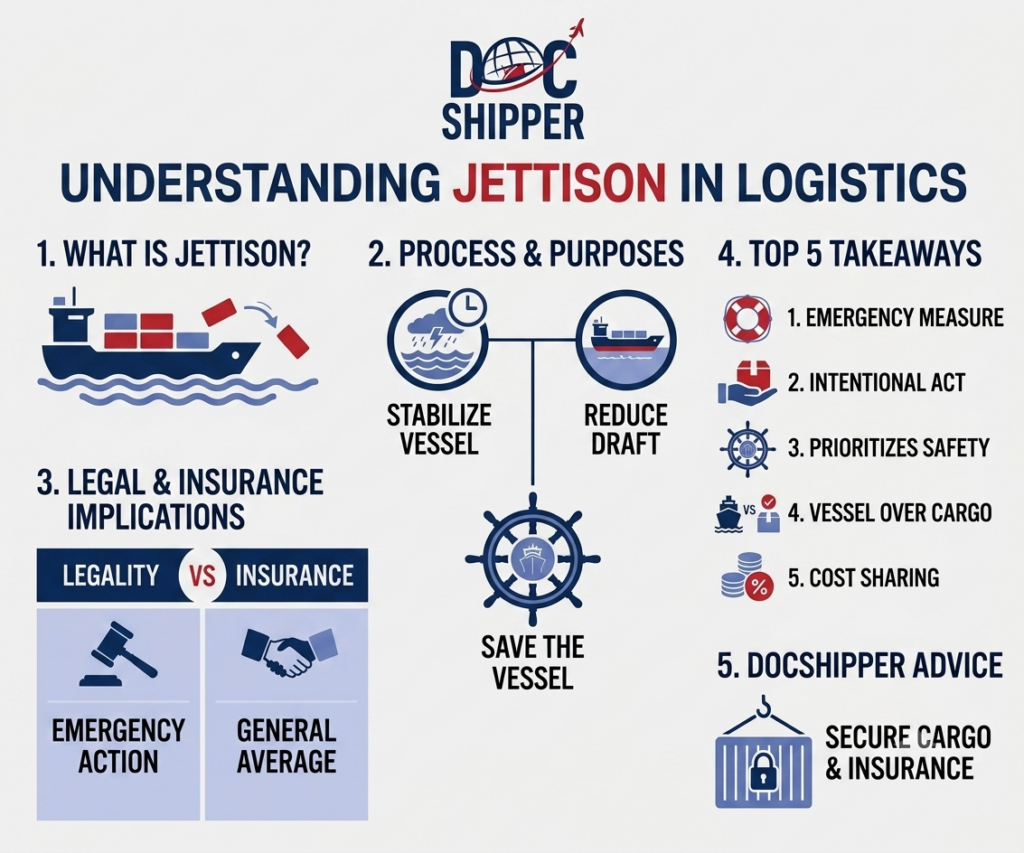
Jettison is the deliberate act of throwing cargo, equipment, or ship components overboard during maritime transport to save the vessel, crew, or remaining cargo from imminent peril. This emergency measure, governed by maritime law principles, triggers specific liability and compensation mechanisms under general average regulations.Introduction
When a cargo ship faces life-threatening conditions at sea, captains may make a critical decision: sacrifice part of the cargo to save the entire vessel. This ancient maritime practice remains relevant in modern international trade. Confusion often arises regarding who bears the financial loss when goods are deliberately thrown overboard.
Understanding jettison is crucial for importers and exporters because it directly impacts insurance claims, liability distribution, and supply chain continuity. Unlike accidental cargo loss, jettison involves intentional destruction governed by specific legal doctrines.
Key characteristics of jettison in international shipping:
- Voluntary sacrifice: Deliberate action taken by the ship’s master under emergency circumstances
- Preservation objective: Aimed at saving the ship and remaining cargo from common danger
- General average applicability: Losses distributed proportionally among all cargo owners and the shipowner
- Documentary requirements: Proper recording and declaration necessary for insurance claims
- Legal precedent foundation: Rooted in maritime law dating back to Roman times (Lex Rhodia)
Legal Framework & Maritime Law Principles
Jettison operates under the general average doctrine, one of maritime law’s oldest principles. When cargo is intentionally sacrificed, the loss doesn’t fall solely on the affected cargo owner. Instead, all parties with a financial interest in the voyage share the loss proportionally.
The York-Antwerp Rules, established in 1890 and regularly updated (latest revision in 2016), govern most international jettison cases. These rules standardize how losses are calculated and distributed. Rule I states that general average applies only when the sacrifice is made “reasonably” to preserve property from “common peril.”
Three critical legal conditions must exist for valid jettison claims:
- Common danger: The vessel and cargo face a real, imminent threat (storm, grounding, fire)
- Voluntary act: The captain deliberately decides to jettison, not accidentally losing cargo
- Successful preservation: The action must achieve its purpose—saving the vessel or expedition
Modern marine cargo insurance policies typically cover jettison losses under Institute Cargo Clauses (A), (B), or (C). However, cargo owners must provide a general average security or guarantee before their surviving cargo is released at the destination port. This process can delay shipments by weeks.
According to International Maritime Organization (IMO) guidelines, the ship’s master must record all jettison decisions in the official logbook with precise details: time, location, weather conditions, and justification for the action. This documentation becomes crucial evidence during subsequent general average adjustments.
At DocShipper, we assist clients in navigating general average claims by coordinating with marine surveyors, insurance adjusters, and legal experts to minimize delays and ensure proper documentation from the outset.
Practical Cases & Compensation Data
Real-world jettison scenarios illustrate how this maritime principle functions in modern logistics. Container losses during severe weather constitute the most common contemporary jettison situations.
| Scenario Type | Average Loss Value | Settlement Timeline | Cargo Owner Impact |
|---|---|---|---|
| Storm-related container jettison | $150,000 – $500,000 | 12-18 months | 3-7% general average contribution |
| Fire mitigation jettison | $2 million – $8 million | 18-36 months | 8-15% general average contribution |
| Grounding emergency lightening | $500,000 – $3 million | 10-24 months | 5-10% general average contribution |
| Stability correction jettison | $100,000 – $400,000 | 8-15 months | 2-5% general average contribution |
Use Case: In February 2021, the container ship “ONE Apus” lost 1,816 containers during a Pacific storm. While some losses resulted from accidental dislodging, the crew deliberately jettisoned several containers to prevent vessel capsizing. The general average declaration required all cargo owners to post security before cargo release.
For a typical $100,000 cargo shipment involved in this incident:
- General average contribution: Approximately $5,000-$7,000 (5-7% of cargo value)
- Security deposit required: $15,000 (typically 150% of estimated contribution)
- Cargo release delay: 6-8 weeks pending security arrangement
- Final adjustment timeline: 18-24 months for complete settlement
- Administrative costs: $2,000-$4,000 in additional fees (adjusters, surveyors, legal)
Industry data shows that approximately 15-20% of general average cases involve some form of jettison. The World Shipping Council reports that an average of 1,382 containers are lost at sea annually, with deliberate jettison accounting for roughly 8-12% of these incidents.
Modern technology has reduced jettison frequency through improved weather routing and vessel stability systems. However, climate change and increasingly severe weather patterns maintain jettison’s relevance as a last-resort safety measure.
Conclusion
Jettison remains a critical maritime emergency measure that impacts cargo owners through general average contributions and potential shipment delays. Understanding the legal framework and financial implications helps businesses prepare appropriate insurance coverage and contingency plans.
Need assistance navigating general average claims or maritime insurance complexities? Contact DocShipper for expert guidance on protecting your international shipments.
📚 Quiz
Test Your Knowledge: Jettison
What distinguishes jettison from accidental cargo loss at sea?
Under general average doctrine, who bears the financial loss when cargo is jettisoned?
Your $100,000 cargo shipment was NOT jettisoned, but other containers were thrown overboard to save the vessel during a storm. What is your obligation?
🎯 Your Result
📞 Free Quote in 24hFAQ | Jettison: Definition, Legal Framework & Concrete Examples in Shipping
Jettison is a deliberate, intentional act by the ship's master to sacrifice cargo for the safety of the vessel and remaining cargo. Accidental cargo loss (cargo falling overboard due to improper securing or rough seas without deliberate action) is not jettison and is typically covered differently under insurance policies. Only intentional sacrifice during emergency situations qualifies as jettison under general average principles.
The ship's master (captain) holds sole authority to decide which cargo to jettison during maritime emergencies. This decision is based on factors including cargo location, weight distribution, accessibility, and the specific nature of the danger. The master typically consults with the chief officer and considers which cargo can be most quickly and safely removed to achieve the necessary effect.
General average adjustments typically take 12-36 months to complete, depending on case complexity, number of cargo interests involved, and disputed claims. Simple cases with few parties may settle within 8-12 months, while complex incidents involving hundreds of cargo owners and significant vessel damage can extend beyond three years. The adjustment process requires detailed documentation, cargo valuations, and legal review.
Yes. Under general average doctrine, all cargo owners whose goods were saved by the jettison action must contribute proportionally to compensate those whose cargo was sacrificed. This principle ensures equitable distribution of sacrifice losses. Your contribution percentage is based on your cargo's declared value relative to the total value of all saved property, including the vessel itself.
Most comprehensive marine cargo insurance policies (Institute Cargo Clauses A) cover jettison losses and general average contributions. However, more restrictive policies (Clauses B or C) may have limitations. Review your specific policy wording or consult your insurance broker. Insurers typically handle general average security arrangements and reimburse contributions after final adjustment, though you may need to advance security deposits initially.
Legally, no. Refusing to provide general average security or pay contributions results in your cargo being held at the destination port until payment is secured. The shipowner has a legal lien on your cargo. Additionally, refusal may constitute breach of the contract of carriage and could result in legal action. Most cargo owners arrange security through their insurance companies to avoid these complications.
Critical documentation includes the ship's official logbook entries, weather reports from the time of incident, photographs or video evidence, witness statements from crew members, marine surveyor reports, and the master's detailed written justification. Classification society inspections and port state authorities' reports also provide supporting evidence. This documentation undergoes scrutiny during the general average adjustment process.
Modern vessels have additional emergency response options including ballast adjustment, speed reduction, course alteration, firefighting systems, and assistance requests to nearby vessels or coast guard services. However, when immediate weight reduction is necessary to prevent capsizing or sinking, physical jettison remains the fastest and most effective solution. Technology assists decision-making but cannot always replace immediate cargo removal in extreme situations.
Jettisoned cargo value is determined using the invoice value plus freight charges and insurance premiums, representing the cargo's delivered value at destination. The general average adjuster examines commercial invoices, bills of lading, and insurance declarations. Market value at the time and place of discharge may also be considered. Cargo owners must provide proper documentation to support valuation claims.
If the vessel sinks after jettison, general average typically does not apply because the preservation effort ultimately failed—one of the three essential requirements for general average claims. However, this creates complex legal situations. If some cargo was saved by reaching shore or being recovered, partial general average might apply. Each case requires individual legal analysis based on specific circumstances and applicable maritime law jurisdictions.
Yes. Containerized cargo faces unique jettison considerations due to stacking patterns and accessibility. Deck containers are more vulnerable to both accidental loss and deliberate jettison during emergencies. Below-deck containers are rarely jettisoned due to access difficulties. Container position affects jettison probability—upper deck corners face highest risk. Modern cell guide systems and improved lashing reduce both accidental loss and jettison necessity.
While the York-Antwerp Rules provide standardization, some countries maintain specific jettison regulations under their maritime codes. The Hague-Visby Rules and Hamburg Rules address carrier liability aspects related to jettison. Most bills of lading incorporate York-Antwerp Rules by reference, creating international consistency. However, jurisdictional variations exist regarding calculation methods, time limits for claims, and burden of proof requirements, making legal advice valuable in cross-border disputes.
Need Help with
Logistics or Sourcing ?
First, we secure the right products from the right suppliers at the right price by managing the sourcing process from start to finish. Then, we simplify your shipping experience - from pickup to final delivery - ensuring any product, anywhere, is delivered at highly competitive prices.


Fill the Form
Prefer email? Send us your inquiry, and we’ll get back to you as soon as possible.
Contact us




