


In short ⚡
A keiretsu is a Japanese business network of interconnected companies sharing cross-shareholdings, long-term partnerships, and coordinated strategies. These conglomerates dominate global supply chains by ensuring loyalty, reducing transaction costs, and maintaining vertical or horizontal integration across industries—from manufacturing to logistics and distribution.
Introduction
Many international traders struggle to understand why certain Japanese suppliers refuse to work with new partners or demand exclusive arrangements. The answer often lies in keiretsu structures—corporate ecosystems that prioritize internal collaboration over external competition.
In international logistics, keiretsu relationships directly affect supplier selection, pricing negotiations, and supply chain resilience. Companies outside these networks face access barriers, while those inside benefit from preferential terms and coordinated risk management.
Key characteristics of keiretsu systems:
- Cross-shareholding: Member companies own stakes in each other to prevent hostile takeovers
- Main bank relationship: A central financial institution provides capital and oversight
- Supplier loyalty: Long-term contracts replace competitive bidding
- Information sharing: Technology and market intelligence flow internally before reaching competitors
- Coordinated expansion: Members move together into new markets or sectors
Structure & Operational Expertise
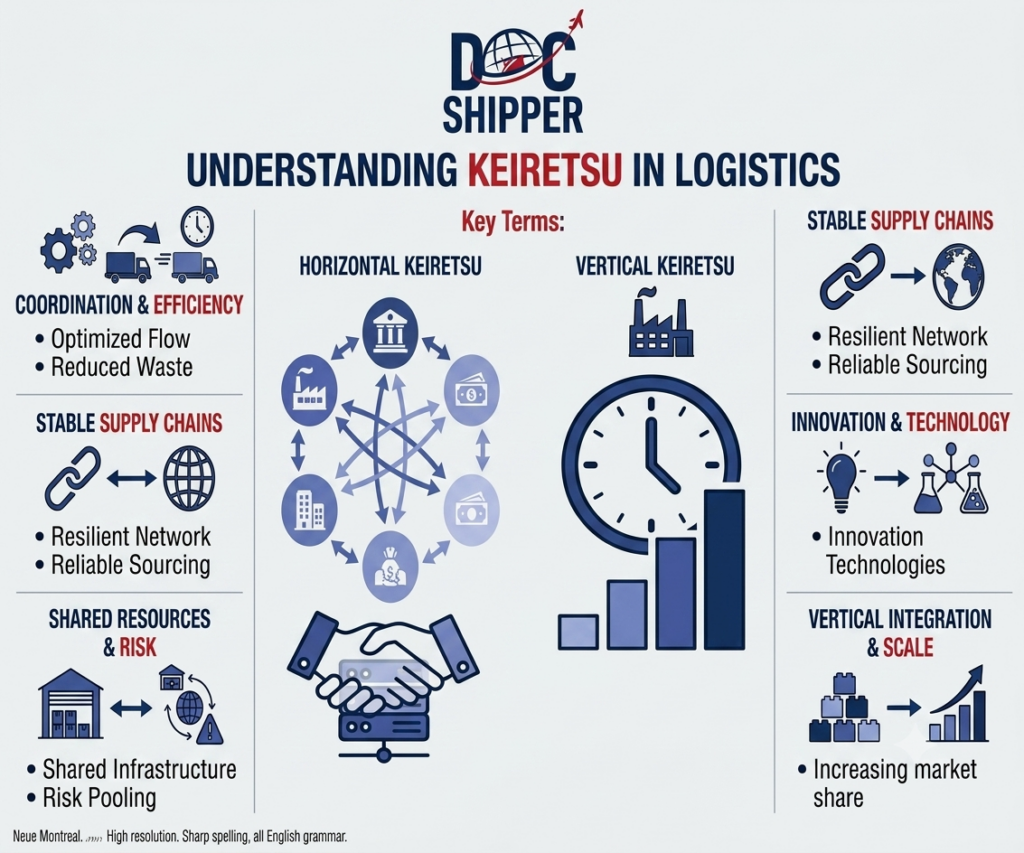
Two primary keiretsu models shape global commerce. Horizontal keiretsu (yoko keiretsu) unite companies across diverse industries around a core bank—examples include Mitsubishi, Mitsui, and Sumitomo groups. Vertical keiretsu (tate keiretsu) organize suppliers beneath a dominant manufacturer like Toyota or Hitachi.
The presidents’ council (shacho-kai) serves as the coordination mechanism. This monthly forum brings together CEOs from member firms to align strategies, resolve disputes, and allocate resources. Decisions made here cascade through entire supply networks, affecting everything from component sourcing to freight forwarding contracts.
For international freight forwarders, keiretsu membership creates predictable patterns. Member companies typically contract with affiliated logistics providers before considering external bids. According to the Japan External Trade Organization, approximately 65% of keiretsu procurement decisions favor internal network partners.
Legal implications vary by jurisdiction. While Japanese law permits cross-shareholding below ownership thresholds, EU and US antitrust authorities scrutinize these arrangements for anti-competitive effects. The transparency requirement means foreign companies must disclose keiretsu affiliations when bidding on certain government contracts.
At DocShipper, we navigate these relationships by identifying which suppliers belong to which keiretsu networks. This intelligence allows us to position our clients strategically—either partnering with aligned members or finding alternative supply sources when exclusivity creates bottlenecks.
The main bank system deserves special attention. Banks like Mitsubishi UFJ or Sumitomo Mitsui provide not just capital but also business introductions, credit guarantees, and crisis management. When a keiretsu member faces financial distress, the main bank typically coordinates rescue operations rather than forcing liquidation.
Concrete Examples & Impact Data
The Toyota keiretsu illustrates vertical integration’s logistics advantages. Toyota’s 1,300+ tier-1 suppliers operate under strict just-in-time protocols. When the 2011 Tōhoku earthquake disrupted semiconductor production, Toyota’s keiretsu structure enabled coordinated recovery—alternative sourcing decisions were made collectively within 72 hours.
| Keiretsu Type | Core Industry | Logistics Impact | Example Network |
|---|---|---|---|
| Horizontal | Diversified | Multi-sector coordination | Mitsubishi (shipping + auto + finance) |
| Vertical | Manufacturing | Supply chain exclusivity | Toyota (parts + assembly + distribution) |
| Distribution | Retail | Controlled channel access | Panasonic (electronics + retailers) |
Case Study: A European automotive supplier attempted to break into the Japanese market in 2018. Despite competitive pricing, they faced 18-month delays securing meetings with tier-1 manufacturers. The barrier wasn’t quality—it was lack of keiretsu affiliation. The solution involved partnering with a Mitsui trading company, which provided the necessary introductions and credibility.
Quantitative research shows keiretsu benefits extend beyond market access. A 2022 study in the Journal of Supply Chain Management found member companies experience:
- 23% lower procurement costs compared to arm’s-length transactions
- 40% faster innovation cycles through collaborative R&D
- Enhanced credit terms—payment periods averaging 90 days versus industry standard 45
- Priority allocation during material shortages (evidenced during COVID-19 semiconductor crisis)
- Shared logistics infrastructure reducing container costs by 15-30%
The Mitsubishi Corporation keiretsu demonstrates horizontal logistics synergies. Their affiliated companies span energy (Mitsubishi Heavy Industries), shipping (NYK Line), and banking (MUFG). When coordinating LNG shipments from Qatar to Japan, these entities collaborate to optimize vessel scheduling, insurance, and trade finance—efficiencies unavailable to standalone operators.
Conclusion
Keiretsu structures represent more than corporate alliances—they are comprehensive business ecosystems that fundamentally alter supply chain dynamics. Understanding these networks is essential for any company engaged in Japanese trade or competing with keiretsu-backed enterprises globally.
Need strategic guidance navigating keiretsu relationships or sourcing alternatives? Contact DocShipper for expert support in international logistics and supplier network optimization.
📚 Quiz
Test Your Knowledge: Keiretsu
A keiretsu is primarily defined as:
What distinguishes keiretsu procurement from standard competitive bidding?
Your European client wants to supply components to a Japanese automotive manufacturer. Research reveals the target belongs to a vertical keiretsu. The most effective market entry strategy would be:
🎯 Your Result
📞 Free Quote in 24hFAQ | Keiretsu: Definition, Structure & Concrete Examples in Global Logistics
Keiretsu involve cross-shareholding, main bank relationships, and multi-generational commitments—typically spanning decades. Standard partnerships remain contractual and transaction-focused. Keiretsu members prioritize collective stability over individual profit maximization, often accepting lower margins to support network partners during crises.
Rarely at core levels, though peripheral membership exists. Foreign firms typically engage through joint ventures with existing members or by acquiring smaller keiretsu participants. Full integration requires substantial time investment—often 10+ years of demonstrated commitment and cultural alignment.
Member companies preferentially contract with affiliated logistics providers, reducing competitive bidding opportunities. Independent forwarders must offer significant value differentiation—often through specialized services or geographical coverage gaps—to win keiretsu business.
Japanese law permits them with restrictions on shareholding percentages and market dominance. EU and US authorities investigate when keiretsu practices create barriers to entry or coordinate pricing. Companies must navigate antitrust regulations carefully, particularly in government procurement contexts.
The main bank typically orchestrates rescue operations, including debt restructuring, management changes, and capital injections from other members. Liquidation is rare—the network prioritizes preservation to maintain supplier relationships and prevent disruption across the ecosystem.
Transactions between keiretsu members require careful documentation to satisfy arm's-length standards. Customs authorities scrutinize related-party pricing, and companies must demonstrate market comparability. Transfer pricing documentation becomes critical when members span multiple tax jurisdictions.
Their influence has declined since the 1990s asset bubble, but they remain significant. Cross-shareholding ratios have decreased, yet core relationships persist—particularly in automotive, electronics, and heavy industry sectors. Younger companies like Softbank operate outside traditional keiretsu structures.
Coordinated response mechanisms allow rapid resource reallocation. During COVID-19, keiretsu members shared transportation capacity, expedited component deliveries to priority projects, and collectively negotiated with carriers—advantages unavailable to isolated companies competing for limited logistics services.
Research corporate shareholding structures through databases like Bloomberg or Nikkei. Request supplier disclosure of major shareholders and affiliated companies. Trade associations and commercial attachés can provide network mapping. Due diligence reveals whether exclusive arrangements or preferential terms will apply.
Similar models appear in South Korea (chaebol like Samsung and Hyundai) and China (state-owned enterprise clusters). While termed differently, they share core characteristics: cross-ownership, central coordination, and preferential internal transactions. Each variant reflects local legal and cultural contexts.
Sogo shosha like Mitsubishi Corporation and Mitsui & Co. act as network coordinators—sourcing materials globally, arranging financing, and managing logistics for member manufacturers. They leverage relationships to secure preferential shipping rates, warehouse access, and customs facilitation unavailable to individual companies.
Member companies often extend 90-120 day payment terms compared to standard 30-45 days, trusting long-term relationships over immediate cash flow. This creates working capital advantages but requires non-members to negotiate alternative financing—such as factoring or letters of credit—to compete effectively.
Need Help with
Logistics or Sourcing ?
First, we secure the right products from the right suppliers at the right price by managing the sourcing process from start to finish. Then, we simplify your shipping experience - from pickup to final delivery - ensuring any product, anywhere, is delivered at highly competitive prices.


Fill the Form
Prefer email? Send us your inquiry, and we’ll get back to you as soon as possible.
Contact us




