


In short ⚡
Landing gear is the aircraft undercarriage system that supports the entire weight during ground operations, takeoff, and landing. It consists of wheels, struts, brakes, and shock-absorbing mechanisms designed to withstand extreme forces while ensuring safe aircraft mobility on runways and taxiways.
Introduction
A common misconception is that landing gear merely “holds up” an aircraft. In reality, this system endures impact forces exceeding 300% of the aircraft’s weight during landing while simultaneously managing braking, steering, and ground stability.
For aviation logistics operators, freight forwarders, and cargo airlines, understanding landing gear capabilities directly impacts operational planning. Aircraft ground time, weight distribution calculations, and cargo loading sequences all depend on landing gear specifications.
- Load-bearing capacity: Determines maximum takeoff weight and cargo payload limits
- Retraction mechanisms: Affect fuel efficiency and cruising speed in cargo operations
- Brake systems: Critical for short runway operations at secondary cargo airports
- Tire specifications: Influence ground handling procedures and turnaround times
- Maintenance cycles: Directly impact aircraft availability for scheduled freight routes
Technical Components & Engineering Principles
Modern landing gear systems integrate multiple engineering disciplines to achieve reliable performance across thousands of landing cycles. The primary structure consists of main gear assemblies positioned under the fuselage or wings, and nose gear at the forward fuselage.
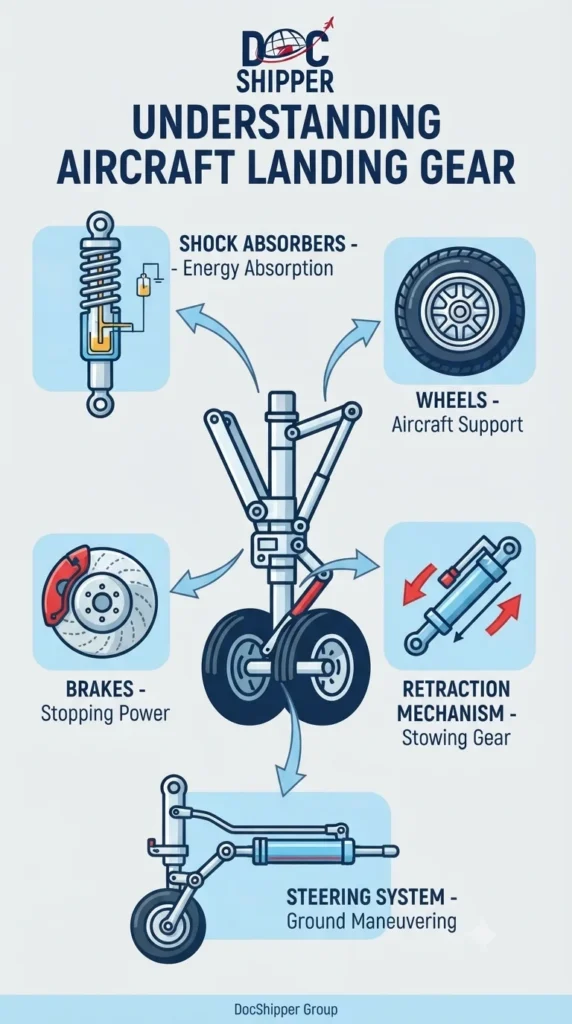
The shock strut mechanism uses oleo-pneumatic technology—combining hydraulic fluid and compressed nitrogen gas—to absorb vertical impact forces during touchdown. This system compresses up to 12 inches during a typical landing, dissipating kinetic energy that would otherwise damage the airframe.
Retraction systems employ hydraulic actuators or electric motors to fold landing gear into wheel wells after takeoff. This reduces aerodynamic drag by up to 15%, significantly improving fuel efficiency on long-haul cargo flights. At DocShipper, we coordinate with airlines to optimize loading schedules around maintenance windows when landing gear inspections might affect aircraft readiness.
The braking assembly incorporates multi-disc carbon brakes capable of stopping a fully loaded Boeing 747 freighter from 150 knots within 6,000 feet. Anti-skid systems modulate brake pressure 10 times per second to prevent tire blowouts on wet runways.
Steering mechanisms on nose gear allow pilots to maneuver aircraft through tight cargo apron spaces. Hydraulic actuators provide up to 70 degrees of wheel rotation, essential for positioning freighters at narrow loading docks. According to EASA regulations, landing gear systems must undergo structural inspections every 4,000 flight cycles to maintain airworthiness certification.
Landing Gear Types & Operational Data
Aircraft manufacturers design landing gear configurations based on operational requirements, weight distribution, and intended runway conditions. The choice directly affects cargo loading strategies and ground handling procedures.
| Configuration Type | Typical Aircraft | Load Capacity | Operational Advantage |
|---|---|---|---|
| Tricycle Gear | Boeing 767F, Airbus A330F | Up to 52 tons payload | Superior ground visibility and braking control |
| Tandem Gear | Boeing 747F main body | Up to 140 tons payload | Distributes weight across multiple wheel sets |
| Multi-Bogey System | Antonov An-124 | Up to 120 tons payload | Operates on unpaved cargo airfields |
| Kneeling Gear | Boeing 747-400F nose section | N/A (facilitates loading) | Lowers cargo door to truck bed height |
Real-world cargo scenario: A Boeing 777F operating a Hong Kong to Memphis route carries 102 tons of electronics cargo. Its 14-wheel main landing gear distributes this load across tires rated for 210 PSI each. During the 13-hour flight, the retracted gear reduces drag, saving approximately 850 gallons of fuel compared to fixed-gear alternatives.
At DocShipper, we factor landing gear specifications into our cargo planning. When coordinating shipments through secondary airports with shorter runways, we verify that the aircraft’s brake system and tire ratings meet the airfield’s load classification number.
Key operational metrics:
- Tire lifespan: Cargo aircraft main gear tires average 200-300 landings before replacement
- Brake wear: Carbon brakes require inspection every 2,000 landings
- Hydraulic system pressure: Maintained at 3,000 PSI for gear extension/retraction
- Weight-on-wheels sensors: Trigger automatic system transitions during takeoff/landing phases
- Ground clearance: Determines maximum cargo pallet height for belly loading
Conclusion
Landing gear systems represent critical engineering that enables safe, efficient cargo operations across global air freight networks. Understanding these specifications allows logistics professionals to optimize aircraft utilization and ground handling procedures.
Need assistance coordinating air freight shipments with specific aircraft requirements? Contact DocShipper for expert guidance on aviation logistics solutions.
📚 Quiz
Test Your Knowledge: Landing Gear
What is the primary function of landing gear in aviation logistics?
How does retractable landing gear impact cargo aircraft fuel efficiency?
A Boeing 777F is scheduled to transport 102 tons of electronics from Hong Kong to Memphis. Which landing gear specification is MOST critical for this operation?
🎯 Your Result
📞 Free Quote in 24hFAQ | Landing Gear: Definition, Types & Concrete Examples in Aviation Logistics
Landing gear experiences vertical loads of 2-3G (twice to three times the aircraft's weight) during typical landings, with peak forces reaching 4G during hard touchdowns. Horizontal braking forces add another 0.5G of stress. The shock absorption system dissipates this energy through oleo-pneumatic struts that compress and rebound in controlled motion.
Extended landing gear increases aerodynamic drag by 15-20%, significantly impacting fuel consumption. Retractable systems allow gear to fold into streamlined wheel wells, reducing parasitic drag. On a 10-hour transpacific cargo flight, this saves approximately 800-1,200 gallons of fuel compared to fixed-gear configurations.
Kneeling systems lower the aircraft's nose or tail section by compressing specific shock struts. This reduces cargo door height to align with truck beds (typically 48-54 inches), eliminating the need for expensive ground equipment. Boeing 747 freighters commonly feature this capability, cutting loading times by 20-30 minutes per turnaround.
Scheduled maintenance includes daily visual inspections, tire pressure checks every 72 hours, brake wear assessments every 500 landings, and complete gear overhauls every 8-12 years. Hydraulic fluid analysis occurs every 1,000 flight hours. Compliance with these intervals is mandatory for maintaining airworthiness certification under EASA and FAA regulations.
Configuration varies by aircraft size. The Boeing 767 freighter has 10 wheels (two nose, eight main gear), while the 747-8F has 18 wheels (two nose, 16 main gear arranged in four-wheel bogies). The Antonov An-225 holds the record with 32 wheels to distribute its 640-ton maximum takeoff weight.
Specialized cargo aircraft like the Lockheed C-130 and Antonov An-124 feature reinforced landing gear with low-pressure tires and multi-wheel configurations designed for unpaved surfaces. Standard commercial freighters require paved runways with load classification numbers matching their tire pressure ratings to prevent surface damage and ensure safe operations.
Aircraft have manual extension systems using gravity and mechanical backup mechanisms. Pilots follow emergency procedures to lower gear without hydraulic power. Cargo operators maintain foam application equipment at major hubs for belly landings. Modern systems include redundant hydraulic circuits, reducing failure probability to less than 1 in 10 million flights.
Airport engineers calculate pavement thickness based on aircraft classification number (ACN), which factors landing gear configuration and load distribution. A Boeing 747F with 18 wheels exerts less pressure per wheel than a smaller aircraft with fewer wheels carrying similar weight. Cargo airports publish load ratings to prevent pavement cracking and subsidence.
Modern systems integrate weight-on-wheels sensors, position indicators, hydraulic pressure transducers, brake temperature monitors, and tire pressure sensors. These feed data to flight management computers and maintenance tracking systems. Real-time monitoring detects anomalies like uneven tire wear or hydraulic leaks before they cause operational disruptions.
Cargo variants feature reinforced gear structures to handle higher floor loading and concentrated weight from palletized freight. Main gear positioning may shift aft to accommodate larger cargo doors. Brake systems use higher-capacity carbon discs to handle frequent heavyweight takeoffs. Some freighters add auxiliary gear to distribute loads when operating at maximum payload.
Electric actuation systems are replacing hydraulics on newer aircraft like the Boeing 787, reducing weight by 200-300 pounds. Carbon-ceramic brake materials extend service intervals by 50%. Predictive maintenance algorithms analyze sensor data to forecast component failures. Some experimental designs incorporate self-healing tire materials and adaptive shock absorption for varying runway conditions.
Ground clearance determines whether cargo loaders need elevated platforms or can load at truck bed height. Gear compression under load shifts the aircraft's center of gravity, requiring precise load distribution calculations. Wider gear tracks provide stability during asymmetric loading. DocShipper coordinates with ground handlers to ensure loading sequences account for these aircraft-specific characteristics.
Need Help with
Logistics or Sourcing ?
First, we secure the right products from the right suppliers at the right price by managing the sourcing process from start to finish. Then, we simplify your shipping experience - from pickup to final delivery - ensuring any product, anywhere, is delivered at highly competitive prices.


Fill the Form
Prefer email? Send us your inquiry, and we’ll get back to you as soon as possible.
Contact us




