


In short ⚡
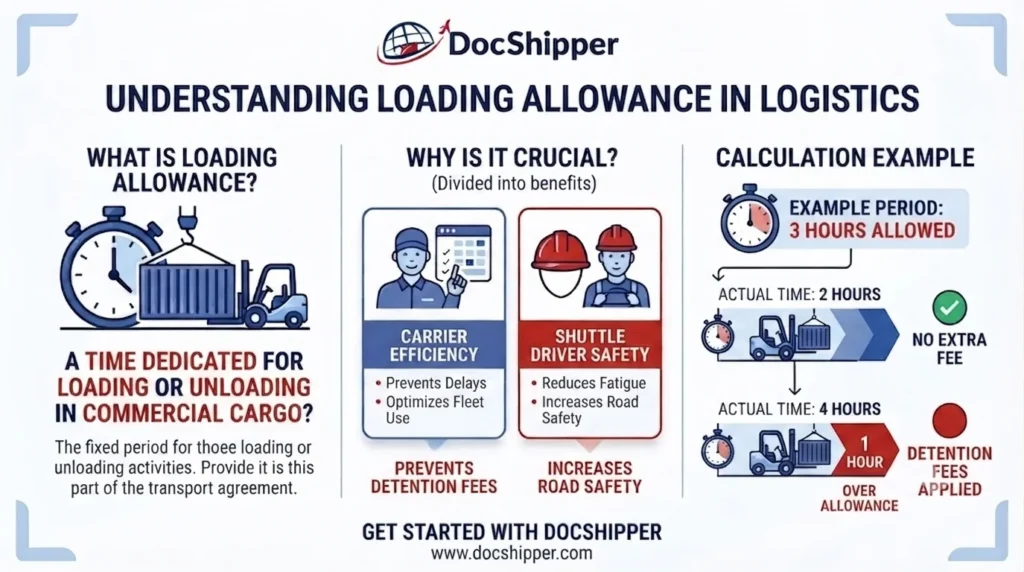
Loading Allowance is a time-based allowance granted to a vessel or carrier for loading cargo without incurring demurrage charges. It represents the agreed free time period during which shippers can load goods onto the vessel. Once this period expires, demurrage fees begin to accrue, making efficient loading operations critical for cost control in international shipping.
Introduction
Many shippers underestimate the financial impact of exceeding loading allowances. A seemingly simple delay can trigger thousands of dollars in demurrage charges, affecting profit margins and supplier relationships. In international trade, where vessel schedules are tightly coordinated, understanding loading allowance terms is essential for operational efficiency.
Loading allowance directly impacts the economic performance of shipping contracts. It balances the carrier’s need for vessel turnaround efficiency against the shipper’s operational constraints. This contractual provision appears in charter parties, bills of lading, and freight agreements, making it a fundamental element of maritime commerce.
- Contractual basis: Specified in charter parties (voyage or time charter) and freight contracts
- Measurement units: Typically expressed in days, hours, or tons per day
- Calculation methods: Weather Working Days (WWD), Running Days, or Working Days variations
- Financial consequence: Exceeded time triggers demurrage charges at agreed daily rates
- Operational impact: Influences port selection, cargo readiness, and logistics planning
Mechanism & Legal Framework
Loading allowance operates within a contractual framework governed by maritime law and commercial agreements. The International Chamber of Shipping provides standardized clauses, but terms vary significantly based on trade routes, cargo types, and negotiation power between parties.
The calculation begins when the vessel is ready to load and the Notice of Readiness (NOR) is accepted. From this moment, laytime—the permitted loading period—commences. The charter party specifies whether the calculation uses Working Days (excluding Sundays and holidays), Weather Working Days (excluding periods when weather prevents loading), or Running Days (consecutive calendar days regardless of conditions).
Under the UK Maritime and Coastguard Agency guidelines, the burden of proof for delays typically falls on the party claiming exceptions. If loading operations extend beyond the allowance, demurrage applies at the pre-agreed daily rate. Conversely, if loading completes early, the shipper may earn despatch money, though at a lower rate than demurrage charges.
Three key legal principles govern loading allowances: the doctrine of deviation (unauthorized route changes can void allowance terms), force majeure clauses (extraordinary circumstances may suspend laytime), and estoppel (parties cannot contradict their previous conduct regarding time counting). At DocShipper, we systematically review charter party clauses to ensure our clients understand their time obligations and potential liabilities before cargo operations begin.
Modern contracts increasingly incorporate electronic monitoring systems that timestamp each loading phase, reducing disputes. However, disagreements still arise over what constitutes “readiness to load,” whether interruptions were shipper-caused, and how weather exceptions apply. The BIMCO Laytime Definitions 2013 provide standardized interpretations, but contractual language always prevails in legal disputes.
Calculation & Practical Examples
Understanding loading allowance requires mastering the calculation methodology specific to your contract. The most common formula: Allowance = (Cargo Quantity ÷ Loading Rate) × Time Unit. However, real-world applications involve numerous variables that can extend or reduce available time.
Consider this practical scenario: A shipper contracts to load 25,000 metric tons of grain with a loading rate of 2,500 tons per day on Weather Working Days terms. The theoretical loading allowance is 10 days. The vessel arrives January 15th, and the Notice of Readiness is accepted at 14:00 hours. Loading commences January 16th at 08:00.
| Date | Status | Time Counted | Cumulative Days |
|---|---|---|---|
| Jan 15 (14:00) | NOR Accepted | 0.42 days (10 hrs to midnight) | 0.42 |
| Jan 16-24 | Normal loading (7 working days) | 7 days | 7.42 |
| Jan 18 & 19 | Weekend (not counted – WWD) | 0 days | 7.42 |
| Jan 21 | Heavy rain (exception) | 0 days | 7.42 |
| Jan 25 (12:00) | Loading completed | 0.5 days | 7.92 days |
In this case, the shipper used 7.92 of 10 allowed days, earning despatch money. The calculation excluded weekends and weather interruptions per WWD terms. Had loading required 11 days, demurrage would apply to the excess 1 day at the contractual rate (typically $15,000-$50,000 per day for bulk carriers).
Real-world variables affecting calculations:
- Reversible laytime: Allows unused loading time to offset discharge delays
- Turn-time provisions: Additional hours granted for vessel shifting between berths
- Once on demurrage, always on demurrage: Once exceeded, all subsequent time counts regardless of exceptions
- Average laytime basis: Multiple ports’ allowances are pooled and averaged
- Time lost waiting for berth (WIFPON): “Whether in Free Pratique or Not” clause determines if waiting time counts
At DocShipper, we assist clients with laytime calculation audits, identifying contractual ambiguities before they result in disputes. Our experience shows that 60% of demurrage claims contain calculation errors or misapplied exceptions, making expert review financially beneficial.
Conclusion
Loading allowance represents a critical cost control mechanism in international shipping, directly impacting operational budgets and contractual relationships. Proper understanding of calculation methods, legal frameworks, and contractual nuances prevents costly disputes and optimizes logistics planning.
Need guidance on charter party terms or laytime dispute resolution? Contact DocShipper for expert support tailored to your shipping requirements.
📚 Quiz
Test Your Knowledge: Loading Allowance
What does loading allowance fundamentally represent in shipping contracts?
Under Weather Working Days (WWD) terms, when does time NOT count toward loading allowance?
A vessel loads 25,000 metric tons at 2,500 tons/day with a 10-day allowance on WWD terms. Loading finishes in 7.92 working days after excluding weekends and weather delays. What is the financial outcome?
🎯 Your Result
📞 Free Quote in 24hFAQ | Loading Allowance: Definition, Calculation & Practical Examples
When loading operations exceed the permitted time, demurrage charges automatically apply at the daily rate specified in the charter party. These charges typically range from $10,000 to $50,000 per day depending on vessel size and market conditions. The clock continues running until loading completes, and accumulated demurrage becomes a debt owed to the vessel owner, often secured against the cargo itself.
Under Weather Working Days (WWD) terms, time is excluded when weather conditions prevent loading operations. However, the burden of proof lies with the shipper to demonstrate that weather actually halted work—mere rain isn't sufficient if loading equipment is weather-protected. The charter party defines what constitutes "preventing" conditions, and disputes often center on whether work could have continued with reasonable precautions.
Yes, parties can negotiate time extensions through formal amendments to the charter party. Such extensions typically involve compensating the vessel owner for schedule disruption, often at a reduced rate compared to full demurrage. Written confirmation is essential—verbal agreements rarely hold in maritime disputes. At DocShipper, we facilitate these negotiations to protect our clients' interests while maintaining carrier relationships.
Loading allowance specifically refers to the permitted time for loading cargo onto a vessel, while laytime encompasses the total allowed time for both loading and discharging operations. In voyage charters, laytime may be expressed as a combined figure with separate loading and discharge components, or as reversible laytime where unused loading time offsets discharge delays. Understanding this distinction prevents misinterpretation of contractual obligations.
Container loading allowances typically use moves per hour rather than tonnage rates. A standard calculation allows 20-30 container moves per crane per hour. For a shipment of 500 TEUs with two cranes operating, the allowance might be: 500 ÷ (25 moves/hour × 2 cranes) = 10 hours of laytime. Port efficiency, container weight distribution, and customs inspections significantly impact actual performance against these theoretical rates.
Key documentation includes the Notice of Readiness (NOR), Statement of Facts (SOF) recording all loading activities, time sheets signed by both parties, and weather reports for WWD claims. Modern practice incorporates GPS timestamps and automated cargo tracking data. Discrepancies between shipper and carrier records frequently trigger disputes, making contemporaneous documentation critical. DocShipper assists clients in maintaining complete audit trails for potential claims.
Exclusion depends entirely on the contractual terms. "Working Days" clauses typically exclude Sundays and local holidays, while "Weather Working Days" may count them if weather permits work. "Running Days" count every calendar day regardless. The charter party must explicitly state which days are excluded—assumptions based on local practice won't prevail in disputes. Always verify the exact laytime definition clause before accepting loading appointments.
Despatch money is a bonus paid by the vessel owner when loading completes faster than the allowance period. Typically calculated at 50% of the demurrage rate, it rewards efficient cargo operations. For example, if demurrage is $30,000/day and loading finishes 2 days early, the shipper earns $30,000 in despatch. This mechanism incentivizes prompt cargo readiness and efficient stevedoring, benefiting both parties through improved vessel utilization.
Force majeure clauses may suspend laytime counting during extraordinary events like wars, strikes, or natural disasters beyond either party's control. However, the event must genuinely prevent loading operations—market changes or routine weather don't qualify. The claiming party must provide immediate notice and supporting evidence. Courts interpret force majeure narrowly, and many modern contracts explicitly list qualifying events rather than using broad definitions.
Treatment of congestion delays depends on the "Time Waiting for Berth" clause. Under "Time Lost Waiting for Berth to Count" (WBWLWB), laytime begins upon vessel arrival even if no berth is available. Conversely, "Whether in Berth or Not" (WIBON) clauses start counting only after berthing. Port congestion significantly impacts shipping costs—during peak periods, vessels may wait weeks for berth access, making clause selection critical during contract negotiation.
Beyond standard demurrage charges, deliberate delays may trigger additional consequences: vessel detention claims seeking compensation for lost commercial opportunities, potential blacklisting by carriers affecting future shipping options, and in severe cases, cargo liens where the vessel owner secures debts against the goods themselves. Some contracts include liquidated damages clauses imposing penalties beyond demurrage rates. Such situations damage business relationships and increase future freight costs substantially.
Optimization strategies include pre-loading cargo inspection to ensure readiness, coordinating with stevedores for 24/7 operations when permitted, using modern cargo handling equipment to increase throughput, maintaining buffer time for unexpected delays, and negotiating favorable laytime definitions during contract formation. Advanced planning, including simulation of loading sequences and contingency protocols, typically reduces demurrage risk by 40-60%. DocShipper provides logistics coordination services that systematically address these factors for improved operational efficiency.
Need Help with
Logistics or Sourcing ?
First, we secure the right products from the right suppliers at the right price by managing the sourcing process from start to finish. Then, we simplify your shipping experience - from pickup to final delivery - ensuring any product, anywhere, is delivered at highly competitive prices.


Fill the Form
Prefer email? Send us your inquiry, and we’ll get back to you as soon as possible.
Contact us




