


In short ⚡
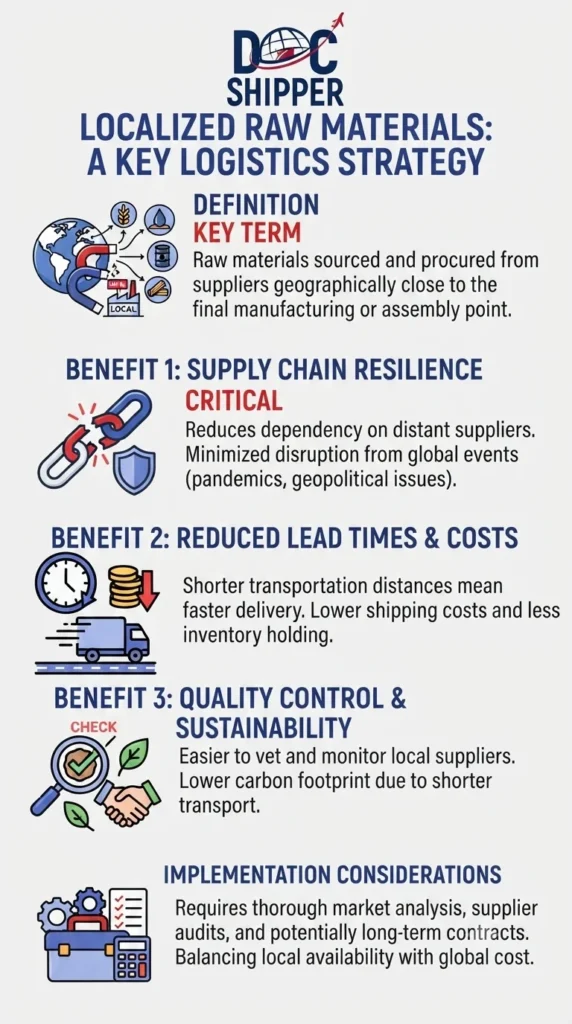
Localized raw material refers to sourcing and procuring production inputs from suppliers geographically close to the manufacturing or assembly site. This strategy reduces transportation costs, shortens lead times, and enhances supply chain resilience while supporting local economies and compliance with regional content requirements.
Introduction
Global supply chains face unprecedented disruption. Companies relying on distant suppliers encounter escalating freight costs, extended delays, and vulnerability to geopolitical tensions. Localized raw material sourcing emerges as a strategic response to these challenges.
This procurement approach transforms logistics operations by bringing material origins closer to production facilities. The implications extend beyond cost reduction to encompass regulatory compliance, sustainability commitments, and competitive differentiation in international markets.
Key characteristics of localized raw material strategies include:
- Geographic proximity: Suppliers located within the same country, region, or economic zone as the manufacturing site
- Reduced transportation footprint: Lower carbon emissions and shorter delivery windows compared to intercontinental shipping
- Regulatory alignment: Compliance with local content requirements in trade agreements (USMCA, EU rules of origin)
- Supply chain resilience: Decreased exposure to international disruptions, port congestion, or customs delays
- Economic multiplier effect: Support for regional suppliers and job creation in the manufacturing ecosystem
Strategic Framework & Implementation
Implementing localized raw material sourcing requires systematic evaluation of supplier capabilities, quality standards, and total cost of ownership. The decision involves balancing immediate procurement expenses against long-term operational benefits.
Regulatory considerations drive many localization initiatives. Trade agreements like the USMCA mandate specific regional value content percentages for tariff-free treatment. The European Union’s Carbon Border Adjustment Mechanism (CBAM) incentivizes local sourcing to minimize embedded emissions. Companies must navigate these frameworks to optimize duty rates and market access.
Quality assurance mechanisms become simplified with local suppliers. Proximity enables frequent site audits, rapid sampling procedures, and collaborative problem-solving without language barriers or time zone complications. Manufacturing teams can address defects within hours rather than waiting for international communications cycles.
Inventory optimization transforms with shorter supply lines. Just-in-time delivery becomes genuinely achievable when suppliers operate within the same economic corridor. Working capital requirements decrease as companies reduce safety stock buffers previously needed to compensate for unpredictable ocean freight schedules.
Risk mitigation strategies improve dramatically. Geopolitical disruptions, such as export restrictions or trade wars, have minimal impact when raw materials originate domestically. The World Trade Organization documents numerous cases where localized supply chains maintained continuity during international crises.
Sustainability credentials strengthen corporate ESG profiles. Scope 3 emissions accounting benefits from reduced transportation distances. Transparency in sourcing becomes easier to verify and communicate to stakeholders. At DocShipper, we help clients map localization opportunities that align with both operational efficiency and environmental commitments.
Practical Applications & Data Analysis
Real-world implementation reveals measurable advantages across industries. Automotive manufacturers, electronics producers, and consumer goods companies demonstrate distinct approaches to raw material localization based on sector-specific constraints.
Comparative Cost Analysis
| Sourcing Model | Material Cost | Freight Cost | Lead Time | Inventory Holding |
|---|---|---|---|---|
| International (Asia-Europe) | $100/unit | $15/unit | 45-60 days | $8/unit |
| Localized (Same Region) | $115/unit | $3/unit | 7-10 days | $2/unit |
| Total Landed Cost | International: $123/unit | Localized: $120/unit |
This comparison reveals a 3% cost advantage for localized sourcing when total ownership costs include inventory carrying charges and faster cash conversion cycles.
Automotive Industry Case Study
A European automotive manufacturer transitioned 40% of steel components from Asian suppliers to Eastern European sources in 2022. Results after 18 months:
- Lead time reduction: From 52 days average to 12 days (77% improvement)
- Freight cost savings: €2.3 million annually on ocean freight and port handling
- Carbon footprint: 68% decrease in transportation-related emissions
- Quality incident response: Resolution time dropped from 3 weeks to 48 hours
- Regulatory compliance: Achieved USMCA qualifying status for North American exports
Electronics Manufacturing Scenario
A medical device producer evaluated localization for plastic injection-molded components. Initial material costs increased by 18%, but comprehensive analysis revealed:
- Tooling modifications: Reduced iteration cycles from 6 weeks to 10 days
- Regulatory documentation: FDA compliance audits simplified with domestic supplier records
- Supply disruption risk: Zero production stoppages versus 3 critical delays in prior year
- Working capital: Inventory value decreased by $1.2 million due to reduced safety stock
At DocShipper, we conduct total cost modeling that captures these hidden expenses often overlooked in traditional procurement evaluations. Our supply chain consulting services identify localization opportunities with positive ROI within 12-18 months.
Conclusion
Localized raw material sourcing represents a fundamental shift from cost-minimization to value-optimization in global supply chains. The strategy delivers measurable benefits in lead time reduction, regulatory compliance, and operational resilience while supporting sustainability objectives.
Need assistance evaluating localization opportunities for your supply chain? Our team specializes in supplier identification, total cost analysis, and implementation support. Contact DocShipper to discuss your specific requirements.
📚 Quiz
Test Your Knowledge: Localized Raw Material
What is the primary defining characteristic of localized raw material sourcing?
A company notices unit material costs increased 18% after localizing suppliers, but total landed costs decreased by 3%. What explains this apparent contradiction?
An automotive manufacturer wants to qualify for USMCA duty-free treatment. Which strategy best supports this objective?
🎯 Your Result
📞 Free Quote in 24hFAQ | Localized Raw Material: Definition, Strategic Impact & Practical Examples
Localization typically refers to suppliers within the same country or economic region (EU, USMCA territory, ASEAN). The specific definition depends on regulatory frameworks, with trade agreements often specifying maximum distances or regional value content percentages. For practical purposes, sources within 500-1000 km of the production facility generally qualify as localized.
While unit material prices may increase 10-20%, total landed costs often decrease when including freight, customs duties, inventory holding, and quality management expenses. Comprehensive total cost of ownership analysis typically reveals break-even or savings within 12-24 months, particularly for high-volume or time-sensitive components.
Automotive, aerospace, food processing, and medical device manufacturing see significant advantages due to stringent quality requirements and regulatory compliance needs. Industries with high freight-to-value ratios (construction materials, furniture components) also benefit substantially. Electronics manufacturing gains operational agility despite potentially higher material costs.
Agreements like USMCA require 75% regional value content for automotive products to qualify for duty-free treatment. The EU-UK Trade Agreement mandates specific origin rules for various sectors. Companies structure localization strategies to meet these thresholds, avoiding tariffs that can range from 2.5% to 25% depending on product classification.
Primary concerns include limited supplier competition leading to pricing power concentration, capacity constraints during demand surges, and potential quality inconsistencies if local suppliers lack technical sophistication. Mitigation strategies involve dual-sourcing arrangements, long-term capacity reservation agreements, and collaborative quality development programs.
Timeline depends on material complexity and qualification requirements. Simple commodities may transition in 3-6 months, while engineered components requiring tooling development and regulatory approvals can take 12-18 months. Parallel qualification processes and phased volume transfers minimize production risk during transitions.
Transportation emissions decrease substantially, but total footprint depends on supplier energy sources and manufacturing processes. A local supplier using coal-fired electricity may have higher embedded emissions than an international supplier with renewable energy. Comprehensive lifecycle assessment should evaluate all Scope 1, 2, and 3 emissions sources.
Companies require certificates of origin, supplier declarations of regional content, bills of materials showing component sources, and manufacturing location records. Customs authorities may request production records, purchase orders, and freight documentation to verify localization claims for preferential duty treatment.
Proximity enables true JIT delivery with reduced safety stock requirements. Lead times of 7-14 days allow weekly or bi-weekly deliveries versus monthly container shipments from distant suppliers. This flexibility reduces working capital tied up in inventory by 40-60% while improving responsiveness to demand fluctuations.
SMEs often find localization more accessible than multinational sourcing due to lower minimum order quantities from regional suppliers and simplified quality management. Regional suppliers may offer flexible payment terms and collaborative development partnerships that large international vendors cannot provide. Government programs in many regions specifically support SME localization initiatives.
Digital supplier networks, real-time inventory visibility systems, and collaborative planning platforms maximize localization benefits. Blockchain-based traceability solutions verify origin claims for regulatory compliance. Advanced analytics identify optimal local supplier combinations based on total cost, capacity, and risk factors.
Localized sourcing reduces foreign exchange exposure when procurement and sales occur in the same currency. International sourcing faces currency risk that can swing costs 5-15% annually. Companies with multi-currency operations may still face FX exposure, but localization typically reduces the magnitude and unpredictability of currency-related cost variations.
Need Help with
Logistics or Sourcing ?
First, we secure the right products from the right suppliers at the right price by managing the sourcing process from start to finish. Then, we simplify your shipping experience - from pickup to final delivery - ensuring any product, anywhere, is delivered at highly competitive prices.


Fill the Form
Prefer email? Send us your inquiry, and we’ll get back to you as soon as possible.
Contact us




