


In short ⚡
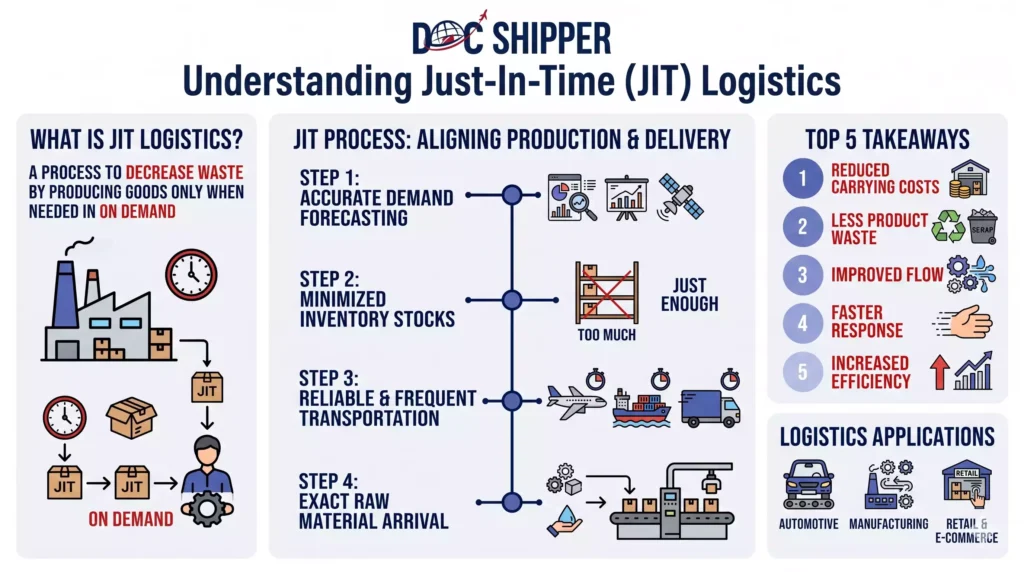
Just-in-Time Logistics is an inventory management strategy where goods arrive precisely when needed for production or sale, minimizing storage costs and reducing waste. This methodology synchronizes supply chain operations to match demand patterns, eliminating excess inventory while ensuring continuous availability of materials and products for seamless business operations.
Introduction
Many companies struggle with the dilemma of maintaining sufficient inventory versus controlling storage costs. Overstocking ties up capital and risks obsolescence, while understocking leads to production delays and lost sales. This tension has made inventory management one of the most critical challenges in international trade.
Just-in-Time logistics emerged as a revolutionary approach to this problem. Originally perfected by Toyota in the 1970s, this methodology transforms the entire supply chain into a precisely synchronized system where materials flow exactly when needed. In today’s global marketplace, JIT has become essential for companies seeking competitive advantages through operational efficiency.
Key characteristics of Just-in-Time logistics include:
- Demand synchronization: Production and delivery schedules align precisely with actual customer orders
- Minimal inventory holding: Warehouses maintain only buffer stock necessary for immediate operations
- Supplier integration: Close partnerships with vendors ensure reliable, frequent deliveries
- Quality assurance: Zero-defect policies prevent disruptions from faulty materials
- Continuous flow: Seamless material movement eliminates bottlenecks and waiting times
JIT Fundamentals & Strategic Implementation
Implementing Just-in-Time logistics requires fundamental restructuring of procurement and production processes. The core principle involves pull-based inventory management, where production signals trigger material orders rather than forecasts driving inventory accumulation. This shift demands unprecedented visibility across the entire supply chain.
The foundation rests on vendor-managed inventory (VMI) relationships, where suppliers monitor customer inventory levels and automatically replenish stock. This collaborative approach reduces ordering costs and ensures continuous material availability. According to U.S. Department of Commerce guidelines, successful VMI partnerships can reduce inventory carrying costs by 25-35% while improving product availability.
Transportation optimization becomes critical in JIT systems. Companies establish milk run routes where vehicles follow predetermined circuits collecting materials from multiple suppliers. This consolidation reduces transportation costs while maintaining delivery frequency. The strategy requires sophisticated route planning and real-time tracking capabilities.
Risk mitigation through safety stock calculations balances efficiency with resilience. While JIT minimizes inventory, strategic buffer stocks protect against supply disruptions. Mathematical models incorporating lead time variability and demand fluctuations determine optimal safety stock levels. At DocShipper, we help clients calculate precise buffer quantities that maintain JIT efficiency while safeguarding against supply chain volatility.
Technology infrastructure underpins successful JIT implementation. Enterprise Resource Planning (ERP) systems integrate demand forecasting, production scheduling, and supplier communication in real-time. Advanced solutions incorporate IoT sensors that monitor inventory levels automatically, triggering replenishment orders without human intervention. This automation ensures the precision JIT logistics demands.
The methodology also requires quality management integration. Since minimal inventory exists, defective materials immediately halt production. Total Quality Management (TQM) practices and Six Sigma methodologies ensure suppliers deliver defect-free materials consistently. Inspection protocols shift from batch testing to continuous monitoring and supplier certification programs.
Concrete Examples & Performance Data
Real-world implementation demonstrates JIT logistics’ transformative impact. Toyota’s Georgetown, Kentucky facility exemplifies mature JIT operations, receiving over 300 truck deliveries daily with parts arriving within hours of assembly line use. The plant maintains only 2-4 hours of inventory for most components, achieving inventory turnover ratios exceeding 50 times annually compared to industry averages of 8-12 times.
Performance metrics across industries reveal substantial benefits:
| Performance Metric | Traditional Logistics | JIT Logistics | Improvement |
|---|---|---|---|
| Inventory Holding Costs | 18-25% of inventory value | 5-8% of inventory value | 60-70% reduction |
| Warehouse Space Requirements | 100% baseline | 30-50% of baseline | 50-70% reduction |
| Lead Time to Customer | 15-30 days | 3-7 days | 75-80% reduction |
| Product Obsolescence Rate | 8-12% annually | 1-3% annually | 75-85% reduction |
| Cash Conversion Cycle | 90-120 days | 30-45 days | 60-65% improvement |
A practical case study from the electronics manufacturing sector illustrates JIT implementation. A European smartphone manufacturer transitioned from traditional forecasting to JIT replenishment for circuit board assemblies. Previously, the company maintained 45 days of component inventory across regional warehouses.
After implementing JIT with three Asian suppliers, the company established daily air freight deliveries of critical components directly to assembly facilities. Initial investment included $2.3 million in ERP upgrades and supplier integration systems. Within 18 months, the company achieved $8.7 million annual savings from reduced warehousing costs and eliminated obsolete inventory write-offs.
Critical success factors identified in this implementation:
- Supplier proximity: Establishing regional distribution centers reduced air freight dependency to 30% of shipments
- Demand forecasting accuracy: Machine learning algorithms improved forecast precision to 94%, enabling confident JIT scheduling
- Multi-sourcing strategy: Dual suppliers for critical components provided redundancy without excessive inventory
- Customs pre-clearance: Advanced filing procedures eliminated border delays, ensuring predictable delivery windows
- Performance monitoring: Real-time dashboards tracking supplier delivery precision and quality metrics maintained accountability
At DocShipper, we’ve facilitated JIT transformations for clients across automotive, electronics, and pharmaceutical sectors, managing the complex coordination between international suppliers and production facilities while ensuring customs compliance and transportation reliability.
Conclusion
Just-in-Time logistics represents a fundamental shift from traditional inventory management to demand-synchronized operations. While implementation requires substantial investment in technology, supplier relationships, and process redesign, the financial and operational benefits justify the transformation for companies committed to operational excellence.
Need assistance implementing JIT logistics in your international supply chain? Contact DocShipper for customized consultation on supplier coordination, customs optimization, and transportation management.
📚 Quiz
Test Your Knowledge: Just-in-Time Logistics
What is the core principle that defines Just-in-Time logistics?
Which statement correctly describes a common misconception about JIT implementation?
A pharmaceutical manufacturer sources active ingredients from Asia. Which scenario represents correct JIT application?
🎯 Your Result
📞 Free Quote in 24hFAQ | Just-in-Time Logistics: Definition, Implementation & Concrete Examples
Automotive manufacturing, electronics assembly, pharmaceutical production, and fast-fashion retail gain maximum advantage from JIT. These industries feature high inventory carrying costs, rapid product obsolescence, and predictable demand patterns. Manufacturing sectors with repetitive production processes and standardized components achieve the greatest operational improvements through JIT implementation.
Lean manufacturing encompasses comprehensive waste elimination across all business processes, while JIT specifically targets inventory and material flow optimization. JIT represents one component of lean methodology, focusing exclusively on timing material arrivals to match production requirements. Lean includes broader concepts like continuous improvement (kaizen), value stream mapping, and employee empowerment beyond logistics considerations.
Supply chain disruptions pose the greatest risk, as minimal inventory provides little buffer against delays. Transportation failures, supplier bankruptcies, natural disasters, or geopolitical events can halt production immediately. Quality issues from suppliers create immediate crises without backup inventory. Market demand volatility challenges JIT systems designed for stable consumption patterns. Successful JIT implementation requires comprehensive risk assessment and mitigation strategies.
Small businesses can adopt JIT principles proportionate to their scale. Start with high-value, fast-moving items rather than complete inventory transformation. Negotiate consignment arrangements with key suppliers or implement vendor-managed inventory for top-selling products. Cloud-based inventory management systems provide affordable technology infrastructure. Focus on building strong relationships with local suppliers capable of frequent, reliable deliveries without massive technology investments.
Full JIT transformation requires 18-36 months depending on organizational complexity and supply chain maturity. Initial pilot programs targeting specific product lines can demonstrate results within 6-9 months. Technology infrastructure deployment takes 3-6 months, while supplier integration and relationship development extends 12-18 months. Continuous refinement continues indefinitely as companies optimize processes and expand JIT practices across additional product categories.
Enterprise Resource Planning (ERP) systems integrating production, procurement, and inventory management form the foundation. Electronic Data Interchange (EDI) enables automated communication with suppliers. Real-time tracking systems using RFID or GPS monitor shipment locations continuously. Warehouse Management Systems (WMS) coordinate receiving and material movement. Cloud-based collaboration platforms facilitate supplier visibility into demand forecasts and production schedules, ensuring synchronized operations.
JIT demands accelerated customs clearance through programs like Authorized Economic Operator (AEO) status or Customs-Trade Partnership Against Terrorism (C-TPAT). Pre-arrival processing and bonded warehouse facilities reduce border delays. Consolidation strategies balance frequent deliveries against transportation economics. Air freight becomes cost-justified for high-value components despite premium rates. Customs brokers specializing in expedited clearance become critical partners in maintaining delivery reliability.
Suppliers must demonstrate consistent quality with defect rates below 0.5% to avoid production disruptions. Geographic proximity or reliable transportation networks ensure delivery predictability. Financial stability prevents supply interruptions from vendor failures. Technological capability for electronic communication and real-time data sharing enables coordination. Flexibility to accommodate volume fluctuations and schedule changes maintains system responsiveness. Cultural alignment with continuous improvement philosophies sustains long-term partnerships.
Key Performance Indicators include inventory turnover ratio (target: 20+ annual turns), on-time delivery percentage (target: 98%+), stockout frequency (target: <2% of orders), carrying cost as percentage of sales (target: <5%), and order cycle time reduction. Quality metrics track supplier defect rates and reject percentages. Financial measures assess working capital requirements and return on assets. Operational KPIs monitor dock-to-stock time and material handling efficiency.
Just-in-Case (JIC) maintains higher safety stock for critical components as insurance against disruptions. Just-in-Sequence (JIS) delivers materials in exact production order rather than just timing. Vendor-Managed Inventory (VMI) without full JIT maintains slightly higher stock levels while transferring inventory management to suppliers. Hybrid approaches implement JIT for stable, high-volume items while maintaining traditional inventory for unpredictable or strategic materials, balancing efficiency with resilience.
The pandemic exposed JIT vulnerabilities when supply chains experienced unprecedented disruptions. Many companies increased safety stock levels by 15-30% for critical components. Nearshoring and regionalization strategies reduced dependence on distant suppliers. Dual-sourcing became standard practice rather than cost-optimization focus. However, core JIT principles remain valid; companies refined implementations to incorporate resilience without abandoning efficiency gains. The evolution emphasizes "just-in-time with strategic buffers" rather than complete abandonment.
Accurate demand forecasting enables suppliers to prepare materials without maintaining excess inventory. Advanced analytics incorporating point-of-sale data, seasonal patterns, and market trends improve forecast precision to 85-95% accuracy. Collaborative Planning, Forecasting, and Replenishment (CPFR) processes share demand information across the supply chain. Machine learning algorithms identify consumption patterns humans might overlook. Forecast accuracy directly determines JIT effectiveness; each percentage point improvement reduces safety stock requirements proportionally.
Need Help with
Logistics or Sourcing ?
First, we secure the right products from the right suppliers at the right price by managing the sourcing process from start to finish. Then, we simplify your shipping experience - from pickup to final delivery - ensuring any product, anywhere, is delivered at highly competitive prices.


Fill the Form
Prefer email? Send us your inquiry, and we’ll get back to you as soon as possible.
Contact us




